



What if the Internet stopped tomorrow in Guadeloupe?
🇫🇷 Lire en français : Et si Internet s'arrêtait demain en Guadeloupe ?
Reading the anticipation story “Digital Sovereignty, the Day After” — published in Le Monde diplomatique, April 2026, by Robin Lambert — seen from Guadeloupe.
Digital sovereignty: an invisible emergency for our businesses
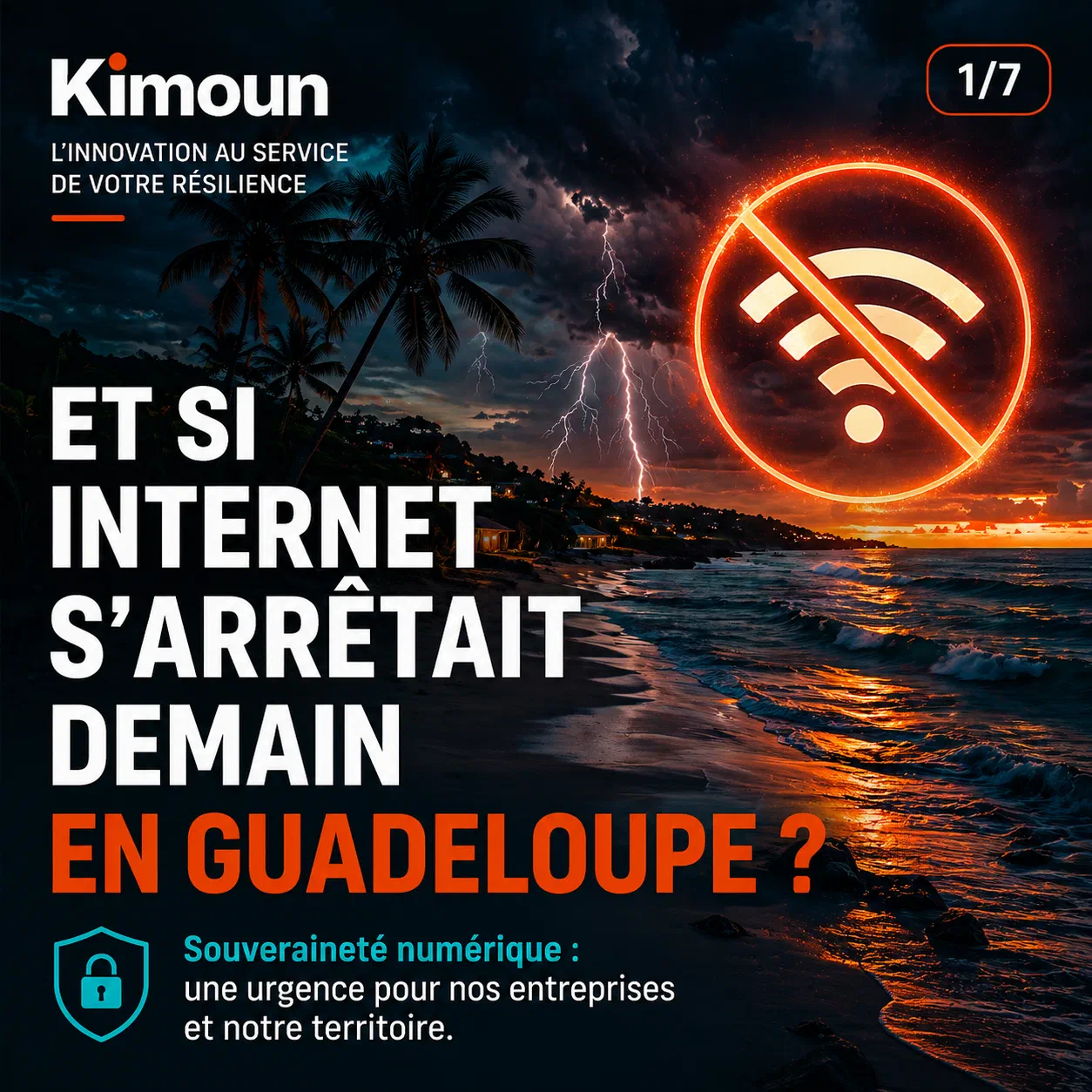
1 / 7 · Catastrophe — What if the Internet stopped tomorrow in Guadeloupe? Digital resilience and business sovereignty.
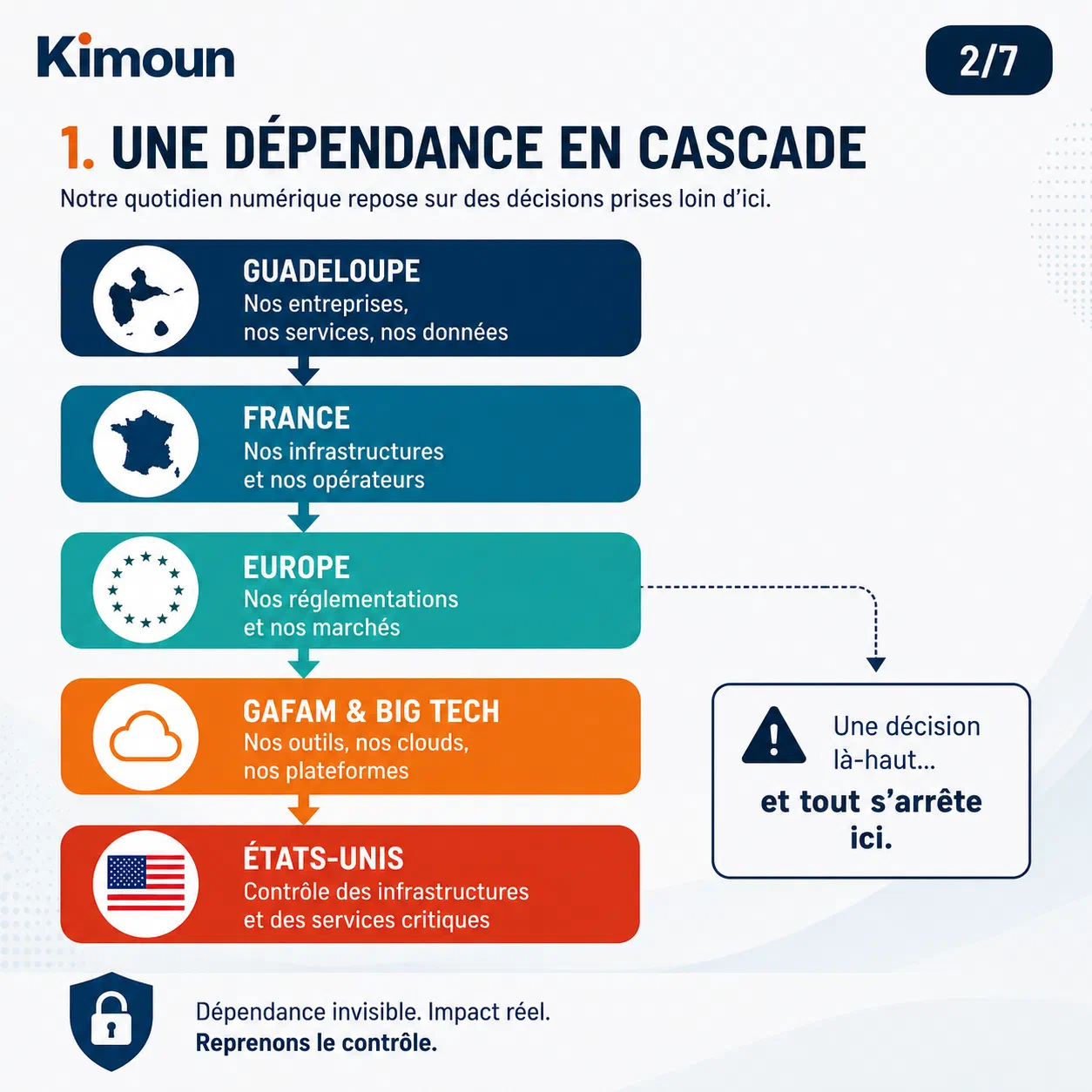
2 / 7 · A cascading dependency — Our digital tools depend on a chain: Guadeloupe → France → Europe → Big Tech → United States.
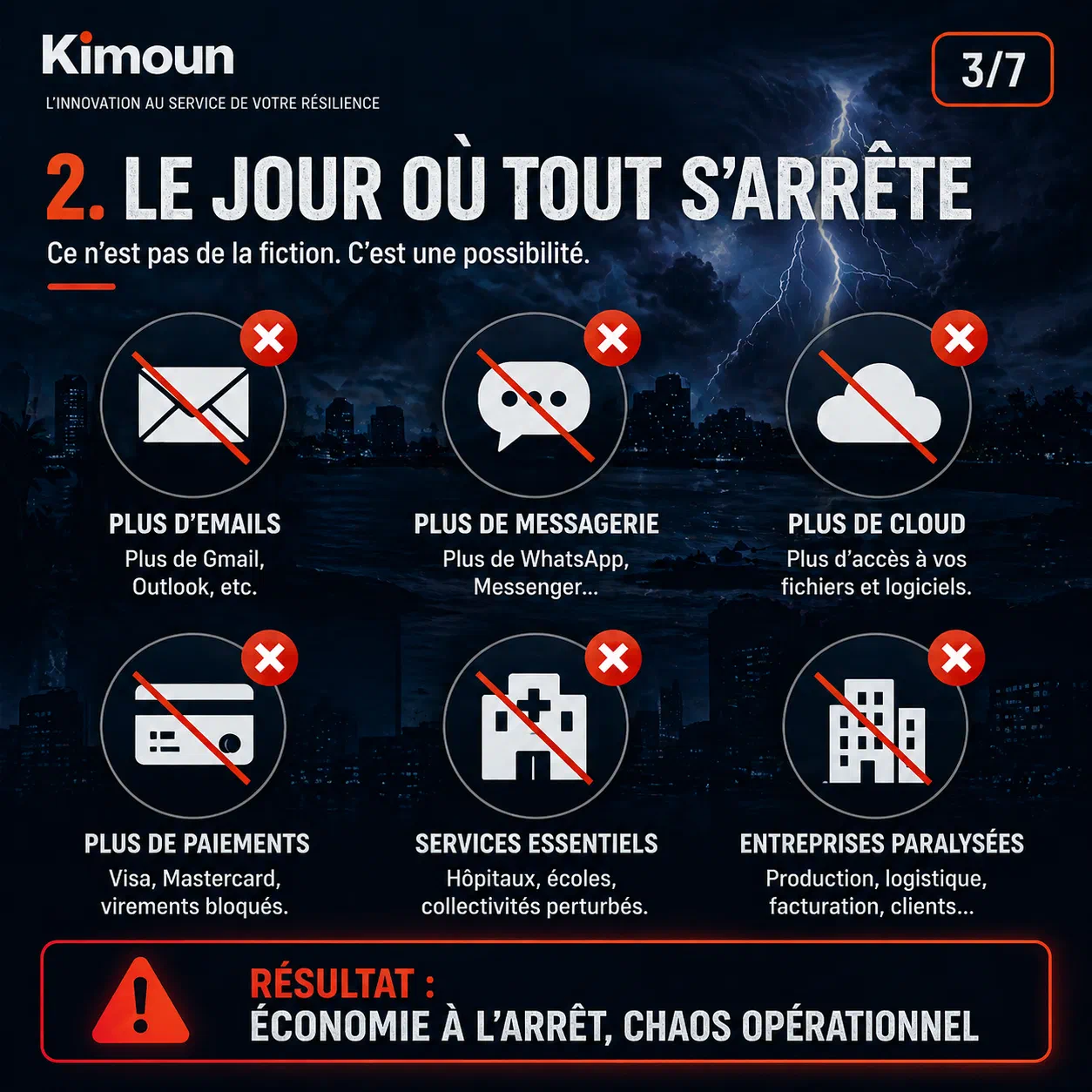
3 / 7 · The day everything stops — Emails, messaging, cloud, payments, essential services: when the Internet goes down, everything seizes up.
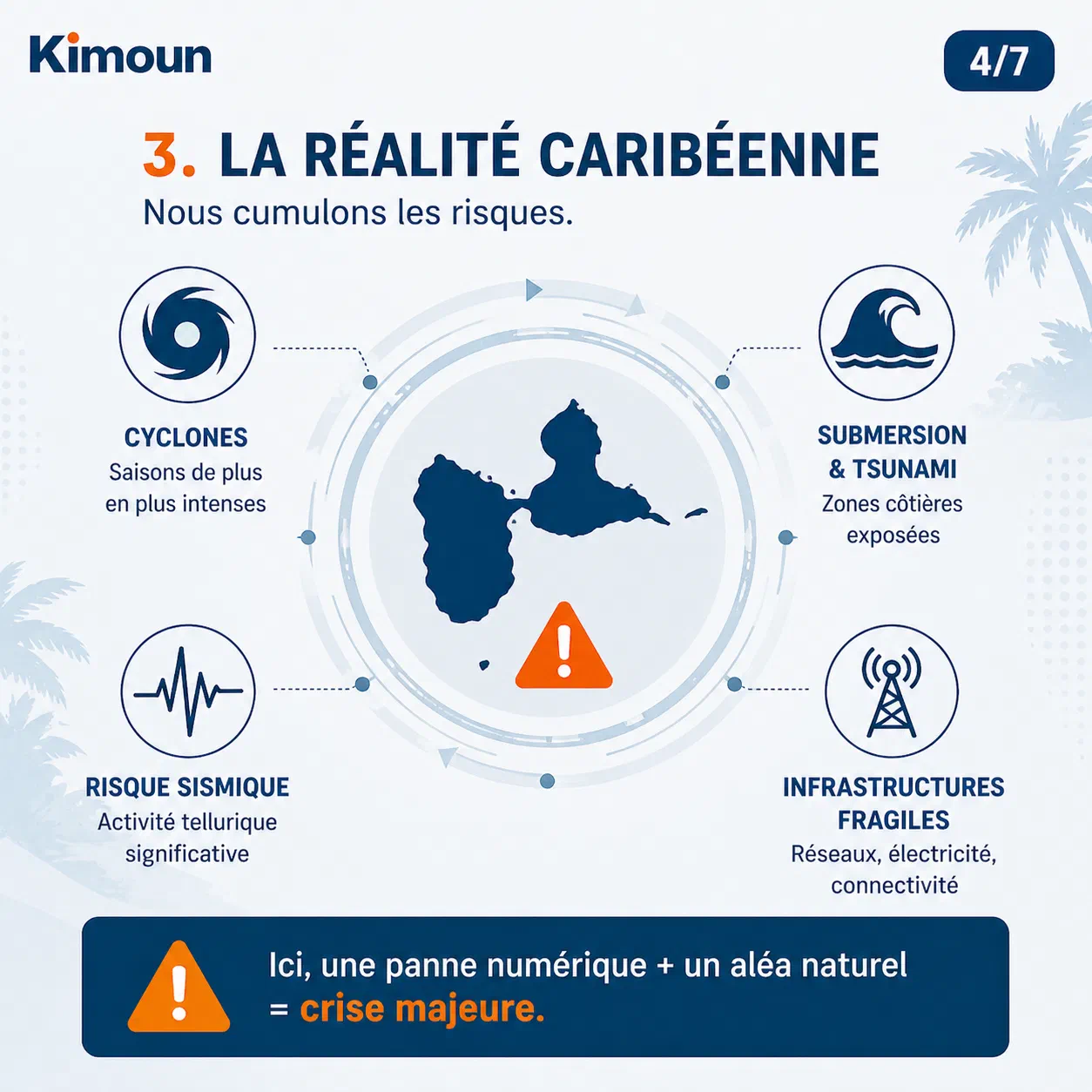
4 / 7 · The Caribbean reality — Hurricanes, earthquakes, storm surge, power outages: in Guadeloupe, physical risks compound digital ones.
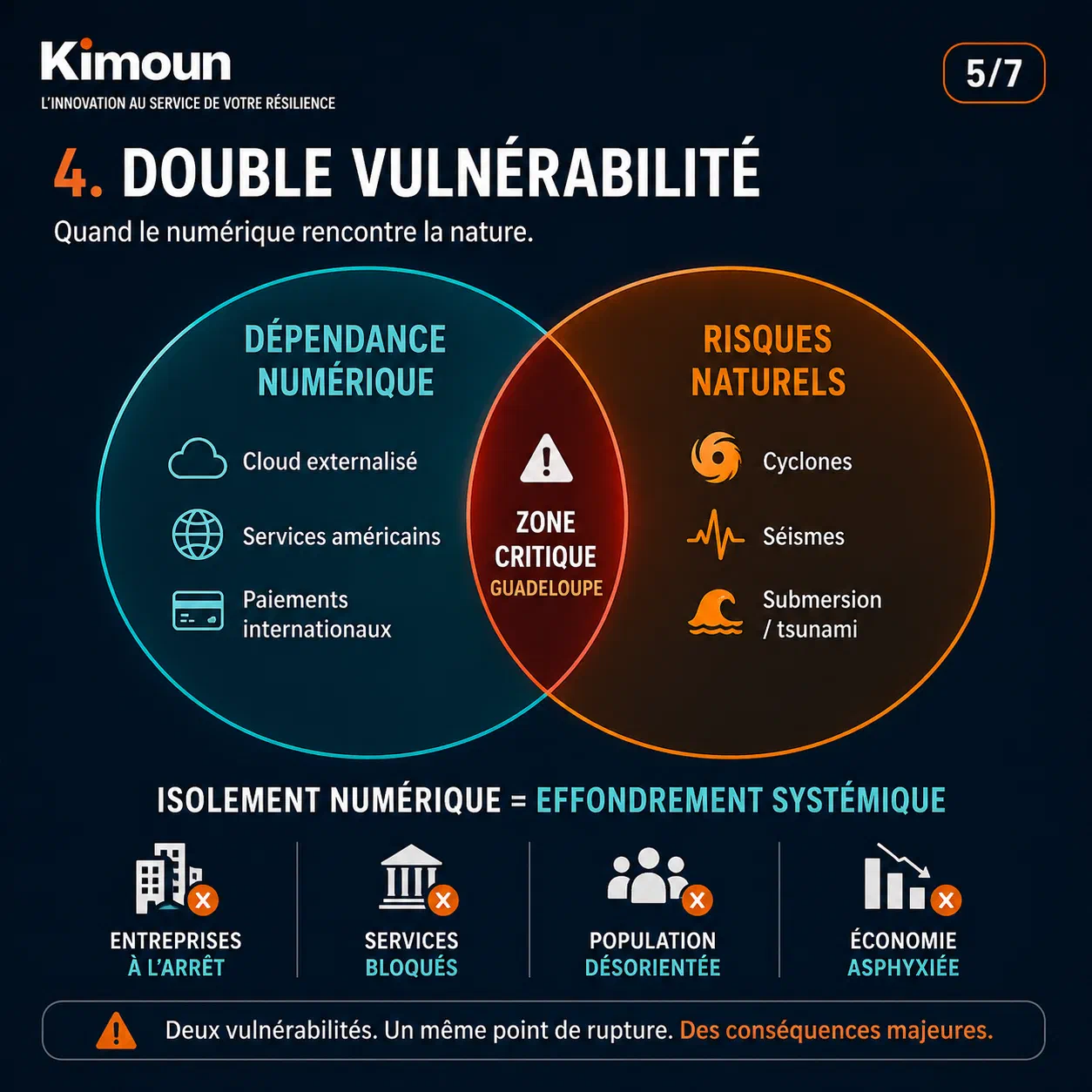
5 / 7 · Double vulnerability — The overlap of digital dependency and natural risks creates a zone of critical vulnerability.
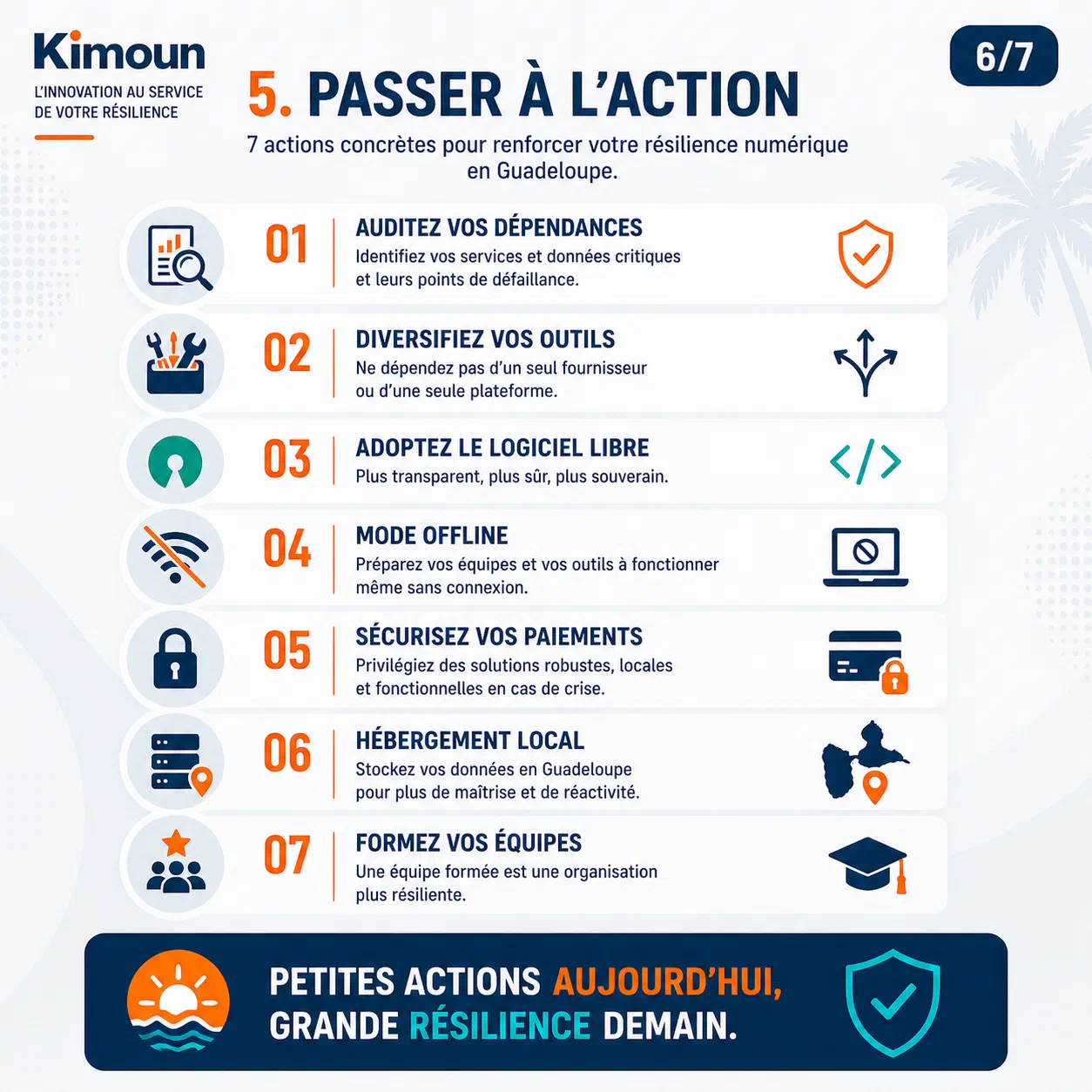
6 / 7 · Taking action — Dependency audit, diversification, open-source software, offline mode, payment alternatives, local hosting: 7 concrete priorities.
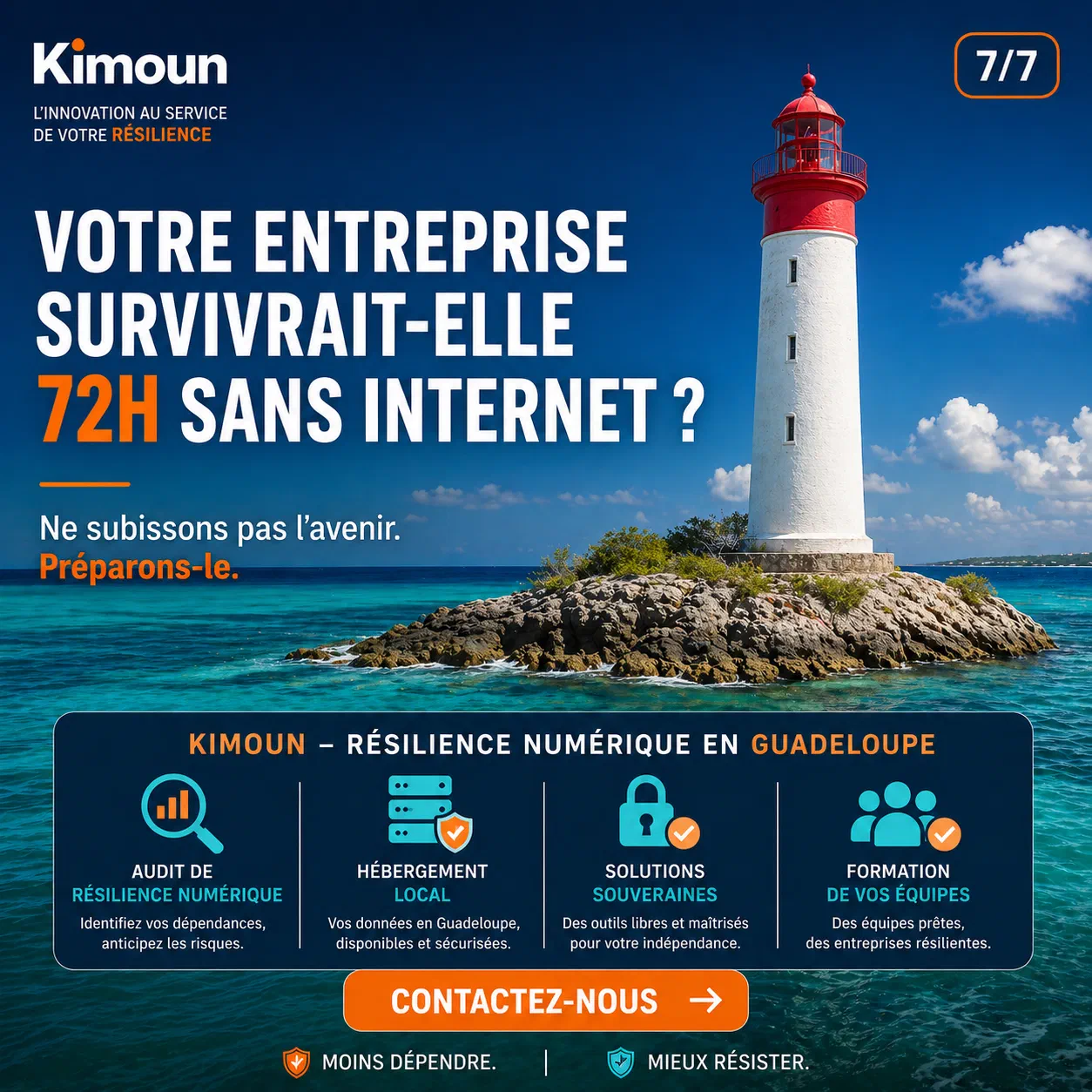
7 / 7 · The 72-hour challenge — Could your business survive 72 hours without Internet? Kimoun helps you find out — and get ready.
Have you ever tried to get lunch in Jarry with the card payment network down?
Within minutes, everything gets complicated.
- The restaurant owner can no longer process payments;
- customers don’t necessarily have cash;
- the queue grows longer;
- frustration builds;
- and a simple payment outage turns into an immediate economic problem.
Now imagine it’s not just the card network.
- Emails stop working;
- WhatsApp becomes unreachable;
- your files in the cloud temporarily disappear;
- your point-of-sale software refuses to start;
- your website goes offline;
- your booking, invoicing, delivery or customer management tools are all blocked.
This scenario sounds like fiction.
And yet it is precisely what the article “Digital Sovereignty, the Day After”, published in Le Monde diplomatique in April 2026, stages as anticipation fiction.
In that piece, the United States cuts European access to its digital services. Within hours, a large part of daily economic and administrative life seizes up: payments, communications, cloud, messaging, professional tools, operating systems.
What is most unsettling is not that this scenario is dramatic.
What is most unsettling is that it reveals an already present reality: our societies run on digital infrastructures we do not always control.
What the Le Monde diplomatique article reveals
The article does not simply describe an IT outage.
It tells the story of a sovereignty crisis.
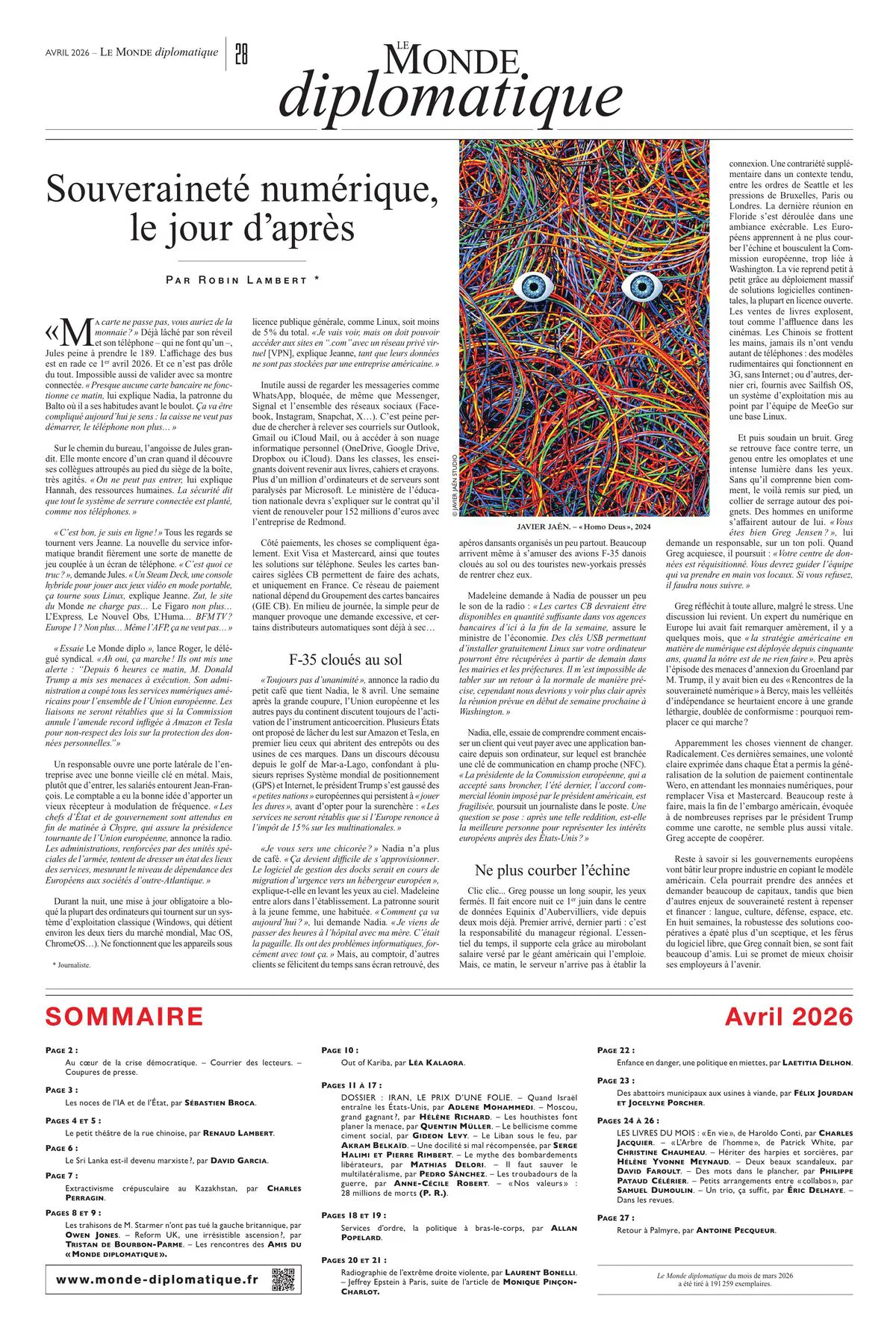
When American services go dark, businesses, public bodies, schools, hospitals, shops and citizens all discover their true level of dependence.
- Bank cards stop working;
- messaging platforms are blocked;
- cloud tools become unreachable;
- computers tied to certain systems grind to a halt;
- social networks vanish from daily life;
- organisations are left to improvise.
The piece makes one essential point: the digital world is no longer just one sector among others.
It is a vital infrastructure.
When it stops, everything slows down.
When it depends on outside actors, it becomes a lever of power.
"The digital world is no longer just one sector among others. It is a vital infrastructure. When it stops, everything slows down. When it depends on outside actors, it becomes a lever of power."
Why Guadeloupe is even more exposed
In Guadeloupe, this question takes on a particular weight.
Our dependency is a cascading one:
Guadeloupe → France → Europe → United States / Big Tech
We use global digital services that are mostly designed, hosted, operated and controlled elsewhere.
Our emails, payments, cloud storage, marketing tools, social networks, websites, business applications and sometimes even our backups all depend on technical ecosystems far removed from us.
But unlike large continental territories, we are also an island, exposed to major risks.
- hurricanes;
- earthquakes;
- coastal flooding;
- tsunamis;
- power outages;
- network disruptions;
- logistical fragility.
Here, a digital outage is never purely digital.
It can stack on top of a physical, climatic or logistical crisis.
And it is this overlapping of risks that should put us on alert.
The “it works fine as it is” trap (i bon kon-sa)
The trap is believing that because everything works today, it will work tomorrow.
A card terminal works.
A Gmail account works.
A website works.
A point-of-sale system works.
Cloud storage works.
A WhatsApp group works.
…
Until the day it doesn’t.
And on that day, the real question becomes:
do we have an alternative?
- Do we have a local copy of our data?
- Do we have another way to accept payment?
- Do we have an offline procedure?
- Do we have documented access to our hosting?
- Do we know how to restore our website?
- Do our teams know what to do?
- Do our critical tools all depend on the same provider?
Digital resilience: a local economic priority
Digital sovereignty does not mean doing everything yourself, or cutting yourself off from the world.
It means understanding your dependencies, choosing your tools with clear eyes, and preparing alternatives.
For a business in Guadeloupe, that can mean:
- identifying your critical tools;
- verifying where your data is hosted;
- securing your access credentials;
- documenting your procedures;
- planning for a mode of operation that works offline;
- setting up backups that can actually be restored;
- diversifying your payment methods;
- avoiding dependence on a single provider or a single platform;
- favouring, where relevant, open-source or locally controlled solutions.
These are not purely IT topics.
They are business continuity topics.
What businesses can do right now
The first step is not necessarily to change all your tools.
The first step is to carry out an assessment.
- Which services are essential to your operations?
- Which providers run them?
- Where is your data?
- Who holds the access?
- What happens if the Internet goes down for 24 hours? 48 hours? 72 hours?
- What happens if your payment solution becomes unavailable?
- What happens if your website goes offline?
- What happens if your cloud storage becomes unreachable?
A resilient business is not a business that never has problems.
It is a business that has anticipated the most likely and most critical problems.
"A resilient business is not a business that never has problems. It is a business that has anticipated the most likely and most critical problems."
Kimoun: web, hosting and digital resilience in Guadeloupe
Kimoun supports businesses, associations and organisations in Guadeloupe with their digital presence: website creation, hosting, online visibility, digital strategy, tools and ongoing support.
But today, being visible online is no longer enough.
You also need to be able to stay available, reachable and operational when conditions deteriorate.
That is why Kimoun offers a digital resilience approach tailored to the Guadeloupe territory — one that brings together:
- web expertise;
- hosting;
- open-source software;
- a culture of business continuity;
- on-the-ground experience in Guadeloupe;
- an understanding of natural risks and economic dependencies.
Could your business survive 72 hours without Internet?
This question may sound blunt.
But it is a necessary one.
Because the next outage will not announce itself.
Because the next natural crisis will not ask whether your backups are ready.
Because your customers, your teams and your partners will need you even when the usual tools stop responding.
Digital resilience is not built in an emergency.
It is prepared now.
Take action
Kimoun offers a Digital Resilience Audit.
The goal: identify your dependencies, your breaking points and your action priorities to strengthen the continuity of your operations in Guadeloupe.
At the end of the audit, you walk away with:
- a clear map of your digital dependencies;
- a resilience score;
- an analysis of your critical risks;
- 24h / 48h / 72h scenarios;
- concrete recommendations;
- a prioritised action plan.
Sources
- Robin Lambert, “Digital Sovereignty, the Day After” (Souveraineté numérique, le jour d’après), Le Monde diplomatique, April 2026, p. 28. Read on monde-diplomatique.fr (subscribers) · Download the PDF extract
- When digital civil safety was being invented in Guadeloupe — Kimoun