



AI detectors: what the Orélien affair says about our texts

🇫🇷 Lire en français : Détecteurs d'IA : ce que l'affaire Orélien révèle sur nos textes
On 21 September 2026, C’était ça ou mourir, the novel by Canadian-Haitian writer Thélyson Orélien, received the Fnac novel prize. That same evening, an anonymous account on X accused it of having been written by artificial intelligence, on the strength of a single detector. Yet a detector proves nothing: it computes a probability. I ran my own tests, on Zola and on Martinican Creole from 1869. And above all, I ask the question this debate keeps avoiding: what if it were?
Key points
- An AI detector returns a statistical score, not proof. None can, on its own, establish that a book was written by a machine.
- My tests on Pangram, 23 September 2026: two excerpts from Zola and two Creole fables by Marbot, all classified 100 % human.
- Creole does not explain the scores given to Orélien’s novel: nineteenth-century Creole passes without difficulty.
- In literature as on the web, what matters is the quality of the text, not the tool. Google penalises worthless content, not AI.
I don’t ask a song whether it was born of a human or a machine. I ask whether it does something to me.
— Olivier Watte, known as Oliver · founder of Kimoun
What exactly is Thélyson Orélien accused of?
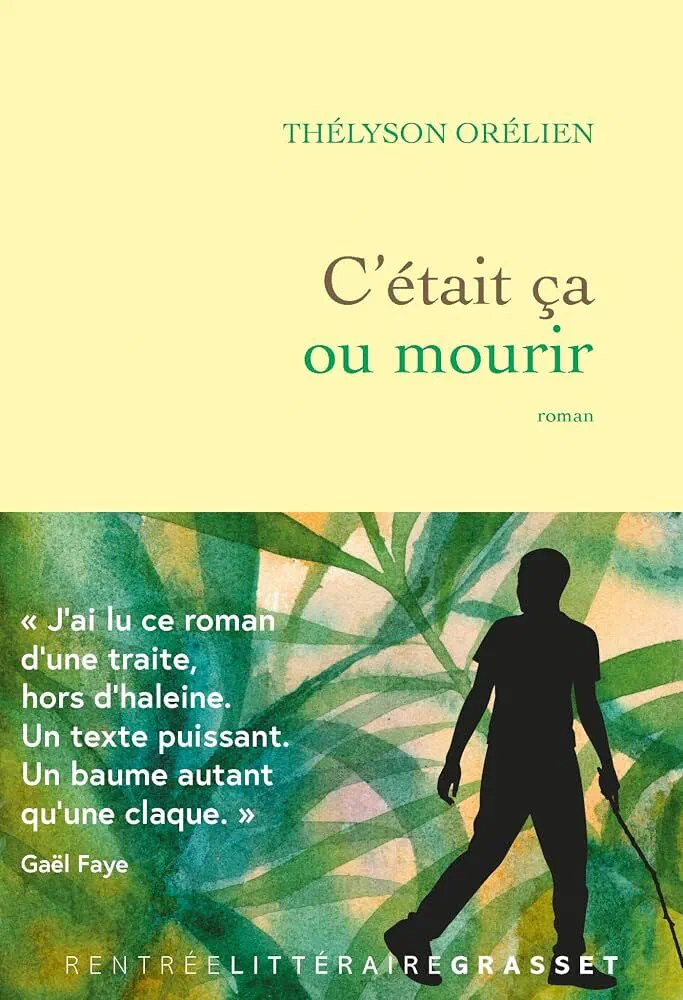
Born in 1988 in Gonaïves, Haiti, Thélyson Orélien settled in Quebec after the 2010 earthquake. C’était ça ou mourir (Boréal in Quebec, Grasset in France) appears in the selections for the Goncourt, the Renaudot, the Femina and the Médicis.
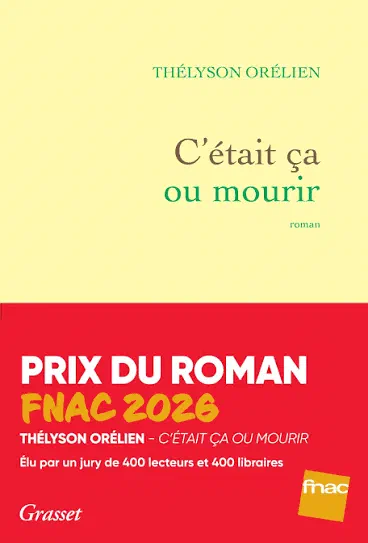
The accusation comes from an anonymous X account, “Balance ton Claude”. It claims to have submitted more than twenty excerpts from the novel to the Pangram detector, which classifies almost all of them as AI-generated. The author denies it, in Libération and in a statement from Boréal. Grasset speaks of a “hate campaign”.
Franceinfo repeated the exercise. The novel’s excerpts do come back 100 % AI. But two older texts by the author, a 2015 book and a 2014 article, both predating generative AI, come back 100 % human. Four other novels from this autumn’s season, including one by the Franco-Mauritian writer Ananda Devi, also pass at 99 or 100 % human.
At this point, a piece of software gives a book a high score, and nobody knows why. Nothing establishes that the author used an AI.
Can an AI detector prove a text came out of a machine?
Tip
An AI detector measures statistical resemblance to generated texts: it is a lead to verify, never proof.
Pangram is considered the most reliable detector on the market, according to one study from the University of Chicago (2025) and another from the Vrije Universiteit Brussel (2026). Its publisher claims roughly one false positive per 10,000 texts. That is very little. It is not zero.
Above all, twenty excerpts from the same novel do not make twenty independent tests. If a quirk of an author’s style fools the detector on page 12, it will fool it again on page 140. There is precedent: in May 2026, Pangram flagged several prize-winning stories at the Commonwealth Short Story Prize. After a month-long inquiry into the authors’ drafts and time-stamped documents, the foundation concluded that no AI had been used, and upheld the prizes.
What I tested myself
An idea circulates, notably on LinkedIn: Zola’s texts supposedly get classified as “AI-written” on a regular basis. I checked on 23 September 2026, with the free version of Pangram.
| Text submitted | Source | Length | Pangram result |
|---|---|---|---|
| Germinal, opening (Zola, 1885) | Project Gutenberg | 415 words | 100 % human |
| Germinal, strike scene | Project Gutenberg | 401 words | 100 % human |
| Marbot, La Cigale et la Fourmi, Le Corbeau et le Renard (Martinican Creole) | Gallica, 1869 edition | 361 words | 100 % human |
| Marbot, Le Chêne et le Roseau (Martinican Creole) | Gallica, 1869 edition | 270 words | 100 % human |
On a specialised detector, Zola is not mistaken for an AI. My test has its limits (one tool, one day, a handful of excerpts), but that is the standard of proof currently being wielded against a novelist.
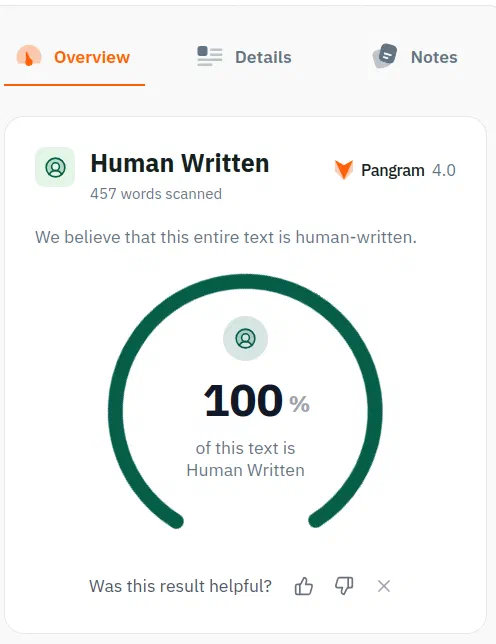
I also hand-tested a poem by Aimé Césaire: 100 % human. I did not hand that test to our agents. Césaire’s work is under copyright, and the harness of our AI agents is configured not to reproduce copyrighted texts, even towards a third-party tool. That is a choice of method, not a guarantee that those texts were never used to train an AI. On 20 July 2026, the US courts gave final approval to the 1.5 billion dollar settlement between Anthropic and authors whose pirated books had been used to train its models.
Warning
Never accuse anyone on the strength of a score alone, whether a pupil, a job applicant, a contractor or an author. A high score justifies a question, not a sanction.
Does Creole fool the detectors?
The hypothesis was put forward in Orélien’s defence: his language, described as “creolised”, shot through with orality and other tongues, would be exactly the kind of prose detectors handle worst. The intuition holds up. Creole is rare in training data: a team at Inria had to build a dedicated tool just to spot French-based Creoles in large web crawls.
But the facts do not follow, at least for Pangram. In 2023, a Stanford study showed that seven detectors of the time were massively wrong about English essays written by non-native speakers. Pangram now claims 0 % error on that same test set. The nineteenth-century Creole fables pass at 100 % human, as does Ananda Devi’s novel.
So Creole does not explain Orélien’s score, and nobody knows what does. That guarantees nothing for the free, less rigorous detectors: before judging a paper or a Creole text with one of them, test it first.
“With or without AI”: is that even the right question?
Tip
Sorting texts into “with AI” and “without AI” puts the spell-checker, a review by an agent and total delegation in the same box.
This kind of test rests on a binary view. Yet AI intervenes at very different depths: fixing spelling, suggesting a turn of phrase, reviewing a chapter, translating, producing a first draft, or writing everything. I am not even sure what “doing everything by AI” would mean for a novel: someone chose the subject, the story, the characters, what stays and what gets cut.
At Kimoun, I work with many AI agents, on technical, administrative, accounting and even sales tasks. Humans steer them, watch them and answer for what comes out. That is also the principle behind our AI and automation offer: AI executes, experience guarantees.
It does not stop at work. A good share of my Deezer playlists contains AI-made tracks, and I know it. I am in a minority: in June 2026, Deezer was receiving close to 90,000 AI-generated tracks a day, more than half of new uploads at peak times, yet they account for only 1 to 3 % of listening. I keep them for a simple reason: I like them.
Behind this affair, what I mostly see is an unease: the fantasy of a “purely human” creation, unique and solitary. It produces conflations, and rankings out of step with how the world already works.
And what if it were?
Tip
Even written with the help of an AI, a novel remains the product of its author’s choices, and its readers’ pleasure is no less real.
Suppose for a moment the accusation were founded. What would that take away from the writer’s endeavour, or from the pleasure of those who loved the book? Rejecting a novel because a tool contributed to it amounts to demanding that a real manuscript be written by hand. Or, for the more daring, on a typewriter. But certainly not in a word processor.
Every writing tool has had its trial. In 1882, Nietzsche, newly moved to the typewriter, was already noting that our writing instruments take part in our thoughts. He did not stop being Nietzsche for it.
This debate reminds me of another one, twenty years old and never really settled. In the early days of blogs, some wanted to reserve online writing for a vetted circle of recognised pens, far from the “amateurs”. In 2007, Andrew Keen made a book of it, The Cult of the Amateur. Same reflex as today: judging the author and their tools, not what they wrote.
There is a real question, but it lies elsewhere: transparency. A jury has the right to set its rules, and a reader has the right to know how a book was made if the author claims it. Those are matters of rules and honesty, not of literary worth. And in the present case, the author denies it, and nothing is established.
Note
The best defence against a detector is not another detector. It is your drafts, your dated notes and the version history of your documents. The Commonwealth winners were cleared that way. Keep them, even when everything is fine.
On your website, does Google judge the tool or the content?
Tip
Google does not penalise AI: it penalises pages produced at scale that bring the reader nothing, whatever the tool.
Google’s position is in writing, black on white. Generative AI can help research a subject and structure original content. On the other hand, generating lots of pages with no added value for the user can breach its scaled content abuse policy, whether those pages come from an AI or from humans.
The difference lies in what cannot be found elsewhere: your data, your experience, your ground truth. I develop this in what Google’s official guide changes for SEO and GEO, and on a concrete case in building a website with AI. The real enemy is hollow content, AI slop. Not AI.
Sources
- Franceinfo — True or false: did Thélyson Orélien use AI to write his novel? (in French)
- Franceinfo — Grasset denounces a “hate campaign” (in French)
- Radio-Canada — Thélyson Orélien denies using AI for his novel (in French)
- Entrevue — The Commonwealth Short Story Prize precedent (in French)
- Pangram Labs — Technical report (arXiv)
- Inria — KréyoLID, identifying French-based Creoles (arXiv)
- Deezer Newsroom — AI music passes 50 % of uploads (in French)
- Google Search Central — AI-generated content on your site
- Livres Hebdo — US courts give final approval to the Anthropic settlement (in French)
- Project Gutenberg — Germinal, Émile Zola
- Gallica — Les Bambous, F.-A. Marbot, 1869 edition
- Kimoun — Local SEO and visibility in Guadeloupe