



French e-invoicing 2026: what changes in Guadeloupe
🇫🇷 Lire en français : Facturation électronique 2026 : ce qui change en Guadeloupe
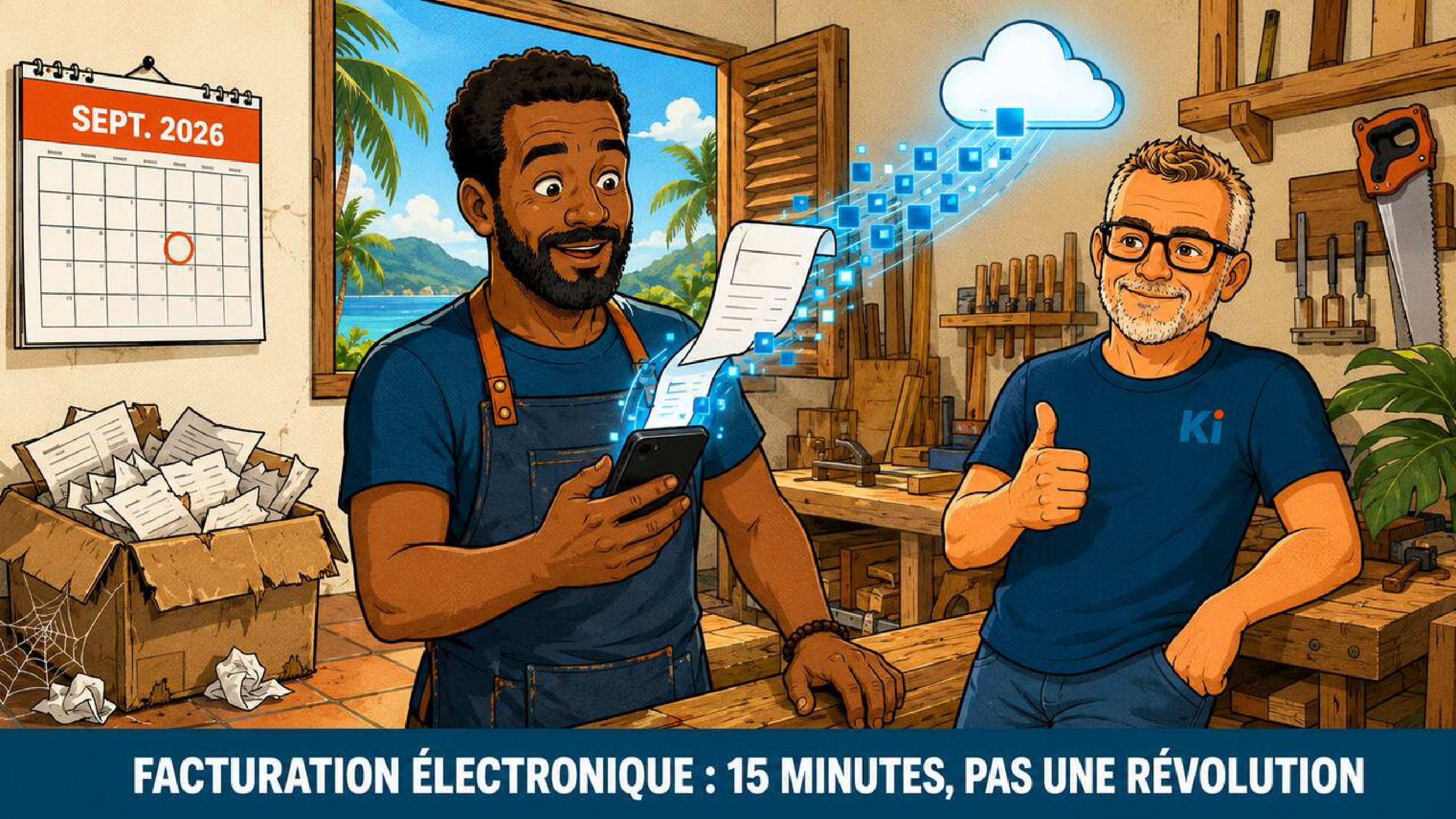
In our conversations with business owners across the islands these past weeks (craftspeople, guesthouse operators, independents), the same mix keeps coming back: nerves about the 1 September 2026 deadline, and among many self-employed people, the opposite illusion of being left out. Both miss the mark. According to the French tax authority (DGFiP), close to 10 million businesses must be able to receive electronic invoices by that date, micro-businesses included, and the step to take between now and then is smaller than the anxiety suggests. We have gathered here the questions that come up most, and the answers available today, with official sources attached.
“Am I concerned by e-invoicing?”: almost certainly, yes

Tip
On 1 September 2026, every business subject to French VAT, including those under the small-business exemption, must be able to receive electronic invoices through an approved platform.
The reform arrives in two steps. Step one, 1 September 2026: every business, whatever its size, must be able to receive electronic invoices. On the same date, large and mid-sized companies start issuing them. Step two, 1 September 2027: the duty to issue extends to small and medium businesses, and to micro-businesses.
This is where the most common illusion sits. The test is not whether you collect VAT, but whether you are taxable for it. “I am under the exemption, this does not concern me” is the sentence we hear most often, and it is wrong.
The distinction is worth thirty seconds. A VAT collector charges VAT and pays it over to the State. A VAT-taxable person is broader: anyone, individual or company, carrying on an independent economic activity. A self-employed person under France’s VAT exemption scheme for small businesses does not charge VAT, but does carry on an independent activity: they are taxable, therefore concerned, receiving from September 2026 and issuing in 2027. Exemption or not, if your business is established on a territory where VAT applies, treat yourself as concerned.
And the duty to receive is not theoretical: from September, your large suppliers (power, telecoms, wholesalers, insurers) will move their invoices into the electronic circuit. With no declared receiving platform, those invoices will stop arriving through the usual channel.
“I already send my invoices as PDFs, am I compliant?”: no, an electronic invoice is a structured file

Warning
Sending a PDF as an attachment does not meet the obligation. An electronic invoice, as the reform defines it, is a structured file passed from platform to platform, not a document sent by email.
The second misunderstanding, as widespread as the first. The reform rests on structured formats (Factur-X, UBL, CII, built on European standard EN 16931), machine-readable, carried by approved platforms registered with the French tax authority, and routed through a central directory that ties each receiving address to its platform. Article 289 bis of the French tax code is explicit: issuing, transmitting and receiving all go through an approved platform.
Another point many people missed: the design changed along the way. The public invoicing portal, once announced as a free exchange service for everyone, was refocused in October 2024 onto two functions, the directory of recipients and the transmission of data to the tax authority. The direct consequence: there is no free public option for receiving your invoices. Every business must connect to a private approved platform, even just to receive.
Important
The French Finance Act for 2026 set the scale: a 500 € fine where no approved platform is in place, after a formal notice left unanswered for 3 months, then 1,000 € per subsequent notice, quarter after quarter, until the situation is fixed. And once your duty to issue applies: 50 € per non-electronic invoice (against 15 € in the original text), capped at 15,000 € a year. Nobody will be fined on waking up on 2 September. The DGFiP has even announced that during the start-up phase, no penalty will hit businesses genuinely engaged in getting compliant. But the obligation carries no exemption for size or sector.
The good news: connecting to a platform is often simpler, and cheaper, than the ambient nervousness suggests. More on that below.
“Does being in Guadeloupe change anything?”: same timetable, different map of flows
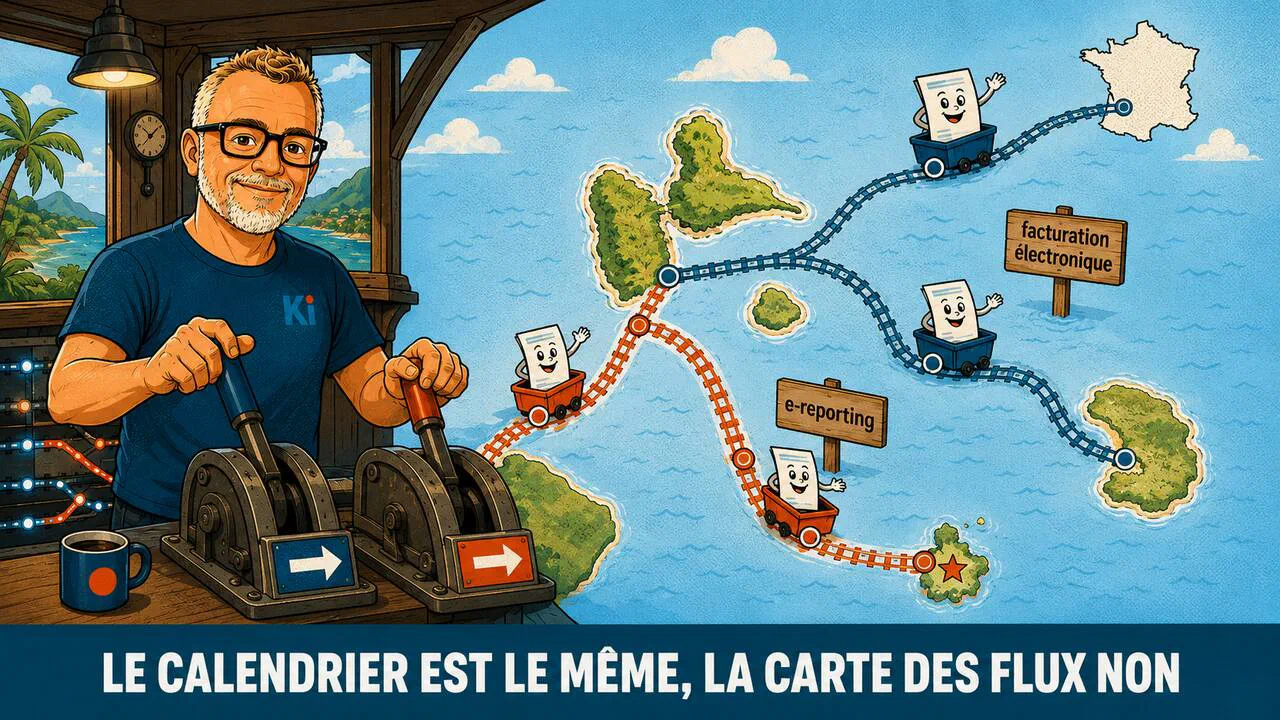
Guadeloupe is a territory where French VAT applies: 8.5 % standard rate, 2.1 % reduced rate. Businesses established here are therefore fully inside the scope of the reform, on the same timetable as mainland France. It is when you look at who you invoice that our tax geography comes into play, and the DGFiP has published a dedicated overseas FAQ, in its version dated 21 January 2026, that almost no mainstream guide relays.
For a business established in Guadeloupe, the applicable rule depends on where the client is established and on their status, as follows:
| You invoice… | Services | Goods |
|---|---|---|
| A business in Guadeloupe, Martinique or Réunion (French overseas departments where VAT applies) | E-invoicing | E-invoicing |
| A business in mainland France | E-invoicing | E-invoicing |
| A business in French Guiana, Mayotte, or an overseas collectivity (Saint-Martin, Saint-Barthélemy and similar) | E-reporting | E-reporting |
| A private individual or any non-taxable client, wherever they are | E-reporting | E-reporting |
The thing to remember is that the dividing line does not follow distance, it follows VAT. The three overseas departments where VAT applies (Guadeloupe, Martinique, Réunion) form a single e-invoicing block together with mainland France, whatever the type of transaction. French Guiana and Mayotte, where VAT does not apply under article 294-1 of the French tax code, fall outside it, as do the overseas collectivities. A craftsman in Le Moule will therefore invoice a client in Fort-de-France, Martinique, electronically just as they would a client in Lyon, but will file e-reporting for a client in Cayenne, French Guiana, which is far closer.
One more thing not to confuse: e-reporting is not an exemption. It is a different obligation, transmitting your transaction data periodically to the tax authority through your approved platform, and it follows the same timetable as your duty to issue. Worth noting too: if you buy a service from a supplier in French Guiana or Mayotte, you, the client, carry the e-reporting duty on that purchase.
This complexity is not an accountant’s footnote. Back in September 2021, a written question from Guadeloupe MP Max Mathiasin asked the government what practical support was planned, in Guadeloupe in particular, for people and businesses far from digital tools facing this reform. Five years on, the deadline is here, and support on the ground still rests largely with businesses and their advisers.
“Where do I start?”: the 4 questions to settle before 1 September 2026

1. What is my situation? VAT-taxable, small-business exemption included: concerned. Only your size sets the date you must start issuing, 2026 for large and mid-sized companies, 2027 for everyone else. Receiving is not up for discussion: September 2026 for all.
2. Do I already have a platform without knowing it? Your invoicing or accounting software is probably already an approved platform, or connected to one, often at no extra cost on your current plan. The official DGFiP list already includes most of the tools independent workers here use daily: Qonto, Tiime, Abby, Indy, Shine, Pennylane, Sellsy, Axonaut. Your accountant has very likely picked a platform for the whole practice too. Either way, the connection can be settled in one conversation. Only take out a dedicated subscription as a last resort.
Watch the coordination point. In the directory, a receiving address points to a single platform only. For a solo operator with one company number and one address, that means one entry point: if your accountant has already connected your business to the practice’s platform, switching reception on inside your own tool would divert the flow. Agree on it before pressing the button.
3. Is my platform genuinely approved? The DGFiP publishes the official list of registrations. Mind the vocabulary: a “compatible solution” is not an “approved platform”. The first produces compliant invoices but is not registered, and must connect to an approved platform to transmit. A tool in neither category does not meet the obligation, whatever its sales pitch promises.
4. Is my directory entry correct? Once connected, check that your business points to the right platform in the central directory. That entry is what your suppliers will use from September. And that is the whole exercise, really: for a company or a solo operator, compliance comes down to appearing in the directory through an approved platform, which takes one click with most online banks and the tools listed above. The subject weighs less than the ambient nervousness suggests.
Note
A concrete case: a self-employed person banking with a neobank already registered as an approved platform (Qonto, in our example, registered since December 2025). Getting compliant meant switching e-invoicing on in the app, since that activation is what registers the business in the directory, then checking no other platform was already receiving on its behalf, and it was done. Supplier invoices will arrive on their own from September. Fifteen minutes, nothing spent. Issuing can wait until 2027, but moving invoices into the tool now sends them out natively in the right format, and on the day itself nothing will need changing.
“So where does Kimoun fit in?”
Let us be clear: we are not accountants, and we have no intention of becoming any. We are a business that works for businesses, and we love working with accountants: they are precise, and they know how to count.
What this reform brings into the light is a deeper shift we have watched among our clients for several years: modern tools, online banks first among them, lift a good part of the administrative burden off the business owner by taking on the whole chain: quotes, invoices, reminders, payment collection, bank reconciliation. As a result, the owner handles most of these tasks alone as they come, and saves their accountant or auditor for the matters where that expertise genuinely counts: year-end accounts, tax, planning, audit. Everyone in their right place, everyone gains, the accountant first, receiving clean entries instead of a shoebox of receipts.
Our own place is helping you take ownership of these tools. Choosing the one that fits your activity, and that does not lock you in: your data, your clients, your history must stay yours and stay portable, like everything we put in place. Setting it up properly. Connecting it to the rest of your online presence: your website, your enquiry forms, your automations. And training you so you end up independent, not dependent on us. E-invoicing is just one more episode in that story: those who own their tools get through it in fifteen minutes, those who endure it will feel one more constraint.
One last line on compliance: at Kimoun it is done, we already receive your electronic invoices. Will you be ready to receive ours?
Sources
- Overseas FAQ on e-invoicing for French overseas departments and collectivities (impots.gouv.fr, version of 21/01/2026, in French)
- E-invoicing: practical start-up guide for 1 September 2026 (DGFiP, in French)
- Moving to e-invoicing (impots.gouv.fr, in French)
- Official list of approved platforms (impots.gouv.fr, in French)
- “Approved platform” guarantee mark and “compatible solution” label (DGFiP, in French)
- E-invoicing: the penalties change (entreprendre.service-public.gouv.fr, in French)
- Everything about e-invoicing for businesses (economie.gouv.fr, in French)
- Written question no. 41366 by Max Mathiasin MP, 28 September 2021 (French National Assembly, in French)
- Kimoun page: AI and marketing automation in Guadeloupe