



3D Printing for the Food Industry in Jarry
🇫🇷 Lire en français : Impression 3D pour l'industrie agroalimentaire à Jarry
A food-industry manufacturer in Jarry needed a precise place to store the test plates of its metal detector — a critical accessory for its HACCP controls, impossible to find off the shelf at the right dimensions. We modelled and 3D printed it, built to the exact size of the plates, integrated with the existing control box. Two weeks between the first WhatsApp message and the part delivered to the workstation, in June 2026. Without a single kilometre of freight or a single day of customs. This case study shows how a very concrete engineering request is handled locally — and what it says about Guadeloupean industry today.
Note
Project run in 2026. A food-industry manufacturer based in the Jarry area contacts us about a problem that looks simple: the test plates of its metal detector — a plate with a ferrous ball (Fe), a non-ferrous one (non-Fe), a stainless-steel one — were stored without any dedicated holder. The result: plates lying around, getting lost, getting damaged, at the exact moment when the operator has to check that the detector works. Yet this test underpins the reliability of an HACCP control. The need was clear: a custom holder, at the right dimensions, integrated with the box already in place.
The need — a custom holder for the test plates
A metal detector on a food line is tested regularly. The operator runs three reference plates — ferrous, non-ferrous, stainless steel — to check that the machine correctly spots each type of contamination. This routine-looking gesture is a control point: if it is done badly, or done with plates that are lost or damaged, the whole food-safety chain loses reliability.
The client’s problem was therefore not a cosmetic one. It was a problem of reliability of a working gesture. The three plates had no assigned slot. They were stored wherever there was room, hunted for at test time, and exposed to knocks.
The technical constraint was twofold: the holder had to match the exact dimensions of the three plates, and integrate with the existing control box without replacing it. Two requirements that rule out an off-the-shelf purchase from the start. A generic tray does not hold these dimensions, and does not fit cleanly into a box already in place.
The answer — modelling and 3D printing a single part
Tip
For a one-off part with imposed dimensions, additive manufacturing delivers faster and cheaper than a mould or custom machining — because you print the file directly, with no intermediate tooling.
The answer was a holder designed specifically for this need: first modelled in 3D from measurements taken on site, then produced by additive manufacturing at the exact dimensions of the test plates. Each plate has its own slot, reachable in a single movement, protected between two controls.
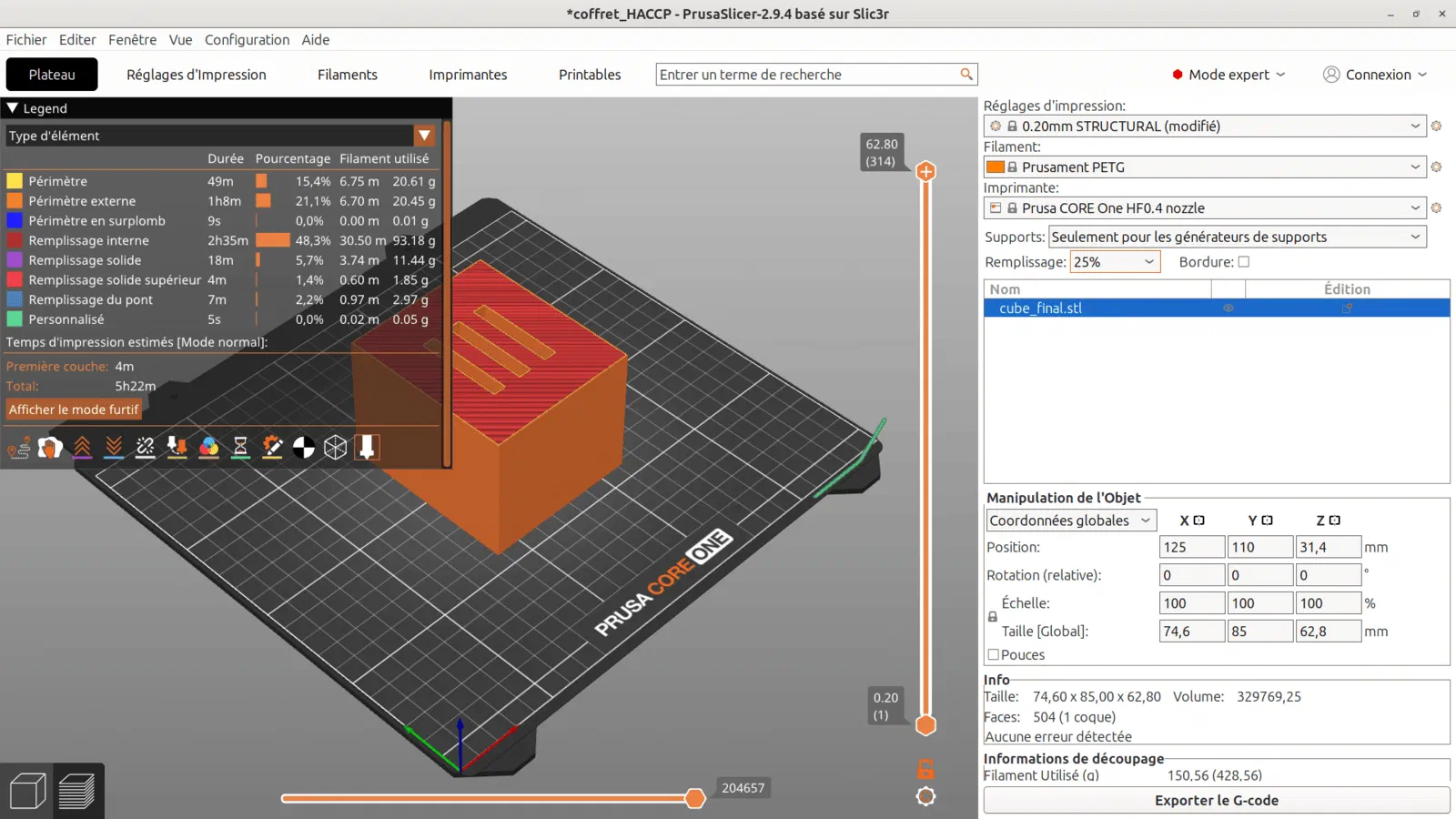
The holder modelled to the dimensions measured on site, ready to print (PETG, 0.20 mm layers, 25% infill). The file goes straight to printing, with no mould or tooling.
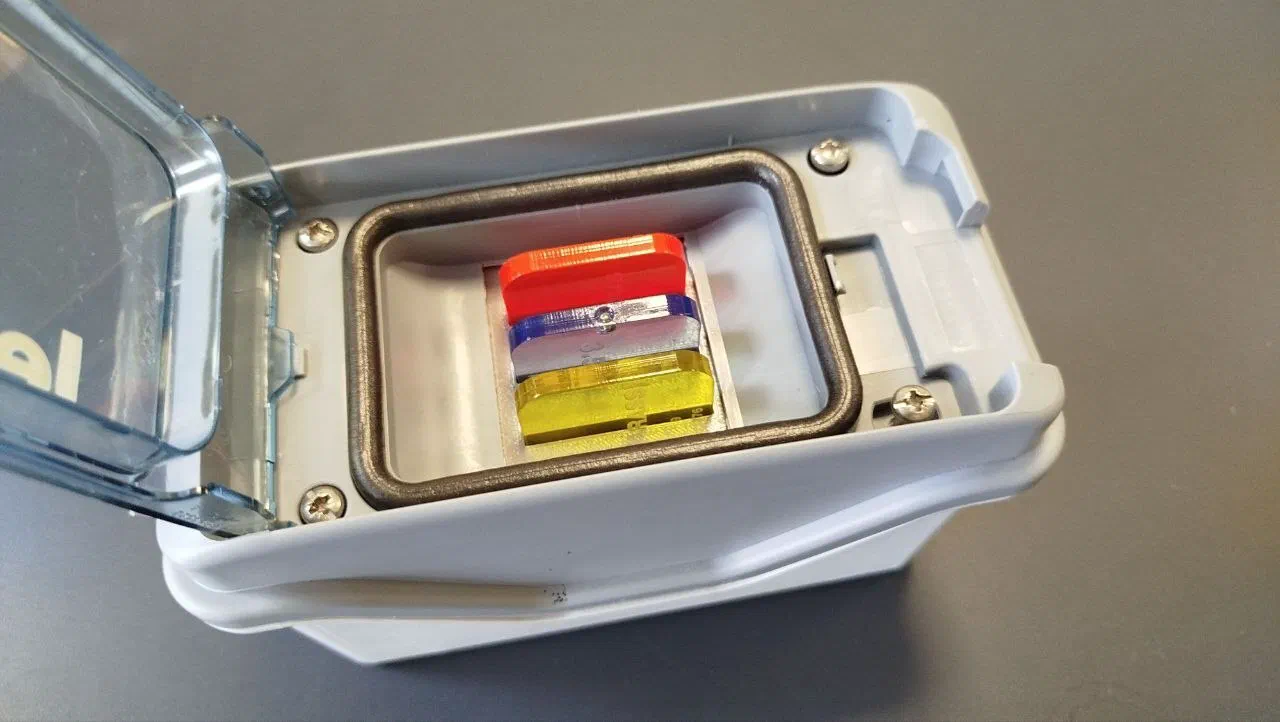
The delivered part, integrated with the existing box: each reference plate — ferrous, non-ferrous, stainless steel — has its own slot, at exact dimensions.
Let us be precise about the scope, because that is what makes a case study credible: the deliverable was the modelling and printing of the holder, only. The part, nothing more.
The concrete result: a critical working gesture made reliable and repeatable. The plates are protected, in their place, immediately accessible at the workstation. The operator no longer searches, no longer improvises. The control is carried out under the same conditions every time — which is exactly the goal of an HACCP approach.
| Item | Detail |
|---|---|
| Need | Custom holder for 3 test plates of a metal detector (HACCP control) |
| Solution | Part modelled in 3D then printed (additive manufacturing) |
| Material / settings | PETG, 0.20 mm layers, 25% infill |
| Lead time | 2 weeks (from first WhatsApp message to delivery), June 2026 |
| Deliverable | 3D-printed holder, integrated into its control box |
| Location | Jarry industrial zone, Baie-Mahault (Guadeloupe) |
Two weeks, from the first WhatsApp message to delivery
The project held to two weeks, from the first WhatsApp message to delivery of the part, in June 2026. That timeframe covered every step of the process, in order:
- The initial discussion;
- Taking measurements at the workstation (the client entrusted us with a set of test plates to build and validate the prototype);
- 3D modelling;
- One validation;
- Printing and finishing.
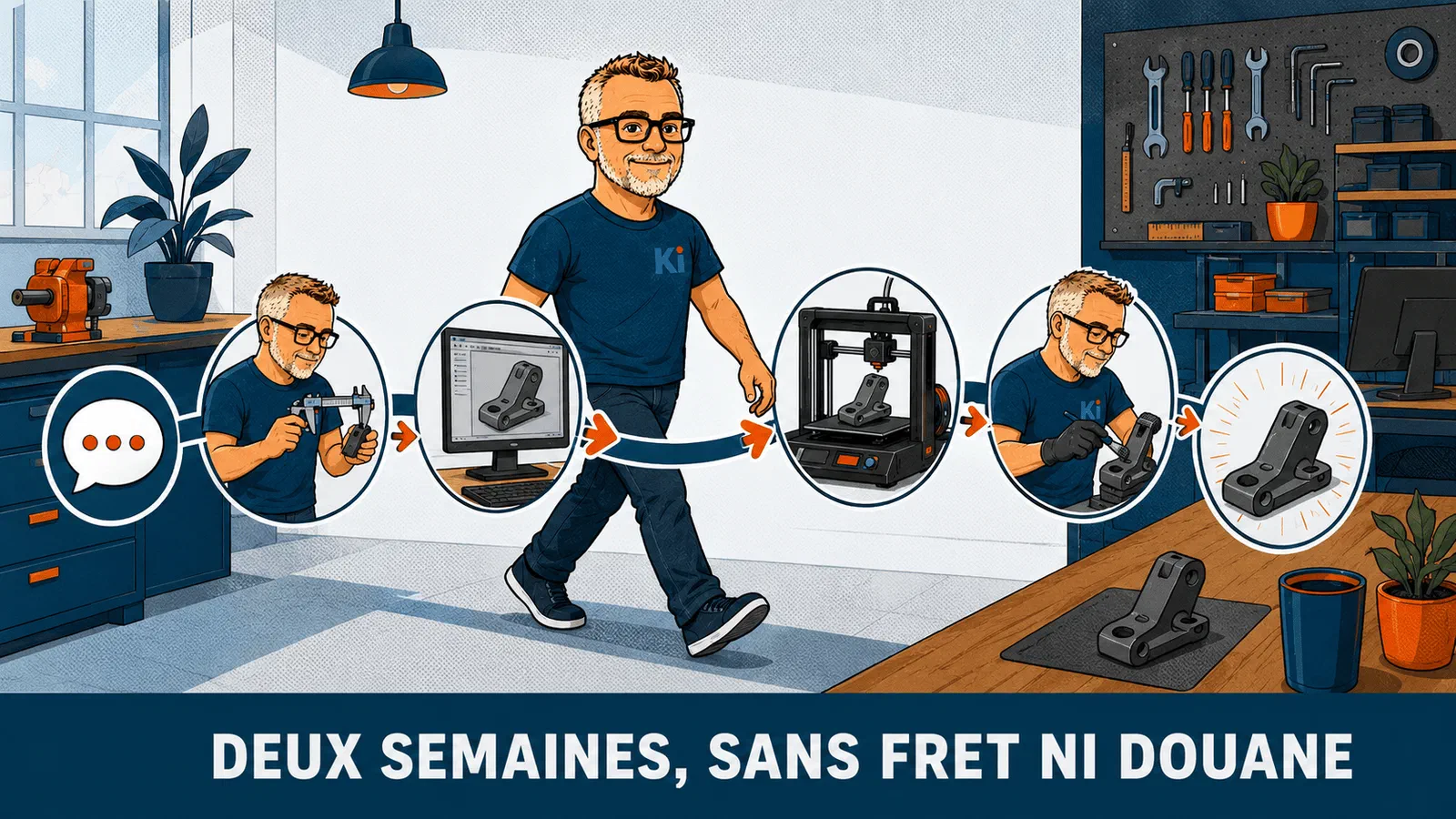
From the first message to the delivered part: discussion, measurements, modelling, printing, finishing. Two weeks, with no sea freight or customs.
This figure is worth pausing on, because it is the real difference with ordering an imported technical part. Two weeks, here, means from the first message to the workstation — with no sea freight, no customs, no distant intermediary to chase. For a standard part ordered from off the territory, these logistics steps often add more delay than the manufacturing itself.
It is also what makes additive manufacturing relevant for the one-off. You do not print a thousand copies: you print one, just one. No mould to fund, no minimum batch to order. Once the 3D file is validated, you launch the print, finish the part, and deliver.
What local engineering makes possible
Tip
On a custom industrial part, proximity is not a comfort argument: it is what lets you take measurements at the workstation, see the operator’s real movement, and adjust the part before printing it.
This project illustrates three things that locally available engineering makes possible.
1. Real custom work. Taking measurements on site, seeing the existing box, understanding how the operator handles the plates: that does not happen by email from the far end of a subcontracting chain. The part fits the need because we saw the need.
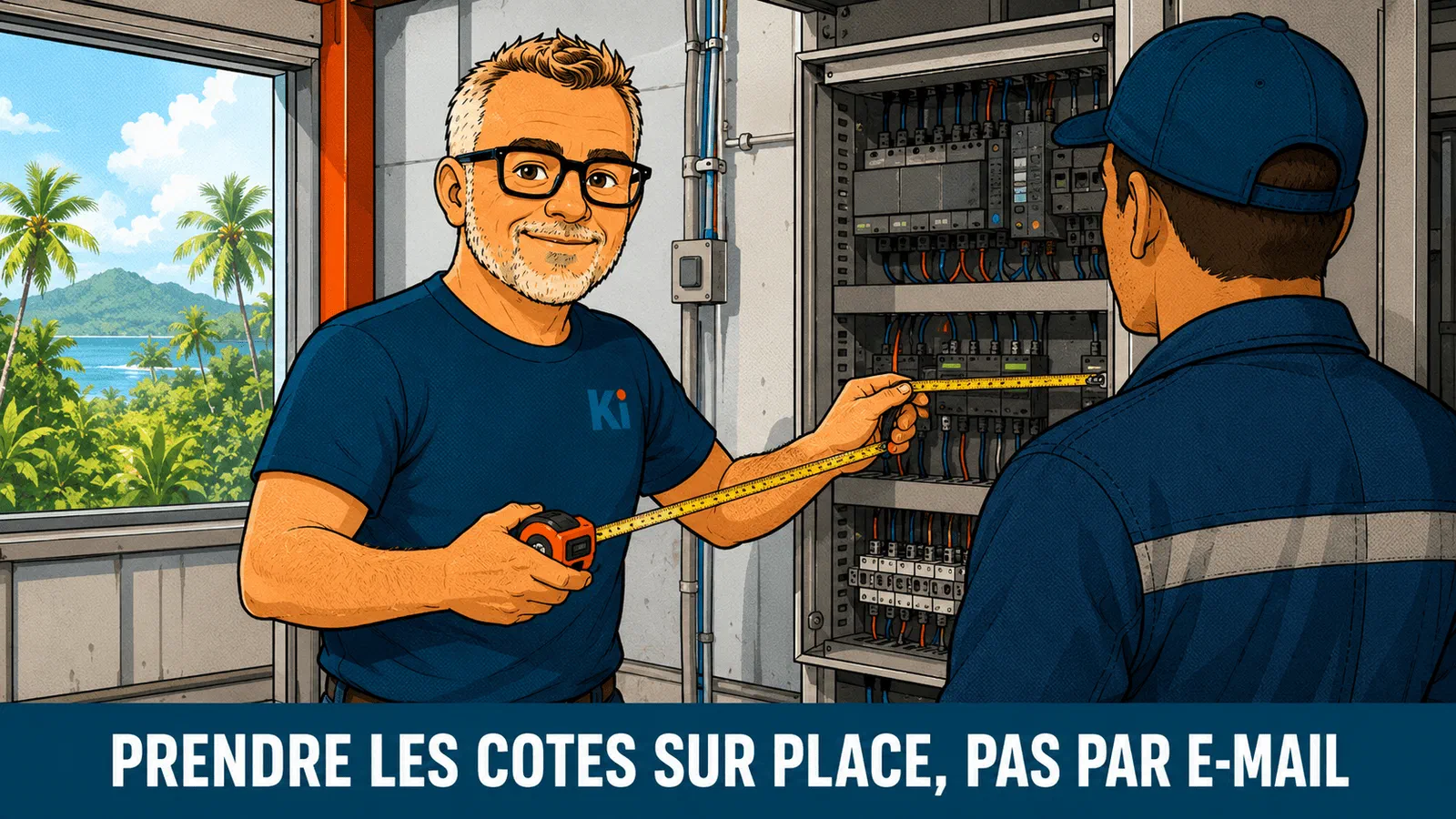
Measurements are taken at the workstation, with the operator — not by email from the far end of a subcontracting chain.
2. Speed. No freight, no customs, no distant subcontractor to coordinate. The timeframe hinges on design and printing, not on international logistics. That is what makes it possible to hold to two weeks on a part started from scratch.
3. A response under pressure. When a part breaks on a line, or an accessory is missing to make a control reliable, waiting three months for an imported order is not an option. A modelling and printing capacity on the territory means a response measured in days or weeks, not quarters.
We put these three levers to work for every need for custom parts made here, from our 3D printing workshop in Guadeloupe — from repairing a part you can no longer find, to an industrial holder, to a prototype to validate before a batch.
The maturity of Guadeloupean manufacturers
There is a signal in this project that goes beyond the case itself. We did not go and sell 3D printing to a manufacturer. A manufacturer spontaneously formulated a request for 3D printing to solve a concrete production problem.
That is a quiet but real shift. A few years ago, additive manufacturing was still seen here as a gadget, a FabLab curiosity, at best a prototyping tool reserved for design offices. That a food-industry manufacturer thinks of it on their own to make an HACCP control reliable is a sign that the technology has entered the ordinary toolbox of the territory’s industry.
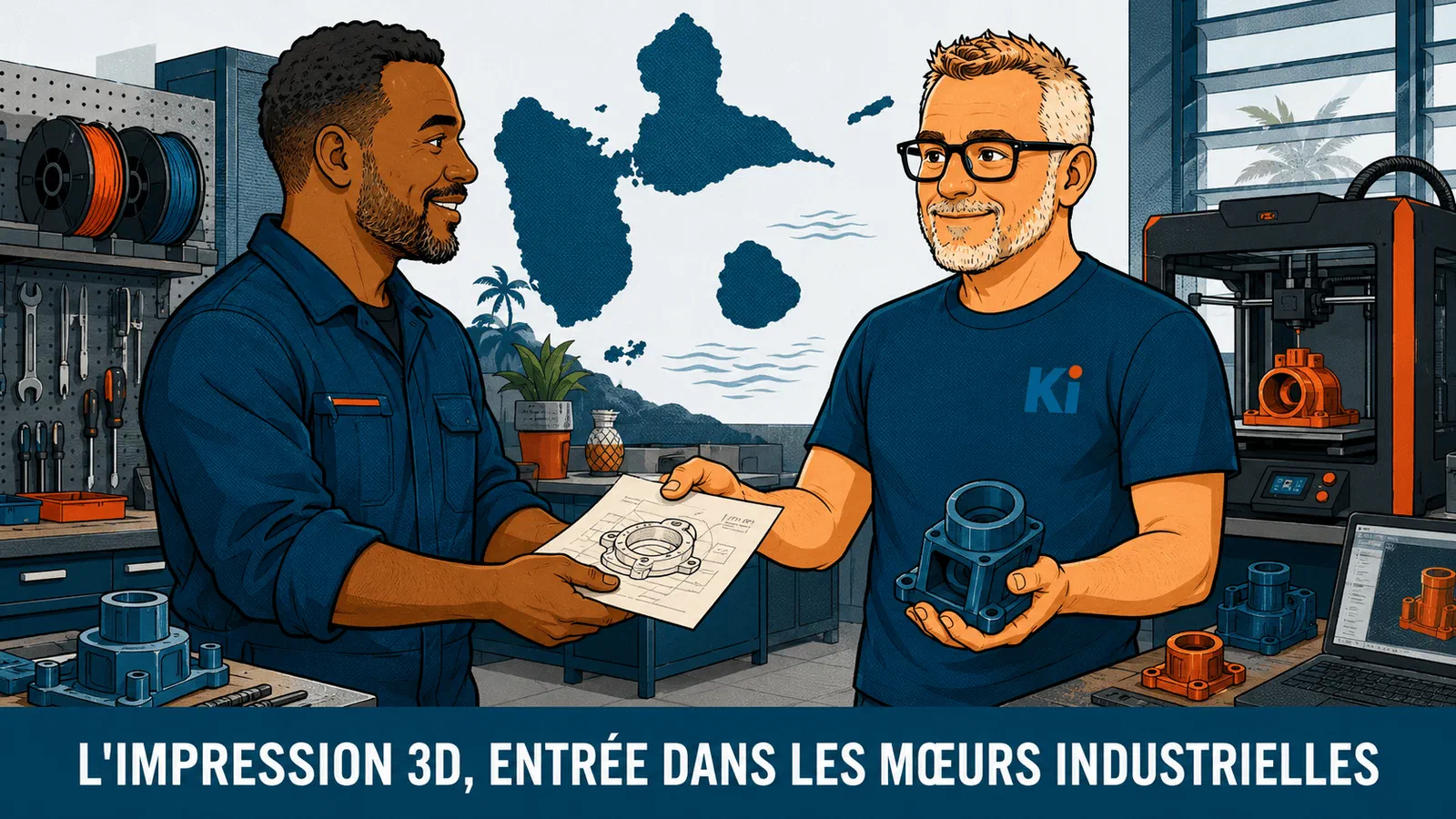
It is no longer the workshop selling 3D printing: it is the manufacturer asking for it to solve a concrete production problem.
This maturity is something we have watched build for a long time. Oliver printed his first part in 2009, has run FabLab workshops for more than ten years, and has taught digital prototyping and 3D printing at the University of the Antilles since 2018 — a Master’s-level course dedicated to rapid prototyping and 3D printing. Seeing a manufacturer in the Jarry zone order a functional part is seeing that diffusion produce its effects on the ground.
For a workshop manager or a production lead, the message is simple: the custom part you are missing, the accessory you cannot find, the holder that would make a gesture reliable — it can be designed and made here, in weeks, not quarters.
Need a custom part made locally? Let’s talk. We’ll look together at what can be modelled, what can be printed, and in what timeframe.