



The data.gouv.fr MCP Server: Public Data Talks to AI

🇫🇷 Lire en français : Serveur MCP de data.gouv.fr : les données publiques parlent à l'IA
This 14 July 2026, two Frances collided: the one we celebrate every Bastille Day — parade, fireworks, the national holiday — and the one going down 0-2 to Spain in a World Cup semi-final, in Dallas. Rather than dwell on Les Bleus bowing out, I chose to celebrate a third, made-in-France pride, less headline-grabbing but far more durable: our country ranks first in the world for open data — top of the OECD’s 2025 OURdata index — and, since this year, data.gouv.fr exposes its public data to AI assistants through an official MCP server. That acronym may be foreign to you; at Kimoun, it has become a daily production tool — all the more reason to pause on this announcement.
An MCP server: the universal socket between AI and your tools
Tip
An MCP server is a standardised connector that lets an AI assistant query a service or a data source, without developing a specific integration for each tool.
MCP stands for Model Context Protocol. It’s an open standard created by Anthropic (the maker of Claude) in late 2024, now entrusted to an independent foundation under the umbrella of the Linux Foundation. The simplest picture: a universal socket. Before, each connection between an AI and a piece of software was hand-wired case by case; with MCP, the service exposes a list of “tools” — precise actions such as search for a dataset or read a document — and any compatible assistant knows how to use them.
This is exactly the “MCP door” of the vault-and-agents architecture I described recently: the data stays with its owner, and the AI comes to work through a door you hold the key to.

The simplest picture of an MCP server: a universal socket between AI and your tools. Any compatible assistant knows how to plug in.
What the State has just plugged in
On 25 February 2026, the data.gouv.fr team — run by the DINUM, France’s interministerial digital directorate — published an experimental MCP server for the French public data platform. From a compatible assistant, you can now search datasets in plain language, explore their metadata and analyse their resources: “what datasets exist on property prices?”, “show me tourism footfall data”.

data.gouv.fr exposes its public data to AI: a public instance with no API key, open source under the MIT license, read-only.
The technical choices are exemplary: a public instance at https://mcp.data.gouv.fr/mcp, no API key, read-only, source code open under the MIT license, setup documented for Claude, ChatGPT, Mistral and the rest. As far as I know, this is the first time a State has published an official MCP server for its national open-data platform. And the stated ambition for what comes next speaks for itself: eventually testing data editing, “relying on sovereign models”.
Warning
The service is explicitly experimental, and a language model’s answers can be incomplete or wrong. The data.gouv.fr team says so itself: check the results, and for serious uses — applications, automated processing — go through the API, which stays traceable and reproducible.
The power of this connector is that it erases the technical barrier that stood between these datasets and the field. Until now, using open data meant knowing where to look in the catalogue, downloading a file, cleaning it, often writing a little code. With the MCP server, you query the national catalogue directly in everyday language, and the assistant does the legwork: it identifies the relevant datasets, reads their metadata, cross-references the resources. I ask “which Guadeloupe municipalities publish data on their public facilities?” or “what’s the latest tourism footfall data for the French Caribbean?”, and I get workable leads in a few seconds, where it used to take half a day of digging. For a business owner, a project lead or a local authority, it’s immediate access to public data, with no technical barrier.
And I’m well placed to gauge the shift: this kind of targeted data extraction, until very recently, was exactly the sort of work I did for my clients. Someone would hand me a question — a figure to source, a dataset to track down and format — and I’d deliver the result. Today, with this connector, that same client can do it themselves, fully on their own, without going through me. I could take it as a service slipping away from me; I’d rather see it as proof that the tooling is improving — and that value is moving. What’s left to build is no longer access to the State’s data, now open to everyone: it’s access to your own data, the data that sits in no public catalogue.
Bespoke connectors: what I already build at Kimoun
If I welcome this release, it’s because I’m on familiar ground: at Kimoun, MCP servers aren’t tech-watch material, they’re production. I design and operate several of them day to day, bespoke.
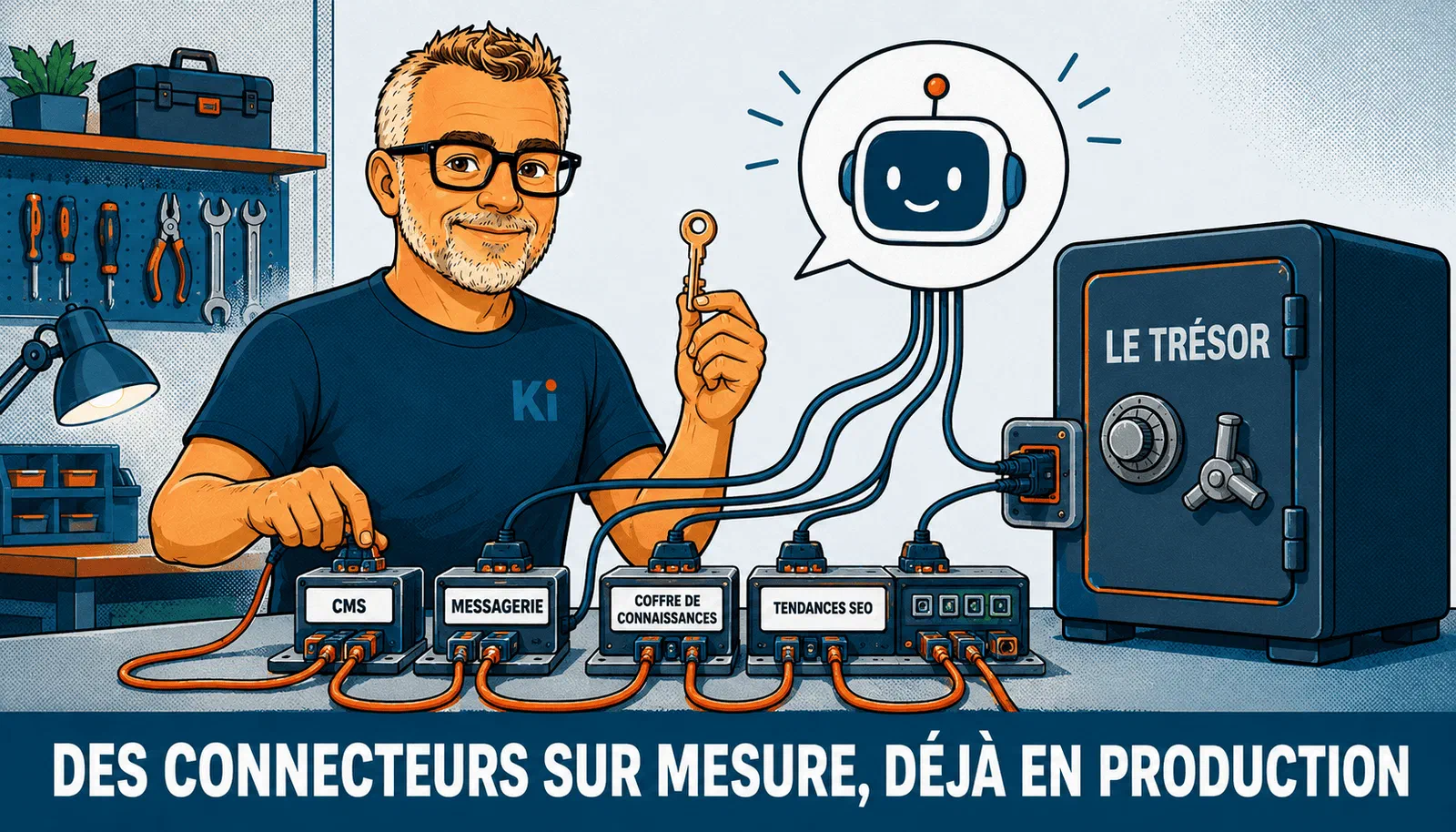
At Kimoun, MCP connectors are in production: CMS, mailboxes, knowledge vault, SEO trends. The AI works inside your tools; the key stays on your side.
Note
A few MCP connectors developed and used in production at Kimoun: driving the SPIP CMS (the AI drafts, illustrates and publishes straight into the site), reading mailboxes across multiple accounts and servers, a “human in the middle” proxy (the AI browses the web through the user’s own browser and sessions), an Obsidian knowledge vault, and search-trend analysis for SEO.
The principle is always the same: rather than copy-pasting your content into a chatbot — with all the risks that carries — you give the AI precise access to your tools. It works at your place, with scoped rights, and the treasure never moves out.
And for your business in Guadeloupe?

In Guadeloupe too: plug an assistant into your point of sale, your catalogue or your mailboxes — your own data, made actionable by AI.
What the State does with its national open-data catalogue, a small Guadeloupe business can do at its own scale: plug an assistant into its product catalogue, its invoicing, its mailboxes or its customer base, instead of feeding the AI by hand. It’s the natural extension of a move already under way: making your site readable by AI was the passive side of it; MCP is the active side — your tools become actionable. This is the kind of project I scope with you on the AI and automation page: identifying what’s worth connecting, defining the rights, measuring the time saved.
That a State publishes this kind of tool in open code, under a free license, with no access key and aiming at sovereign models, tells you where useful technology is heading: towards accessible data and controlled access. What’s left is to do the same with what no public catalogue holds — your own data. And that’s precisely where my work begins.