



Business profiles in ChatGPT: my test from the Caribbean
🇫🇷 Lire en français : Fiche d'entreprise ChatGPT : mon test depuis la Guadeloupe
Since 10 November 2026, OpenAI has let businesses claim their profile inside ChatGPT, much as we have done on Google for twenty years. I tried it for Kimoun on 16 November, from Guadeloupe. The result: a “You’re on the waitlist” screen, a profile preview with every field empty, and nothing to type in. Trade press is busy explaining how to claim your profile. Nobody mentions that here, it stops at a waitlist.
Key points
- OpenAI has opened business profiles in ChatGPT in beta: claiming through a Business Hub, verification, a blue check and mention statistics.
- My test of 16 November 2026 from Guadeloupe stops at a waitlist, with no editable field. One test, one account, one date.
- OpenAI states that only businesses with a website can be claimed. A Facebook page is not enough.
- OpenAI also states that claiming your profile guarantees neither better placement nor higher sales.
- The order of priorities holds: a complete Google profile, then a readable website, then the ChatGPT waitlist.
“The news here is not that you can create your profile in ChatGPT. It is that you cannot yet, and that checking it yourself beat reading about it elsewhere.”
— Olivier Watte, known as Oliver · founder of Kimoun
What OpenAI opened on 10 November
Tip
Business profiles in ChatGPT reuse the mechanics of Google profiles: claiming, verification, information fields and statistics, applied to an answer engine.
On its official page, OpenAI sums up the promise in one line: claim your business to present your offer, keep your information up to date, understand and shape your presence. The vocabulary will feel familiar to anyone who has ever filled in a Google profile.
The scheme offers four things. Claiming, which ties a business to an identified owner. Verification, followed by a blue check on the profile. Statistics, showing how often the business is mentioned in ChatGPT and the “discovery topics” it comes up in. And, for retailers, a product feed to import (products, prices, availability), with a Shopify integration pushed forward, without it being mandatory: OpenAI notes that you can claim your business without a Shopify store.
According to trade press, the beta launched on 10 November 2026, the entry point is chatgpt.com/business-hub, and verification runs through the business phone, the business email, the website domain or a Shopify account, before an identity check handled by the provider Persona. The same sources mention statistics computed over 28 days.
What I actually got on 16 November
Note
Test run on 16 November 2026 from Guadeloupe, on a personal ChatGPT account, for the business Kimoun. Starting the profile creation flow in the Business Hub lands on a screen titled “You’re on the waitlist”, with the message “We’ll email you when you can continue creating kimoun in ChatGPT.” On the right, the profile preview shows the name “kimoun” and a column of empty fields: photo, Category, Address, Phone number, Hours. None of them accepts input. Screenshot below.
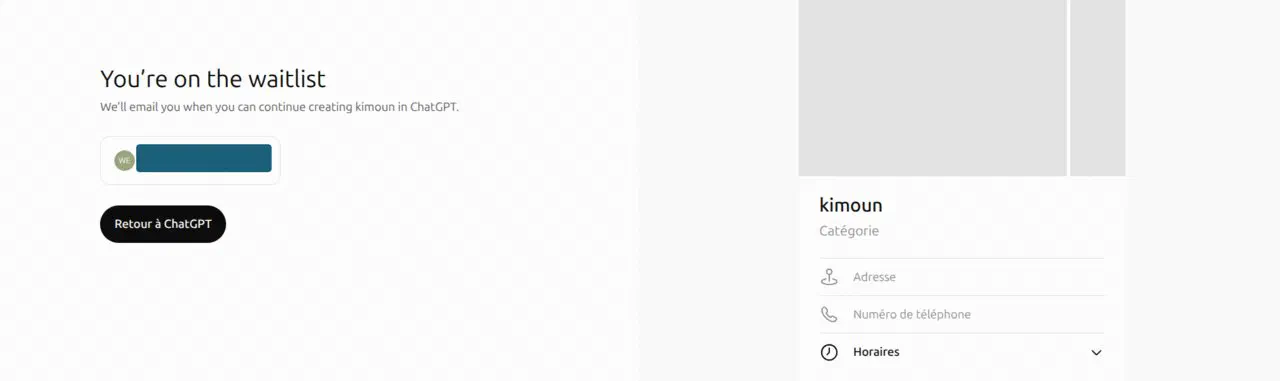
In other words: from Guadeloupe, on that date, you cannot create your business profile in ChatGPT. You can only join a waitlist.
One test, from one account, on one day. It is not a map of global eligibility, and it may change tomorrow with no announcement. OpenAI does state that eligible businesses located in regions where ChatGPT is offered can claim their business, and that eligibility depends among other things on the line of business, the location, and its verification and integrity checks. Three filters, none of them public in detail.
That result lines up with what the trade press describes. On one side, VentureBeat reports that eligible businesses can request to claim a profile in the markets where ChatGPT operates and where OpenAI handles the required verification. On the other, the same article specifies that local shops and restaurants can, for now, only claim an already existing listing in the United States. The two statements do not contradict each other: the first describes the principle, the second the restriction that applies today to neighbourhood businesses, and that is the one my test ran into.
On business agents, OpenAI is just as explicit: they are currently available in the United States, for eligible e-commerce and online services businesses. A local Caribbean shop therefore runs into two exclusions at once: the country and the type of activity.
Why this announcement does not surprise me
In August 2026 I analysed the deal between ChatGPT and Yelp and drew two conclusions: local search was turning commercial inside AI engines, and ChatGPT was becoming a matchmaking tool. Yelp’s “Request a Quote” feature was not deployed in the assistant at that point.
Three months later the trajectory holds, by another route. OpenAI is no longer content to buy data from a directory: it has businesses enter their own information. That is a change of nature, not of intensity. When a platform collects your opening hours and your business category directly, it is not building an index, it is building a marketplace.
The local weak spot has not moved. Yelp is close to empty here, and the ChatGPT profile is closed. In both cases, whatever actually fills an answer about a Caribbean business sits somewhere else.
The parallel with the Google profile, without overstating it
The two schemes look alike enough to compare, and differ enough that confusing them would be a mistake.
| Google Business Profile | ChatGPT business profile | |
|---|---|---|
| Age | Nearly 20 years, mature service | Beta opened 10 November 2026 (trade press) |
| Availability in the Caribbean | Open to everyone | Waitlist during my test of 16 November 2026 |
| Website required | No | Yes, only eligible businesses with a website (OpenAI) |
| What it feeds | Google Maps, local pack, Search | ChatGPT answers and recommendations |
| Trust signal | Google validation, customer reviews | Blue check after verification |
| Statistics | Calls, directions, views, queries | Mention frequency, conversation topics |
| Effect on ranking | Documented relevance signals | Guarantees neither better placement nor higher sales (OpenAI) |
Reading that table is simple. A neglected Google profile costs customers today, in Saint-François as in Jarry. An unavailable ChatGPT profile costs nothing for now, except to those who will have no website on the day it opens.
The strongest argument in the whole affair
Tip
No website, no business profile in ChatGPT: OpenAI makes it a condition of entry, not a comfort option.
The condition is set out in one line on the official page: at this first stage, only eligible businesses that have a website can be claimed. For part of the economic fabric here, that is a door closing before it ever opened.
I regularly see serious operations, with loyal customers and excellent reviews, whose only online existence is a Facebook page. Until now that was a visibility handicap. From here on it is also a criterion for exclusion: no domain in your own name, no claimable profile, therefore no grip at all on what the assistant says about you. The domain, incidentally, serves as proof of ownership in the verification process the trade press describes.
The condition meets my findings on what ChatGPT actually reads of a website, where the assistant often makes up its mind on a title and roughly 200 characters. The website opens the door, but it is the way it is written that decides what the assistant takes away.
The order of priorities, for a professional here
Nothing in this news justifies dropping everything for ChatGPT. The order I recommend to my clients has not shifted by a notch.
- Complete your Google Business Profile. It is the asset that weighs most on local search, and it indirectly feeds part of what AI engines answer.
- Make your website readable by answer-engine crawlers. One title per page, your location and your activity stated in the opening lines, no technical obstacle to crawling.
- Test what ChatGPT already says about you. A fresh conversation, no history, using your customers’ questions: “which [your trade] in [your town]?”. Note every wrong opening hour and address.
- Join the Business Hub waitlist. Five minutes, then nothing left to do but wait for the email.
Warning
Be wary of offers promising to “list your business in ChatGPT” right now, or a better spot in its recommendations. OpenAI states that ChatGPT keeps producing independent recommendations and comparisons, and that claiming a business guarantees neither better placement nor higher sales.
What I am watching next
Three unknowns strike me as more interesting than the feature itself.
Geographic opening, first: when neighbourhood businesses outside the United States will be admitted, and in what order. No timetable has been published, and that is exactly what will decide whether the scheme is of any real use here.
The business model, next. I have seen no announcement of advertising on business profiles. VentureBeat reports, based on an exchange between Digiday and OpenAI’s vice-president of monetisation, that the scheme is free at launch and that later charging remains possible. “Free at launch” is a phrase we have all heard somewhere before.
The real value of the statistics, finally. A measure of mentions drawn from a corpus of private conversations is a new kind of data for a business, provided it is fine-grained enough to decide anything. I will publish my own readings once Kimoun’s profile opens, and I will also say if the wait was not worth it.
Until then the hierarchy holds: an impeccable Google profile, a website that lets itself be read, and a place in the queue. That is what I put in place with clients through our SEO and AI visibility work.
Sources
- OpenAI — Businesses in ChatGPT (official page, consulted 16 November 2026, French edition)
- VentureBeat — OpenAI lets you claim your business in ChatGPT (10 November 2026)
- Kimoun — The ChatGPT-Yelp deal: what it signals for the Caribbean
- Kimoun — Labrador, ChatGPT’s index: what it reads of your site
- Kimoun — Local SEO and AI visibility in Guadeloupe