



The ChatGPT-Yelp deal: what it signals for the Caribbean
🇫🇷 Lire en français : Accord ChatGPT-Yelp : ce qu'il annonce pour la Guadeloupe
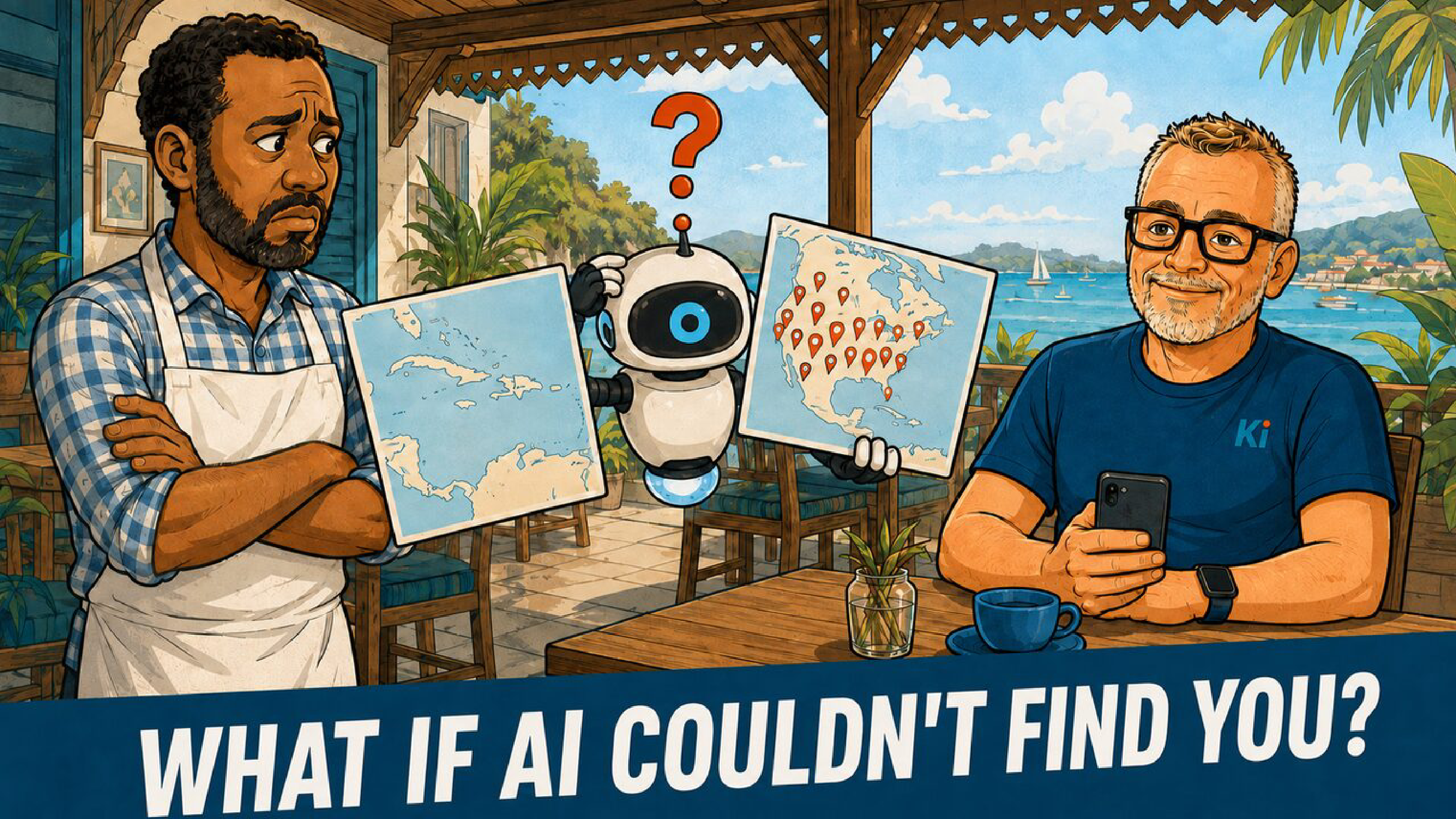
A visitor lands at the airport, opens ChatGPT and asks: which restaurant serves local food with a sea view near here tonight? Since 23 July 2026, OpenAI has given itself the means to answer that kind of question by signing a deal with Yelp: 330 million reviews and more than 8 million business listings. The deal does not concern us directly, because Yelp ignores the Caribbean, and its engine does not even recognise Guadeloupe as a place. But the United States is the laboratory for what reaches us next, as AI Overviews already demonstrated. What this deal really signals is that local search is becoming commercial ground inside AI. In this article I set out what it will change for you, and what it does not change yet.
What does the OpenAI-Yelp deal actually change?
What is Yelp?
Yelp has been the American benchmark for online reviews since 2004: a community directory where customers rate, comment on and photograph restaurants, shops and tradespeople. Across the Atlantic it plays the role that Google reviews and TripAdvisor play here.
What the deal contains
Axios revealed on 23 July 2026 a deal giving OpenAI access to Yelp’s reviews, ratings, photos and business information, in real time. When ChatGPT uses that content, Yelp branding and backlinks appear, but OpenAI controls the presentation, as Yelp chief executive Jeremy Stoppelman confirmed. The deal is not exclusive: Yelp can sign with other AI players.
The “Request a Quote” button inside ChatGPT?
The next step has already been announced: Yelp’s “Request a Quote” feature is coming to ChatGPT. Asking for a quote, booking an appointment, contacting a provider, all inside the conversation.
That is the real shift. Answering “which quiet café with Wi-Fi is open near me?” or “which plumber can come out this weekend?” requires data no model invents: opening hours, location, prices, services, recent photos, customer reviews, availability. With Yelp, OpenAI is buying twenty-two years of that raw material. And the use case moves from answering to making the introduction.
Yelp and Google: a familiar story
Yelp had already opened its content to Google. The relationship curdled into years of conflict, and Yelp is now suing Google over its local search practices. Stoppelman is openly willing to replay the same hand with OpenAI: “Ultimately, we believe that if we allow our content outside the walls of just Yelp, and we provide it in useful ways to consumers, value does accrue back to Yelp.” Everyone can see where the audience is moving.
Why is the Caribbean a different picture?
Tip
Yelp stopped investing outside North America back in 2016, and its engine does not even recognise Guadeloupe as a place. Here, AI will compose its answers from whatever exists: your website, the directories, and everything your Google profile feeds upstream.
Reviews that are overwhelmingly North American
The 330 million reviews in this deal are overwhelmingly North American. In late 2016, Yelp accepted that its international expansion had failed: its 31 countries outside the United States accounted for only 2.2% of revenue, and the company halted all sales and community work outside the United States and Canada. The French subsidiary, Yelp France, was wound up in March 2017. The websites stay online, with no investment behind them.
Ask Yelp for “Guadeloupe” and it answers Quebec
Results like this can be measured, so I measured them. On 12 August 2026 I queried Yelp from a Caribbean connection.
| Location submitted to Yelp | Engine response |
|---|---|
| Le Moule, Guadeloupe | Location not recognised |
| Pointe-à-Pitre, Guadeloupe | Location not recognised |
| Guadeloupe (whole territory) | Location not recognised |
| Fort-de-France, Martinique | Location not recognised |
| Paris, France (control) | 10 restaurants, up to 1,500 reviews |
| La Guadeloupe, Quebec (control) | 10 restaurants |
Yelp does not answer “no results” for Guadeloupe: it answers that it does not understand the place. So there is no handful of forgotten listings waiting to be tidied up, the territory simply does not exist in its database. Paris works perfectly, so the tool itself is not at fault. And if you insist on “Guadeloupe”, Yelp offers you a village in Quebec.
One caveat: I tested the public yelp.com database, not the dataset licensed to OpenAI. It would be surprising for the second to cover a territory absent from the first, but I have not verified it.
I ran these readings on the islands I can test from, and they are the ones I publish. I have no equivalent measurement for Saint Lucia, Antigua or Dominica, and I will not invent one. What the readings do establish is structural rather than local: Yelp withdrew from everything that was not North America, and the Caribbean sits squarely inside everything. A business owner in Castries or Saint John’s can check it in two minutes, using the same method.
A vacuum other sources will fill
Is that cause for concern? Only partly, and I come back to it below. What this vacuum means is that ChatGPT, Perplexity or the AI Overviews now rolled out in France will lean here on the other sources within reach: the business’s own website, its structured data, the directories that list it, the consistency of its information from one source to the next. A business invisible in those sources will be invisible inside AI, and no local Yelp is coming to fish it back out.
Note
Our July 2026 readings on 189 web and digital communication agency sites in Guadeloupe, Martinique, French Guiana and Réunion already show the phenomenon: when an AI overview fires, the company’s official website is the number-one source only 55% of the time. Third-party content answers in its place. Our full findings.
Which trades will see the wave first?
When AI-driven local search takes hold here, it will start with restaurants and hotels, for a simple reason: their customers are the first to ask conversational questions. A visitor who does not know the island does not type “restaurant Gros Islet”. They ask “which restaurant works for a group of ten this Saturday near the marina?”. Exactly the kind of question Google handled badly and AI promises to handle well.
Add fast decisions (a restaurant is chosen in minutes, a hotel in an evening), tourist seasonality, and booking bridges already being built elsewhere. Hospitality will be the full-scale laboratory for this shift. The mechanism itself applies to every trade: whoever watches the wave hit the restaurants gets a head start on their own.
What this deal signals for what comes next
Tip
This deal does not cover the Caribbean, but it tests the commercial value of local search inside an AI. That shift is what concerns us, not Yelp.
So why devote an article to a deal that does not concern us? Because the United States serves as the laboratory. AI Overviews ran there for more than a year before reaching France in July 2026. What is being tested there today describes our horizon reasonably well.
And what this deal tests is the commercial value of local search inside an AI. Yelp sells access to its data, OpenAI buys the means to answer, and “Request a Quote” will turn the answer into an introduction. Put that next to what Time is doing with ads reserved for bots and the trend takes shape: large language models have become a marketing target in their own right, for brands as much as for agencies. Some are buying their place there, others are hiding advertising inside it.
Since then we also know where ChatGPT goes looking for its answers: into its own index, Labrador, rather than into Google. For local questions, that index feeds on map and review data, which confirms this article’s diagnosis. I set out the mechanics in Labrador, ChatGPT’s index.
My position has not changed since my article on Time’s cloaking: in the short term, we do not chase these schemes, they are out of reach here and often out of bounds. We work on the two foundations that do produce measurable results right now. And we keep a close eye on what is being tested elsewhere, because the Caribbean version of this story is coming. It just will not be called Yelp.
What are the two foundations you control?
Tip
A complete, active Google profile and a website AI can read: these are the two levers you control fully, and they govern everything AI will read about you.
Foundation one: a complete, living Google profile
Let me be precise, because the confusion is common: ChatGPT is not going to read your listing inside Google Maps. It has no access to it. Maps data is proprietary, and Google, a direct competitor of OpenAI in search, has no reason to open it up. For its local answers, OpenAI says it relies on “third-party providers”, including Bing, and on the accessible web.
So why does your profile matter so much? Because it is the starting point for everything else. A well-kept profile fixes the official version of your information, the version copied by directories, booking platforms, local media and the sites that mention you. That ecosystem is what AI reads. A wrong address on your profile spreads everywhere, and a model cross-checking three contradictory sources will prefer to cite a competitor whose information agrees with itself.
There is an immediate benefit on top, and this one is perfectly measurable: on Maps, listings that clear three measurable thresholds climb into the local Top 3, which captures 60 to 70% of clicks. Reviews handled, photos dated, categories right, attributes filled in, opening hours exact. One piece of work, two benefits: visibility on Maps today, and the consistency that makes you citable by AI tomorrow. That is the whole point of our Google Business Profile optimisation.
| What the AI is looking for | Where it reads it | What feeds it upstream |
|---|---|---|
| Opening hours, address, phone | Directories, platforms, your website | Your Google profile, the reference source |
| Reviews and reputation | Third-party platforms, local media | Your Google reviews and your replies |
| Description, prices, FAQ | Your website | You, directly |
| Structured data (Restaurant, LocalBusiness, Hotel) | Your website | You, directly |
| Consistency of your information | All sources, cross-checked | Your discipline, everywhere |
Foundation two: a website AI crawlers can read
The second foundation is the website. A Google profile, as I often say, is a quarter of your online presence. Tomorrow it is also a share of what AI knows about you. The rest plays out on a site their crawlers can read: clean JSON-LD structured data, factual content that answers the questions customers really ask, an llms.txt file. That is the groundwork described in our SEO and GEO support, with no attempt to game anything.
GEO does not replace SEO, it sits on top of it
Two movements answer each other. Google is countering the exodus of its users towards ChatGPT by installing AI Overviews in place of its traditional engine. ChatGPT, for its part, has been preparing its users for advertising and a transactional web for a while now. Add what Time observes on its own site, where bot traffic now exceeds human traffic most days, and the conclusion writes itself: a GEO strategy does not replace SEO, it sits on top of it. The technical fundamentals do not change, but the purpose does. It is no longer only about ranking, it is about being understood, then cited.
Either way, I am staying watchful on two fronts: the possible arrival of a Yelp equivalent covering our region, and above all the commercialisation of language models, meaning their gradual turn into advertising space. That shift will bring constraints, but also opportunities for Caribbean businesses and organisations. I will share that watch here on the Kimoun blog.
And here is the paradox that should interest us. The AI layer of the local web starts from zero, including for the big players. No established position on Google transfers into it automatically, no advertising budget guarantees a citation there. What counts is the quality and consistency of the information a business publishes about itself, and that does not depend on its size. I have been watching this rebalancing for a long time on engines like DuckDuckGo or Brave, where modest but well-structured players climb above competitors who dominate Google results. That is exactly why we include them in our analysis and monitoring, not just Google and Bing. In the Caribbean, that layer is close to untouched: no Yelp holding the ground, and few businesses with their foundations ready. It is a window, and windows close.
Sources
- Axios — Exclusive: Yelp deal pushes local reviews into ChatGPT
- Search Engine Land — ChatGPT gains access to Yelp reviews, ratings, and photos
- TechWyse — Yelp Licenses Reviews to OpenAI for ChatGPT (330M reviews, 8M listings)
- Diginomica — Yelp retreats to the US and Canada as international expansion fails (2016)
- Societe.com — Yelp France SARL, dissolution 2017 (in French)
- Kimoun readings, 12 August 2026: visibility of Yelp pages in Google, then direct queries to Yelp’s engine on 5 Caribbean locations and 2 controls (Paris, La Guadeloupe QC), from a Caribbean connection. Reproducible method, details on request