



A Craft Business Website in Guadeloupe: The Full Case Study

🇫🇷 Lire en français : Site web d'artisan en Guadeloupe : l'étude de cas complète
You can judge the quality of a website without knowing anything about the subject, using three free public tools: PageSpeed Insights, HTTP Observatory and SSL Labs. They measure speed, security and encryption, and they work on any address, including yours, in a few minutes. This article puts them to work on a real case: the website of Nicole, a seamstress in Saint-François, Guadeloupe, who takes up a hem, reupholsters an armchair, recovers a boat seat, sells patterns and teaches sewing. The verdict on 14 August 2026: 100 out of 100 on all four mobile indicators, and two A+ security grades. Here is how those results are obtained, and what they produced for her workshop.
Nicole trained in fashion design and pattern making, then drew costumes and sets for the stage before opening her own workshop. I rarely publish case studies: most of them mainly explain how good the provider is, which teaches nobody anything. I took the problem the other way round. What follows describes the decisions made on a real project, with the measurements that back them up and the limits of those measurements. This article gives you the tools to judge your own website, on your own and without ever needing to contact me. That is one of its purposes.
I had already had a website built for another activity, so I knew roughly how it goes. What I did not know was what to say about my trade, or how to present it. At the start, I would have been unable to define the result I was looking for. It was the interviews and the intermediate documents Kimoun handed over along the way that let me genuinely take part in the design, and reach something I could not have put into words on my own at the beginning. Today I like the site, my friends and contacts like it, and above all it has brought me two new clients. I edit my own text and my own prices, from my phone, and I have nothing technical to keep an eye on.
Nicole, De Fil en Épingles, Saint-François, Guadeloupe. Text written by Kimoun from her feedback, reviewed and approved by her.
A trade with four doors, not one more brochure site
The workshop covers four service lines that do not speak to the same people:
- clothing alterations, the most common and most urgent request;
- furniture upholstery, armchairs and seating, with specific work on motorcycle and boat seats;
- sewing patterns, to download, to supply or to adapt;
- private sewing lessons, all levels.
The last two lines are not sidelines. Nicole is driven by sharing and passing on her craft, and you hear it the moment she talks about her work. A website that had presented the lessons as a secondary option would have betrayed the workshop.
Motorcycle and boat upholstery deserves a mention of its own: a rare skill, barely represented online in the region, and yet actively searched for. A boat owner whose bench seat has spent three seasons in the sun is not looking for “a seamstress”. He is looking for someone who redoes upholstery. That is exactly what the page on armchair restoration and furniture upholstery says, boat and motorcycle seats included.
The opening line of the De Fil en Épingles workshop website, in Saint-François sums it up better than I could: “The thread that extends the life of your fabrics, in Saint-François.”
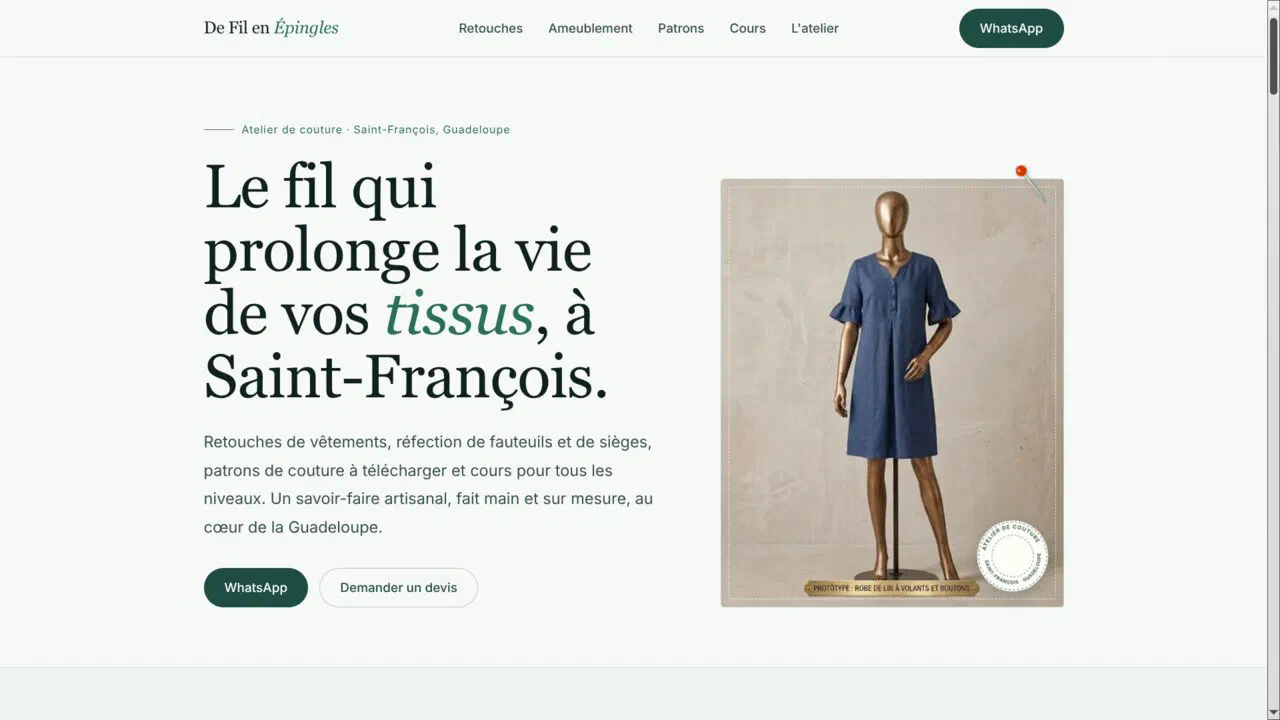
The home page states the trade, the town and how to get in touch, without the visitor having to look for any of it. Both buttons are visible before any scrolling.
Why Astro, and why this is not a developer argument
Tip
A technology choice is never justified by what it is, but by what it removes from the client’s daily life: here, no security updates to follow and no database to protect.
What is a static website, and what does it change for its owner?
The site is built with Astro, as static pages. Each page is prepared in advance, then delivered as it is to the visitor. No database is queried on each visit. That sentence sounds technical; its consequences are not technical at all:
- Nothing to update every week. No plugin to watch, no version that breaks the layout on a Sunday evening.
- Nothing to hack through the usual door. With no database and no public login page, an entire family of attacks has no target left.
- A site that appears quickly on mobile data, including from a car park in Saint-François with two bars of signal.
Can you edit the site yourself, from your phone?
Whenever I present a so-called “static” site, I get the same perfectly reasonable question: “fine, but then how do I change a price? Do I have to call you every time?” That is objection number one against static sites, and it matters: it reveals the fear of being tied hand and foot to your provider.
Yes. Nicole edits her site herself, without going through me. She has an administration interface where she finds her pages, her text, her prices and her photos, laid out as a simple form. She changes what she wants, she saves, and the site rebuilds itself with the new version. She has nothing to install and nothing to monitor.
The detail that really counts: it works from her phone. Correcting a price between two appointments, adding a photograph of an armchair just finished, fixing a typo spotted in the evening, all of it happens one-handed, with no computer and without calling anybody back.
The tool behind it is called Sveltia CMS, in a version we extended for this kind of project. Static does not mean frozen: the page is prepared in advance to be fast and safe, not to be locked. Those are two different things, often confused for one another.
Astro or WordPress for a craft business website?
Astro is my default choice today for a new site. I still work with SPIP, WordPress and Hugo. On WordPress, my work is now mostly optimisation and managed maintenance of existing sites, and there are plenty of them. Unless a client specifically asks for it, it is not my first choice for something new, and it never really was.
This is not about saying a tool is bad. WordPress runs an enormous share of the web, and runs it very well when the need matches: frequent publishing, multiple contributors, a mature plugin ecosystem. A workshop that updates its prices twice a year is not that case. Installing a publishing machine there means forcing maintenance on someone who never asked for it.
From four trades to eight pages: the part that is not technical
The site has eight pages: the home page, one page per service line, contact and the two legal pages. That structure follows a rule I apply everywhere: one search intent, one page.
Someone looking to have trousers altered and someone looking for a sewing lesson do not type the same words and do not need the same photographs. Putting them on a single page forces each of them to sort through it, and stops a search engine from knowing what that page is really about. Four services, four pages, each with its own title, its own images and its own path to getting in touch.
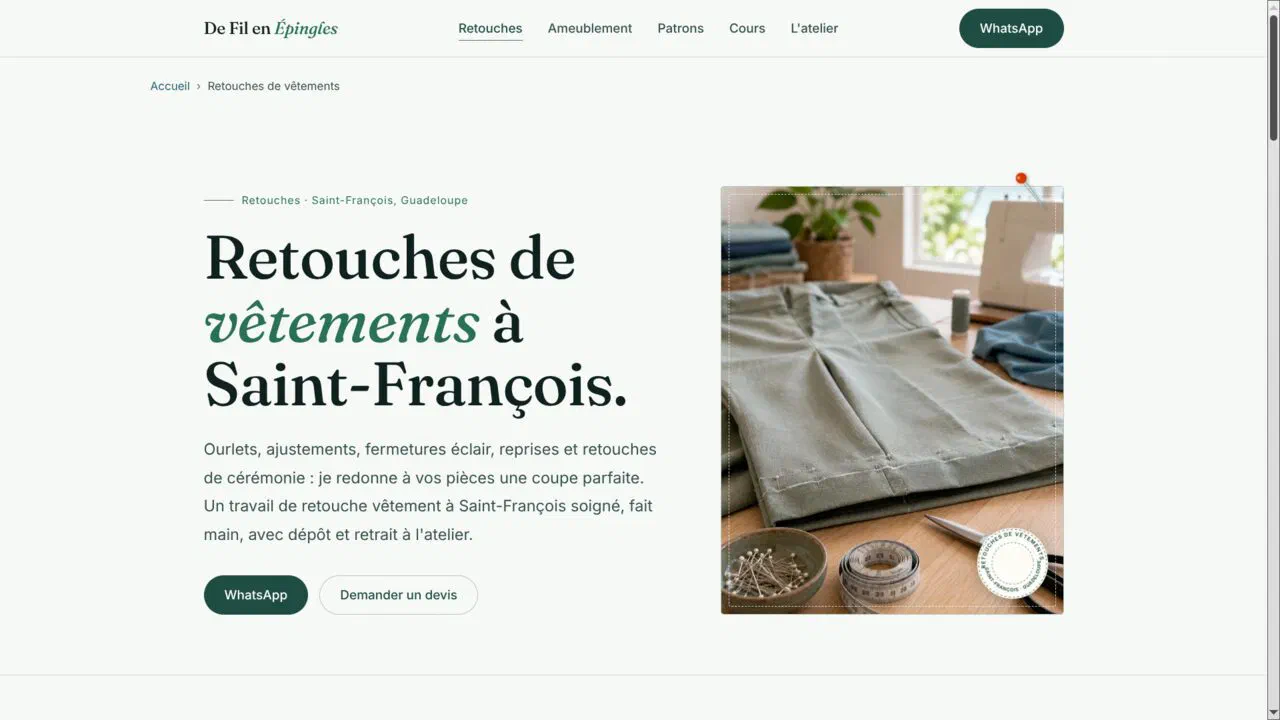
One page per service line, with its own title, its own description and its own contact buttons. Each search intent finds a page that answers it.
How to declare your service area to search engines and AI
Then comes the local dimension. The workshop is in Saint-François and serves the surrounding area. That information is not only written in the text: it is declared in the site’s structured data, the invisible markup that describes a business to search engines and AI systems. The home page declares the business, its postal address, its opening hours, the person who practises the trade, three towns served and a six-entry FAQ. That is the work I describe in my guide to JSON-LD structured data, applied here to a real case.
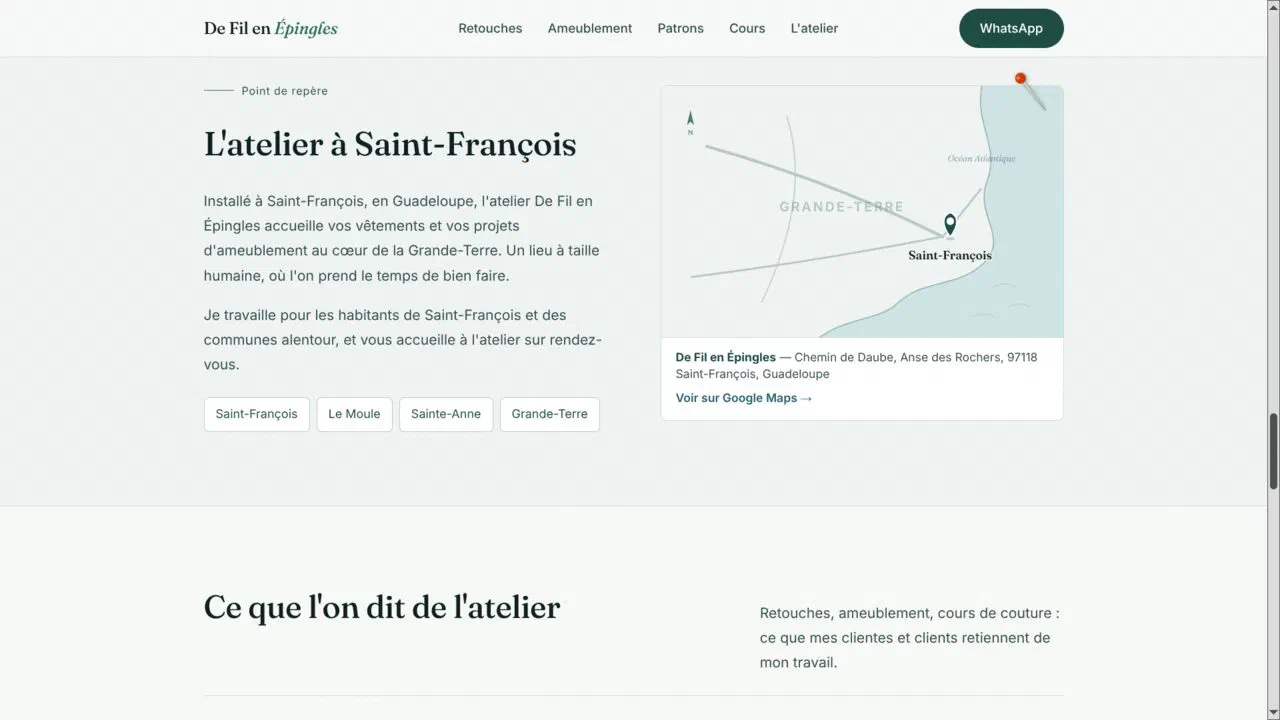
The service area is named in plain words and repeated in the structured data. A search engine, like a customer, knows where the workshop is and how far it travels.
Note
What this changes in practice. A search engine that reads this data correctly knows the workshop is a physical business, open at given hours, located in a given town. A conversational assistant asked where to have a boat seat recovered in the area has a structured answer to quote, rather than a block of text to interpret. It is the continuation of what I explained about making a website citable by an AI.
Why convert every photograph to WebP
The site’s 70 photographs are converted to WebP, a format lighter than JPEG at comparable quality. On a craft business website, the photographs are the content: they are what proves the skill, and they are what weighs the most on a page. Compressing them properly means you can show plenty of them without punishing the visitor.
The measurements, with their dates and their real value
Every measurement below was taken on defilenepingles.net and dates from 14 August 2026. I date them because they will move: tools change their criteria, a site evolves, a server gets reconfigured. The links are at the end of the article so you can run them yourself.
Which free tools let you judge a website?
Before the results, here are the instruments. These four tools are public, free, and need nothing but a website address to work. You can run yours through them in a few minutes, today, with nothing to install.
| Tool | What it measures | What a good result means |
|---|---|---|
| PageSpeed Insights (Google) | Loading speed, accessibility, best practices and search engine basics, on mobile and desktop | The tool shows scores from 90 to 100 in green, 50 to 89 in orange, below that in red. Aim for green on mobile |
| HTTP Observatory (Mozilla) | The security headers your server sends, and the presence of cookies | An A or A+ grade signals a server correctly configured against the most common attacks |
| SSL Server Test (Qualys SSL Labs) | The quality of the encryption between visitor and site: certificate, protocols, robustness | An A or A+ grade means the connection is encrypted to the current state of the art |
| Observatoire Kimoun (ours) | Takes the criteria above and adds DNS configuration, technical debt and readability by AI systems | A high index places a site relative to the other sites measured. We publish this tool: on this particular case, we are therefore measuring our own work |
Tip
Start with PageSpeed Insights on the mobile profile. It is the fastest tool to read, and the one that best reflects what a customer arriving from a phone actually experiences.
A word on the last row of that table: the first three tools are run by Google, Mozilla and Qualys, and the fourth by Kimoun. I include it because it measures three things the others ignore, not to add a medal.
What the measurements say about this site
PageSpeed Insights, mobile profile (choose mobile, which is genuinely demanding, not desktop): 100 out of 100 for performance, accessibility, best practices and search engine basics. On top of that comes an “agentic navigation 3/3” note, a recent criterion assessing how readable the site is to conversational agents.
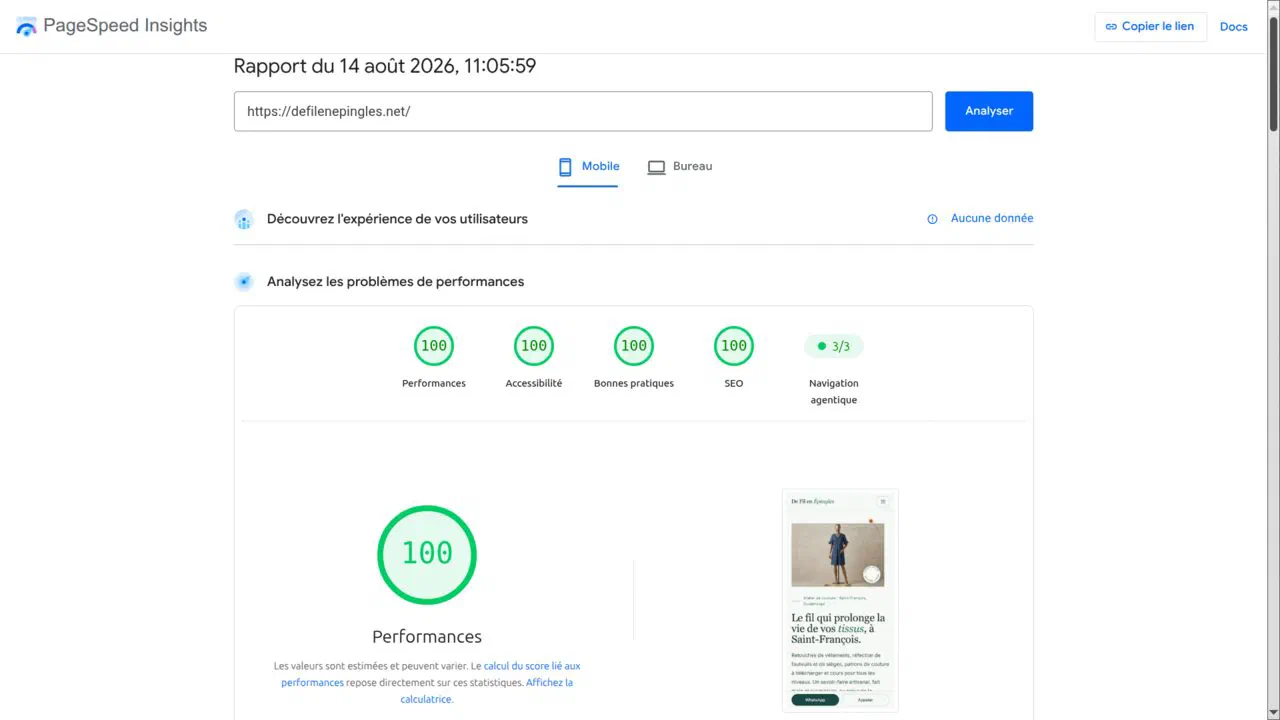
The report of 14 August 2026, on the mobile profile. All four indicators are at maximum, which remains rare on a production website.
Mozilla HTTP Observatory: grade A+, a score of 120 out of 100, 10 tests passed out of 10, no cookie detected. That last point counts: a site with no cookie has no consent banner to display.
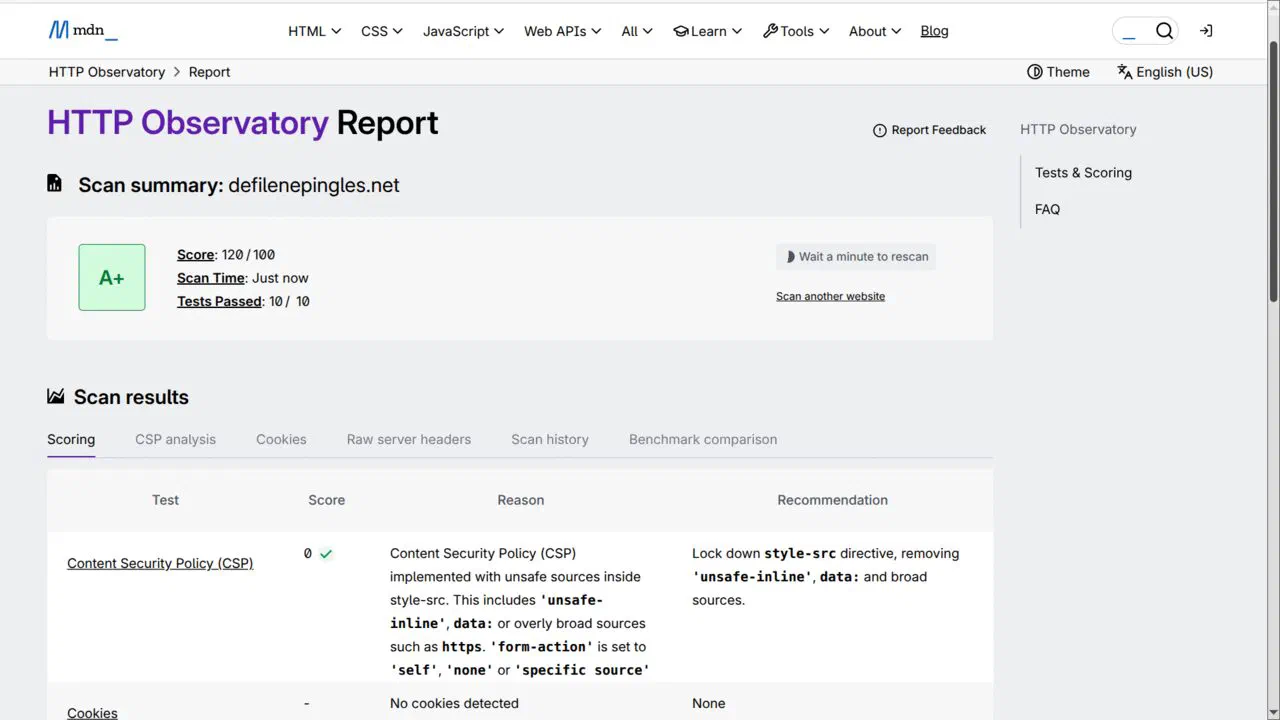
Mozilla HTTP Observatory analyses security headers. The score goes past 100 thanks to bonus points awarded to the strictest configurations.
Qualys SSL Labs: grade A+. The server supports TLS 1.3, a key exchange resistant to quantum computing, a long-duration HSTS policy, a CAA policy at domain name level and a 4096-bit RSA certificate. That line will not interest Nicole, and rightly so. It means the connection between her customers and her site is encrypted to the 2026 state of the art.
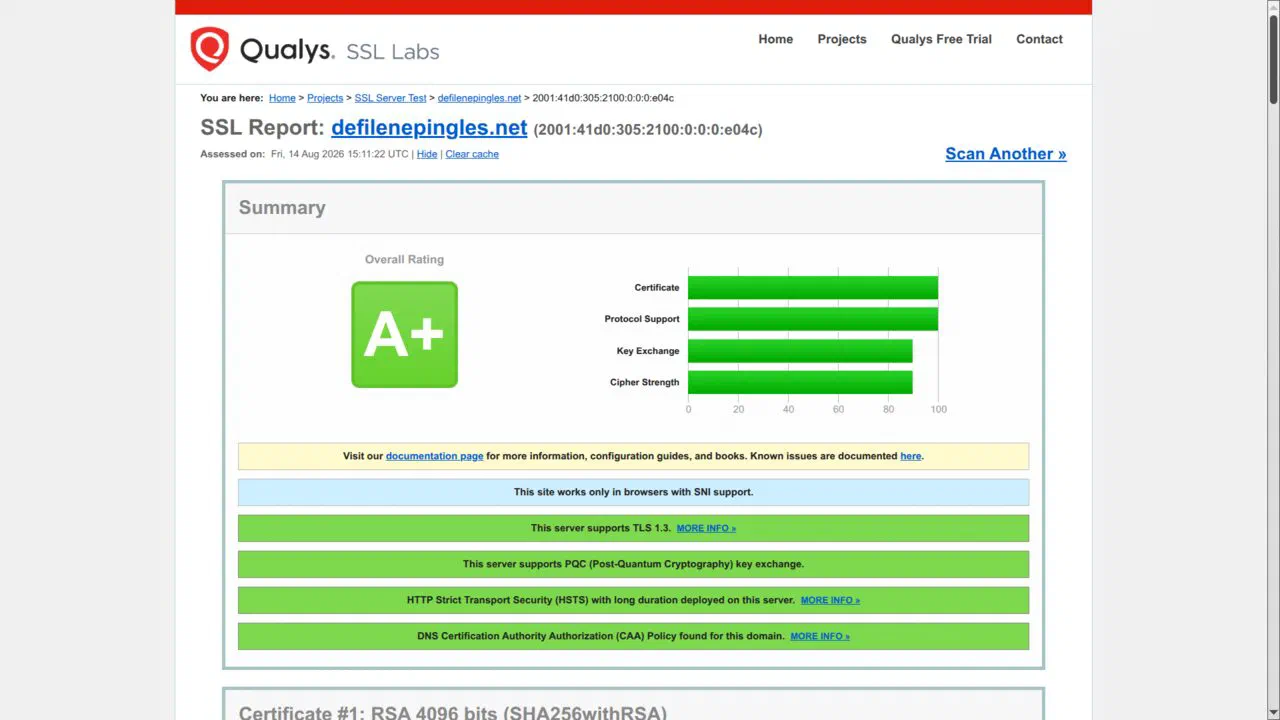
SSL Labs is the reference for TLS configuration. The report also notes support for post-quantum cryptography, still uncommon today.
2,463 bytes of JavaScript for eight pages
The figure I keep is elsewhere. The whole site, across its eight pages, loads 2,463 bytes of JavaScript, split across two small files: a menu and a photo viewer. According to the Web Almanac 2025 from HTTP Archive, the median home page loads 632 KB on mobile. The ratio is roughly one to 250. This is not an engineering feat, it is a consequence: when you only include what serves a purpose, not much is left.
Warning
A perfect score does not bring customers in: it removes obstacles. An instant website that describes its trade badly converts nobody. Technical quality multiplies the content, it never replaces it.
Why I do not put my own tool on the same footing as the others
That leaves the Observatoire Kimoun, and I have to be straight about its status. It is my own tool: I am judge and party. It takes the criteria of the public tools cited above and adds, alongside AI readability, two dimensions nobody else measures: DNS configuration and technical debt. The site gets an A+ with an index of 104.6, and ranks first on the six dimensions measured, except for HTTP security where it comes second out of 639 sites. Take that ranking for what it is: an internal comparison, on a sample I put together myself. The PageSpeed, SSL Labs and Mozilla grades can be verified by anyone in three minutes. Those are the ones I rely on in this article.
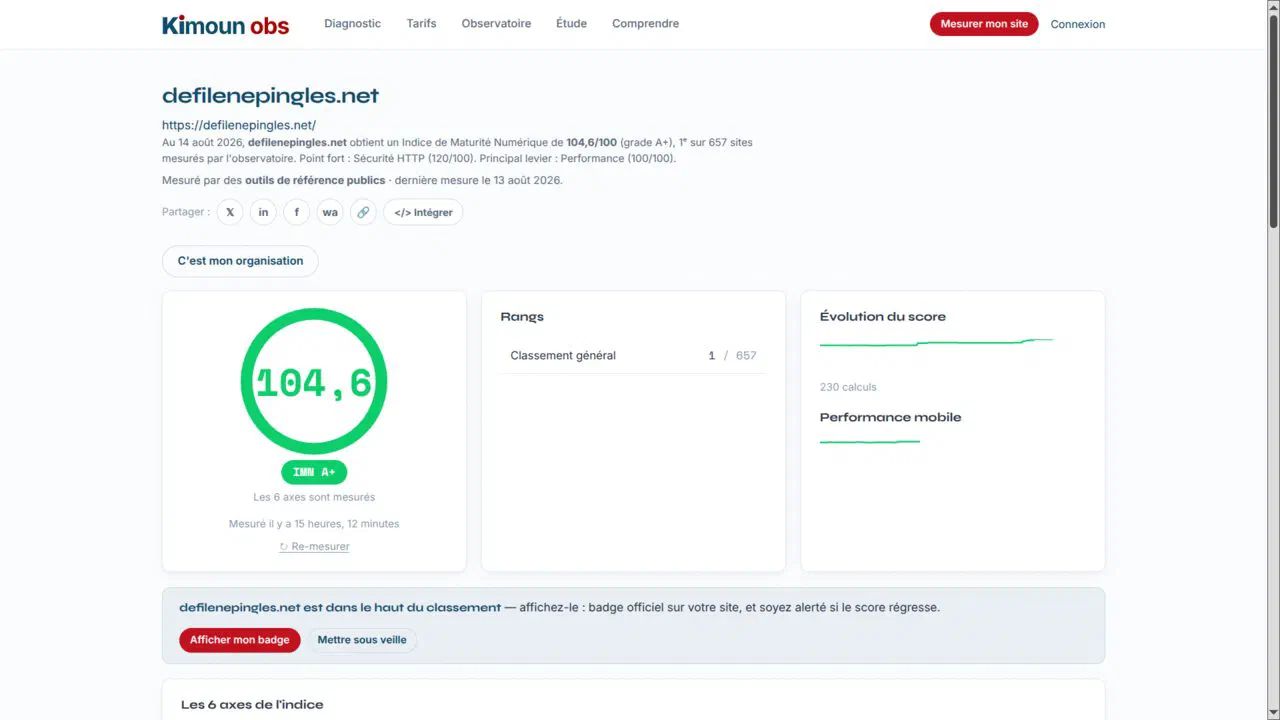
The index adds AI readability, DNS configuration and technical debt to the public criteria. Read it while keeping in mind that the tool is mine.
The result that counts: two clients
In the first few days after the site went live, it brought in two enquiries that became clients.
I stop there deliberately. No projection, no “this is only the beginning”. Two clients within days for a local craft business is a measured fact, and it stands on its own. A technical score impresses a developer; two clients walking through the workshop door speak to a craftsperson.
What you can take from this for your own website
Three things that transfer, whatever your line of work and wherever you are.
Count your search intents, not your pages. List the different questions your customers ask before buying. Every question that deserves its own answer deserves its own page. A craftsperson with four distinct trades needs four pages, not one “our services” page that stacks them up.
Ask what you will have to maintain. Before approving a proposal, ask this precise question: what will I have to monitor, update or renew, and how often? The answer tells you more about the next five years than any mockup.
Measure before you believe. The three public tools in the table above are free. Run your current site through them, today. If the grades are bad, you will know what to ask for. If they are good, you will have avoided an unnecessary rebuild.
Where to start if your website is already a few years old
A craft business website does not need to be complicated. It needs to be accurate about the trade, fast on the network your customers actually use, and readable by the machines that now recommend professionals. Those three requirements do not cost more than their opposite: they simply need to be decided at the start, when they cost almost nothing, rather than afterwards, when everything has to be redone. That is the approach I set out in my comparison between AI alone and working with an agency, alongside real price ranges published without hedging.