



Google Is Cabling the Caribbean: What It Changes, and for Whom
🇫🇷 Lire en français : Google câble la Caraïbe : ce que ça change, et pour qui
On 11 August 2026, Google announced three new subsea cables towards the Caribbean: Alisios, Canoa and OlaLuz, all converging on the Dominican Republic. The first-phase envelope, authorised in June by the Dominican regulator, exceeds 500 million dollars. It is one of the heaviest infrastructure moves the region has ever seen, and it lands squarely in our basin rather than somewhere far away. Here is what is being built, what it changes across the Caribbean, and what it does not change for your business yet.
Three subsea cables, one destination
Tip
Three new cables and one additional branch, all converging on the Dominican Republic, connected to Google Cloud regions in North America, Europe and Chile.
Alisios will link the Dominican Republic, Panama and Chile. Canoa will link it to Bermuda, OlaLuz to Florida. A new branch of the Firmina cable will land there too. The whole set fits into an architecture named Americas Connect, which complements the Curie, Nuvem and Sol cables Google already operates, and connects those routes to the cloud regions of South Carolina, Virginia, Madrid, Los Angeles, Las Vegas and Chile.
In short, the Dominican Republic becomes the Caribbean pivot of Google’s network. Pacific, Caribbean and Atlantic routes all meet there.
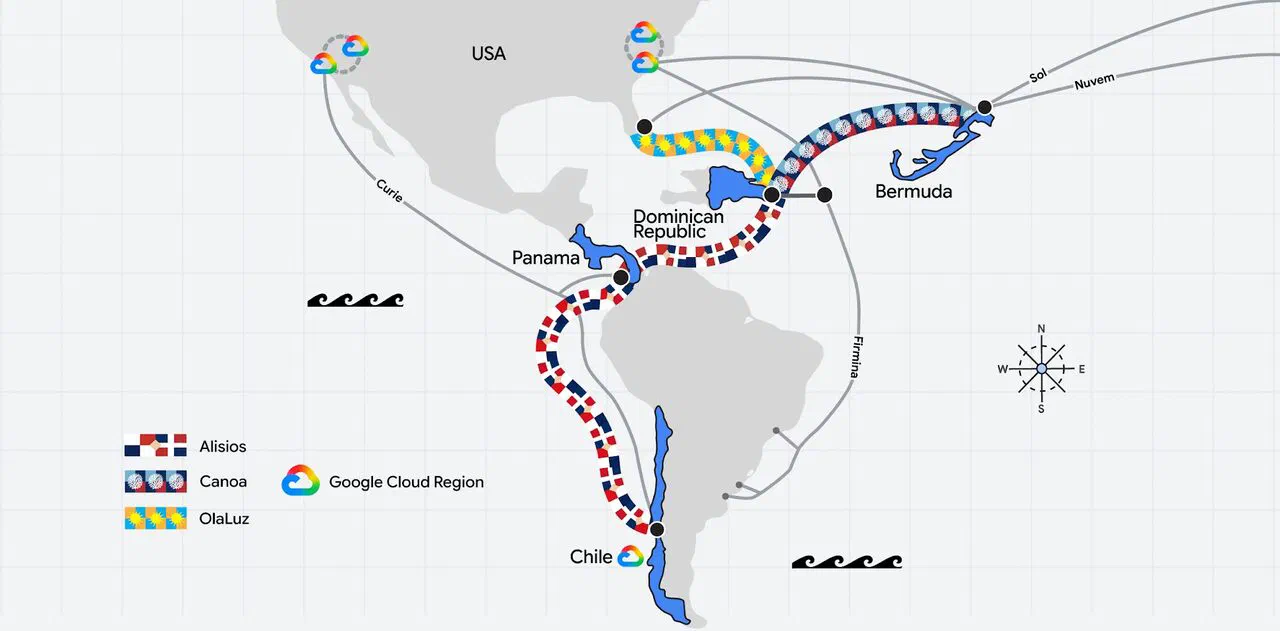
Official map of the Americas Connect programme. © Google Cloud, published on 11 August 2026 on the Google Cloud blog. Reproduced for illustration.
The map says in one image what a paragraph struggles to summarise. Everything converges on a single point, and most of the island chain to its east does not appear at all.
A programme built in stages
This August announcement is the third visible stage of a programme rolled out over six months.
From presidential decree to regulator approval
February 2026. Google announces the construction of a digital exchange port: a building of more than 7,000 m², presented at the National Palace alongside President Luis Abinader and declared of high national priority by decree 113-26. Works run from March 2026 to early 2027. It is Google’s eighth site of this kind worldwide, and the first in Latin America.
June 2026. Indotel, the Dominican telecoms regulator, authorises the cable system on 23 June (resolution DE-083-2026, in favour of the company Swordfish Infrastructure). That document carries the most precise figures: the first-phase investment exceeds 500 million dollars and covers the whole project, port and cables included. The infrastructure is sized for four international cables, two of them in the first phase towards the United States.
Why the regulator’s file says more than the press release
A striking detail that got little coverage: the regulator publishes the precise landing points, at Cabeza de Toro, El Salado section, Verón Punta Cana municipal district, La Altagracia province. Google’s 11 August announcement gives no station location at all. To understand an infrastructure project, the regulatory file is often richer than the press release.
August 2026. The three cables and their routes are revealed. No amount appears, and no public source splits the 500 million between the building and the cables. There is a global first-phase envelope, not an isolated cable budget.
What this changes across the Caribbean
This is the question that matters most for readers in this region, because the hub sits inside our basin rather than on the other side of an ocean.
Transit costs that can fall for neighbouring islands
Until now the Caribbean reached the wider internet through scattered and often ageing routes, generally via Florida or Puerto Rico. The Dominican programme does something else: it concentrates capacity, an exchange point and a ring towards the United States in one place. For neighbours, the promise is tangible: shorter paths, lower latency towards the large online services, and above all potentially cheaper transit. In a region where the price of international bandwidth weighs heavily on operators, that last point matters more than the terabits.
Two cautions belong here. Google publishes neither capacity nor a service date for these systems, which is normal at this stage of a project. And no operator in the region has announced a price cut on the strength of this news. What changes first is the upstream cost structure, not your bill.
How the Dominican Republic became a regional hub
There is also a classic knock-on effect: a hub attracts exchange points, hosting providers, content operators, sometimes data centres. Punta Cana was not a digital crossroads two years ago. The country positioned itself, with a decree, a regulator that moves quickly and open political backing. Google did not pick the Dominican Republic by accident: the Dominican Republic also went looking for Google. For other states in the region, that is a lesson in strategy more than in technology.
I watched that consistency take shape. Back in 2005, I took part in a delegation of Guadeloupe businesses to Santo Domingo, alongside other Caribbean players, Martinique chief among them. Even then, the talk was about turning the country into a regional technology hub, with a Parque Cibernetico opened five years earlier and political backing stated at the highest level. Twenty years on, Google is building its first Latin American digital exchange port there. That is not luck, it is a policy held steady for two decades.
It is a lesson with a short shelf life. A regional hub is not a title you win once. It goes to whoever prepares the file, clears the permits and offers a credible landing site at the moment a builder is choosing.
Who controls the infrastructure, and on what terms
This architecture concentrates a growing share of regional traffic around infrastructure that is chosen, financed and controlled by a private company, whose third-party access terms are not published. Nothing guarantees that an unaffiliated Caribbean operator will benefit from it, or at what price. Capacity that exists and capacity you can actually buy are two different things.
That is worth watching closely, whichever island you operate from. The question to put to your own provider over the next two years is simple: does the new capacity change what you can offer me, and when?
What about the French West Indies?
None of the four announced systems mentions Guadeloupe, Martinique or French Guiana. Google builds its network on its own logic, and these territories are neither a significant cloud market nor a waypoint between Chile and Madrid. It is an instructive edge case: a European territory inside the Caribbean basin, a few hundred kilometres from the new hub, and absent from the map.
What changes now, and what may move later
In the short term, nothing changes for Guadeloupe: the cables carrying your traffic today are the ones that carried it yesterday. In the medium term, however, something may move, because abundant capacity a few hundred kilometres away eventually weighs on regional prices and routes. But that will run through agreements between operators, which are neither decreed nor published.
The local mesh has thickened over the years, from Americas-II to the cable laid from Jarry by the regional authority in 2006, through to Caribbean Connect presented by CANAL+ in October 2025. I watched that evolution from close range: when I was technical director of Mediaserv, a local telecoms operator in Guadeloupe, the territory depended on a single link, and the bandwidth I had for all customers combined was counted in megabits. Today’s connectivity bears no resemblance to it. That is precisely what lets you keep an announcement in proportion: the landscape here has changed before, without Google playing any part in it. I told that story in a dedicated article on how the internet physically reaches these islands.
What the French Guiana outage already demonstrated
The useful reminder is regional. A break in the Americas-II cable has already caused a total internet outage in French Guiana. That cable links Florida to Fortaleza while serving Le Lamentin and Cayenne. One incident, one territory offline. In its May 2025 briefing note, the French regulator Arcep explicitly identifies risks to intercontinental subsea cables among the emerging risks to monitor.
The question to ask yourself on Monday morning
Warning
Two cables drawn separately on a map can share the same landing station, the same power supply and the same terrestrial duct. In that case a single incident cuts both of them.
On a map you see lines heading off in different directions, and the brain concludes: several paths, therefore several chances of staying connected. That holds out at sea. Much less so on arrival.
A cable does not stop at the beach. It enters a landing station, and its fibres head inland. Those elements are shared far more often than people imagine: they are expensive and viable sites are rare. Two apparently independent cables can end up in the same room, on the same transformer, and leave through the same trench. An announced topology is not a proven resilience. Resilience is not read off a diagram, it is observed under real failure, when a link drops and you watch whether traffic switches over, how fast, and with what degradation.
Note
A recurring observation in audits. Only last week, auditing a food retailer in Guadeloupe, neither the owner nor their IT contact knew where their point of sale and their email were hosted. This is not an isolated case: when we ask the question, the most frequent answer is neither “in Europe” nor “in the United States”, it is “I don’t know, my provider handles that”. Across the audits we run, the mapping almost always reveals at least one vital tool, often email or the till, whose failure would halt trading within hours with no degraded mode prepared.
You do not need to know which cable carries your packets: that information is rarely public. Three simpler questions will do.
Where are your tools hosted?
Website, email, point of sale, invoicing, backups: each one is hosted somewhere. Make the list, write the hosting next to it, and the surprises show up on their own.
What still works with no international link?
A card terminal that can no longer reach its server, a till that will not load, a quote you cannot send. Put every tool through the forty-eight-hour offline test.
What has to keep running whatever happens?
That is the only category worth investing in. Taking payment, reaching your customers, opening the day’s documents: three vital functions are usually enough.
That is the approach behind our digital resilience audit: map the dependencies, identify the breaking points, hand over a prioritised plan. Not to become self-sufficient, which would be a lie, but so that somebody else’s outage does not become your crisis. On measuring that dependency, I proposed a scoring method in an article on digital sovereignty.
Google is cabling the Caribbean, and that is potentially good news for the region, but it is not good news for your business yet. The only infrastructure you have your hands on is your own.
Sources
- Google Cloud Blog — Introducing Americas Connect (11 August 2026)
- Acento — Indotel autoriza sistema de cables submarinos de Google en RD, resolución DE-083-2026 (June 2026, in Spanish)
- Diario Libre — Indotel autoriza sistema de cables submarinos de Google en RD (in Spanish)
- Presidencia de la República Dominicana — Google construirá un puerto internacional de intercambio digital en RD (February 2026, in Spanish)
- Arcep — Resilience of electronic communications networks, “Networks of the future” briefing note (May 2025, PDF, in French)
- Data Center Dynamics — Google announces three new cable projects in the Americas
- France-Guyane — Americas-II cable break, internet slowed in French Guiana (in French)