



Google AI Overview overseas: first findings on 189 sites
🇫🇷 Lire en français : AI Overview outre-mer : nos premiers relevés sur 189 sites
On 24 July 2026, two days after Google switched on its AI answers in France, we queried Google’s AI overview about 189 web and digital communication agency sites across France’s overseas territories — web professionals, the very people whose job is to make a site visible. The result: in 92% of cases, Google no longer returns a list of links, it writes an answer. And nearly one time in two, it isn’t the official site that serves as the main source for that answer — it’s a third party. If even the experts get bypassed, imagine what happens for an ordinary business. Here’s what this first reading shows, what it doesn’t show yet, and the one technical lever that genuinely stands out.
In my article last week on AI Overviews, I promised we wouldn’t just comment on the American figures — we’d measure here at home. Done. Here are the first findings from the Kimoun Observatory.
How we measured (and why it’s a reading, not an audit)
Note
The setup. On 24 July 2026, from a residential connection located overseas, we asked Google a standardised question about each site in the panel — of the form who is the company {name} in {territory} — and recorded the AI overview: sources cited, position of the official site, content of the answer. Panel: 189 web and digital communication agency sites in Guadeloupe, French Guiana, Martinique and Réunion, matched by territory. In other words, web professionals observed on their own visibility.
A word on vocabulary, because it matters. The Observatory measures and surveys: a snapshot, on a given date, under comparable conditions. This is not an audit — the audit is the expert work that comes afterwards, for a specific business, and it says why and what to do. Here, we’re placing the thermometer. And it’s a first pass: the protocol calls for several readings spread over time per site, then an extension beyond the overseas territories. You’re reading a starting snapshot. I own the limit — it takes nothing away from what the figures already say.
Finding 1 — the AI overview is already everywhere
The first figure is the clearest. Across the 189 queries, 173 triggered an AI overview — that’s 92%. Two days after the French launch, the tool already shows up almost systematically on this kind of information query.
In plain terms: when a client, a partner or a journalist types your company’s name to understand what you do, there’s better than a nine-in-ten chance they’ll first read a paragraph written by Google. Your company’s first impression is no longer made on your home page — it’s made in a box you don’t write.
Finding 2 — one site in two gets the spotlight stolen
Tip
The official site is the AI overview’s main source only 55% of the time. Nearly one in two, it’s a third party — directory, press, social network, data.gouv — that tells the company’s story in its place.
Here’s the figure that should make any business owner raise an eyebrow. When Google writes its answer, it draws on several sources and puts one forward. That number-one source is the agency’s official site in only 55% of cases (104 sites out of 189). Put differently, nearly one web professional in two doesn’t tell their own story in the AI overview: it’s a directory, a press brief, a LinkedIn profile or a data.gouv page that becomes their official voice. Sometimes it’s flattering. Often it’s dated, incomplete, or not what you’d have chosen to say about yourself.
And let’s pause a second on what that means. The panel is made up of web and digital communication agencies — people whose literal job is to make a site visible. If nearly one cobbler in two is this badly shod, the question is stark for an ordinary business that has neither the time nor the skills: if the experts get bypassed, who speaks in your place?
So the question is no longer just “am I cited?”, but “who speaks in my place?”. And you can check it in thirty seconds: type who is the company {your name} into Google, and look at the source cards under the overview. If your domain isn’t there first, someone else is holding the mic.
Take a concrete, local example — outside the panel, to illustrate the mechanism on a consumer brand everyone knows. On the query who is the company Damoiseau in Guadeloupe, the AI overview writes a solid, accurate profile: the island’s leading producer of agricultural rum, founded in 1942 in Le Moule, family-run, close to 50% of the local market. The distillery is well handled — and its official site rhum-damoiseau.com appears among the cited sources. It’s a good case. But look closely: the first source put forward isn’t Damoiseau’s site, it’s a third-party tourism site. Even a strong, well-described brand doesn’t always hold the first mic. The good news: when a house has substance — a story, data, a well-fed “about” page — it stays in the conversation. That’s exactly what’s at play.
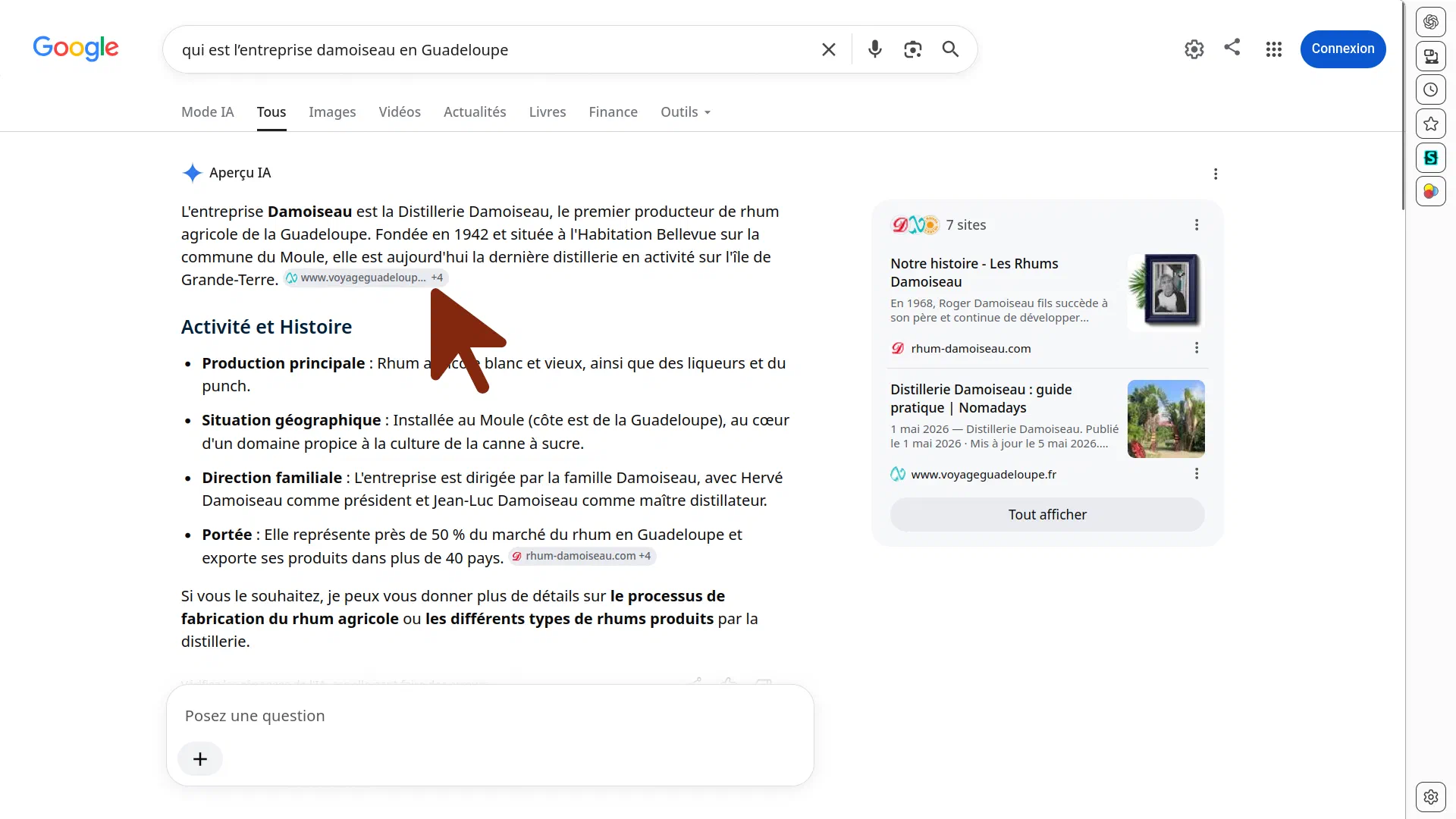
Query who is the company Damoiseau in Guadeloupe: the AI overview writes the answer and cites seven sources. The official site rhum-damoiseau.com is there — but the source put forward remains a third-party site. Even a strong brand shares the mic.
Finding 3 — the surprise: a great site isn’t enough
Tip
A site’s technical quality does not predict its score in the AI overview. What gets a site cited is third-party reputation first — Wikipedia, data.gouv, directories, LinkedIn — far more than clean code.
It’s a half-surprise. You might have bet that a well-built site, fast and machine-readable, would mechanically be better cited. It isn’t the case: in our readings, a site’s quality and its score in the AI overview don’t move together. Very good sites are barely cited, modest sites are cited a lot.
Crossing the two dimensions, the panel splits into four groups. The two that tell the story:
- roughly 48 “blind spot” sites: technically good, but barely cited. They did the work at home and reap none of it in the overview;
- roughly 49 “carried by third parties” sites: their site is nothing exceptional, but the AI cites them readily, because they’re talked about elsewhere.
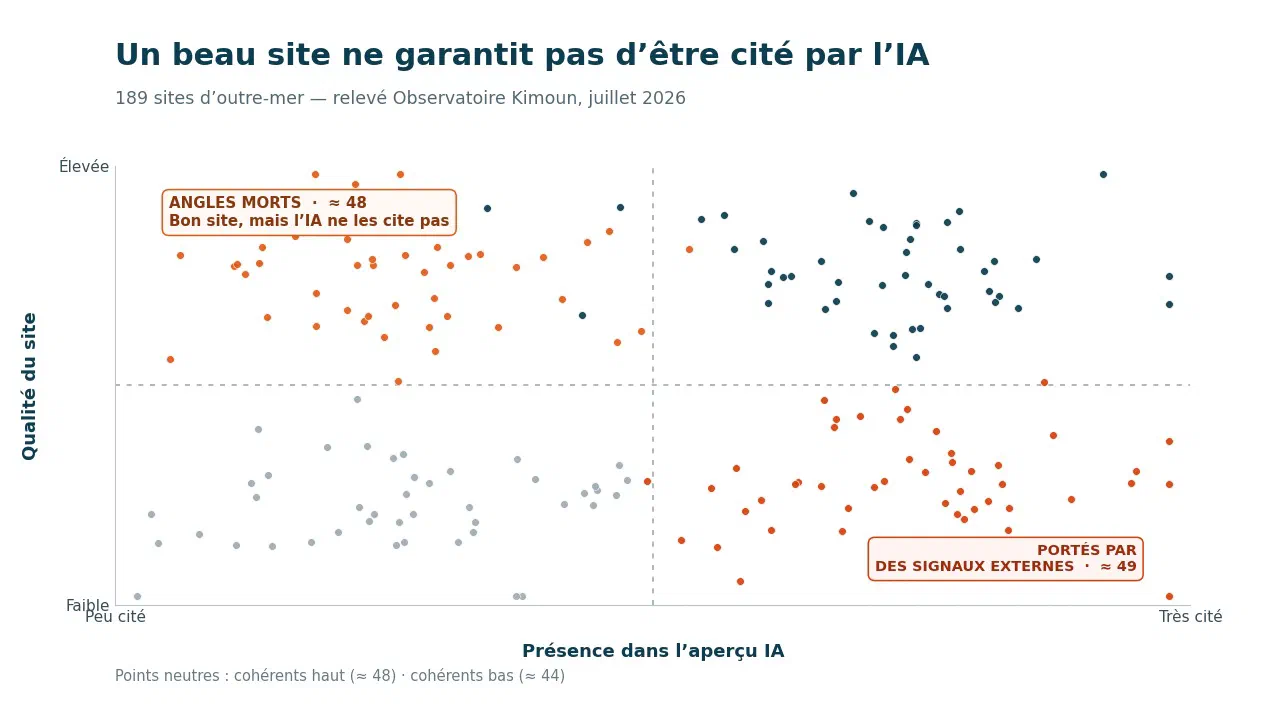
Site quality and presence in the AI overview don't move together: ~48 good sites stay barely cited ("blind spots"), ~49 modest sites are heavily cited because they're talked about elsewhere.
So what makes the difference isn’t the code first: it’s third-party reputation. A Wikipedia mention, a data.gouv record, recognised directories, a LinkedIn presence — that’s what the AI reads as a mark of reliability. It distrusts what you say about yourself; it trusts what others say about you. And I’d rather be clear: our measure of site quality does not predict the AI score. The corollary, though, is very reassuring: this third-party reputation is exactly what classic SEO has always built. Citations on reference sites, backlinks, link building, presence in the directories that matter — far from being obsolete in the AI era, these fundamentals become decisive again. It’s the same logic as Google’s official guide: there is no separate “AI referencing”. GEO is good SEO, applied to an engine that answers instead of listing.
Finding 4 — the one technical lever that stands out: llms.txt
If the site’s general cleanliness doesn’t make the difference, one precise element does stand out. Sites that publish an llms.txt file are noticeably more often their own number-one source: about 67%, versus roughly 50% without. This little file roughly doubles the odds of holding the mic in the overview that concerns you.
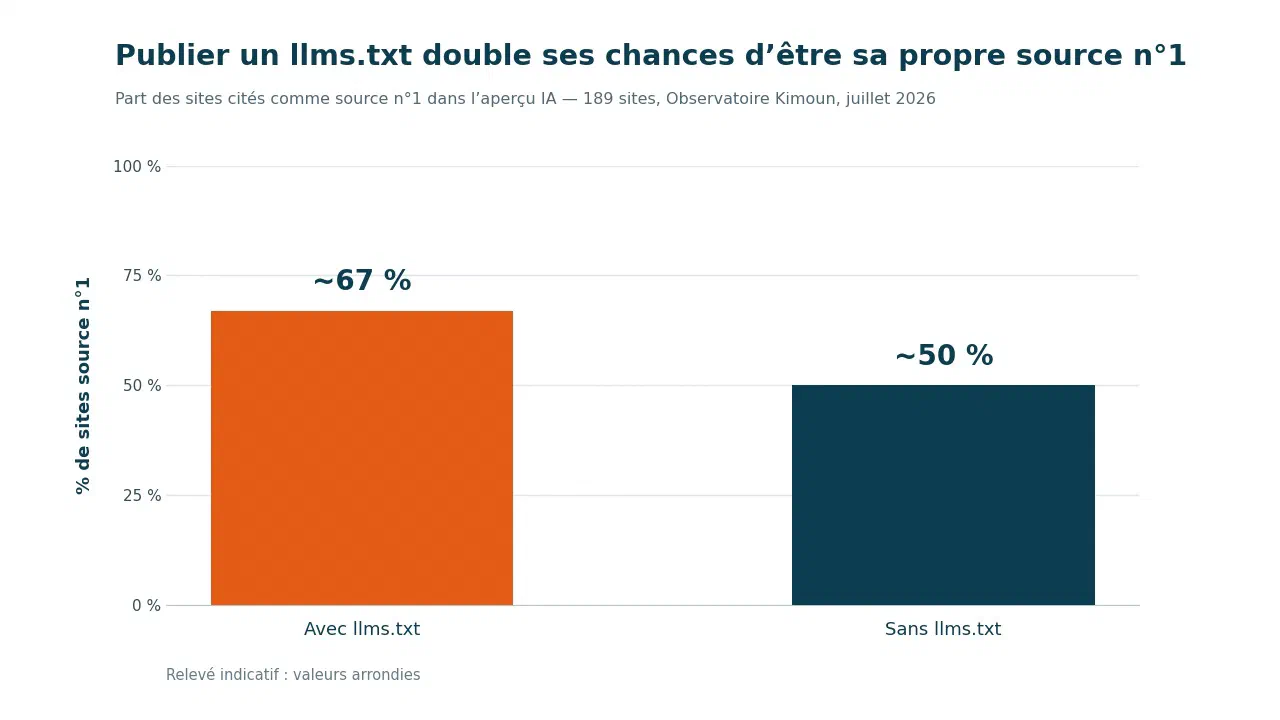
With an llms.txt: ~67% of sites are their own number-one source, versus ~50% without. The one purely technical lever that stands out clearly from the survey.
An llms.txt is a map of your site written for language models: where a web page drowns the information in the menu, the footer and the code, this file lists your important pages in clear text. You do the AI’s work for it. And today, only 31% of the panel publishes one — two web agencies in three haven’t yet made this move. Remember who makes up this panel: web professionals. If the move is missing among the specialists, it’s missing almost everywhere else. It’s an early advantage, the kind that never lasts long.
Note
Proof at home. kimoun.com publishes an
llms.txtand a factual “about” page. The result, shown again last week: on who is the company kimoun in Guadeloupe, Google writes the answer — activity, location in Le Moule, history since 2003 — and cites kimoun.com as a source. We apply what we measure.
A word of caution all the same: two facts that go together don’t prove one causes the other — sites that publish an llms.txt may also take care of the rest. But among the levers you directly control, it’s the most promising and the simplest to put in place, in the same logic as
clean structured data: making your site easy for a machine to read.
What we don’t know yet
I’d rather end on the limits: they say as much about the seriousness of a measurement as its results. This reading is a first pass, not a series — the AI overview varies from one day to the next, and it will take several readings per site to separate signal from noise. The panel is overseas only: the trends may show up in mainland France, but I won’t claim it until I’ve measured it. And correlation isn’t causation: the link between llms.txt and citation is real in our data, not yet proof that acting on one shifts the other. The full method, with the statistical detail, will be published on the Observatory for anyone who wants to look under the hood.
This survey covers Google’s AI overview. ChatGPT draws most of its answers from its own index, where the citation mechanics differ: I measured what it keeps of a page in Labrador, ChatGPT’s index.
One conviction, despite the caveats: the battle for AI visibility isn’t won in the code, it’s won in legitimacy. A clean site is the entry ticket. What gets you cited is existing — clearly and genuinely — both at home and everywhere people look for you.
The question I’ll leave you with, worth a thirty-second test: when you type your company’s name into Google, is it your site that serves as the source for the AI overview — or someone else?
Come tell me what you find on LinkedIn: I answer comments, and the best exchanges often end up feeding a future reading. And to get the rest of the Observatory — the next figures, the panel’s extension — subscribe to the Kimoun newsletter: once or twice a month, a curated watch. One-click unsubscribe.