



Google AI Overviews in France: the Guadeloupe angle

🇫🇷 Lire en français : AI Overviews en France : l'impact pour la Guadeloupe
Since Wednesday 22 July 2026, Google has been showing AI-generated answers at the top of its search results in France: AI Overviews, along with AI Mode, a fully conversational search. France was the last major market without them — and Guadeloupe, which searches on google.fr, switches over with it. Where the tool has been running for two years, the numbers are known: up to −58% of clicks on the first result when an AI box appears. Here’s what has been measured, what really concerns you, and what it changes — or doesn’t — for a business here.
Why Google is doing this (the real calculation)
Tip
The AI overview isn’t a gift to the searcher: it’s an economic move. Google sells advertising — the longer you stay on its results page, the more it earns. Grasp that, and you stop enduring the change and start playing with it.
Google’s business isn’t search: it’s the advertising shown around search. And historically, that model has a flaw. You arrive, you type your question, you click a link — and you leave Google, often in under a second. Every outbound click is a leak: the visitor goes off to spend their attention somewhere else. The AI overview fixes exactly that problem. By showing the answer directly, it keeps you on the page. A US study of 846,000 searches measures it: when an AI overview appears, the share of users still active on the page after twenty seconds is roughly doubled — people read the answer instead of leaving.
Second calculation: countering the AI assistants. Let’s be honest — you yourself are probably using Google less and less, and ChatGPT, Claude or Perplexity more and more, to search. That’s the real threat. But Google holds a trump card: it already owns the index of the entire web. The assistants have to query an external engine to fetch fresh information. By grafting a conversational answer onto its own database, Google repositions itself with a structural head start.
Third calculation, and this one looks ahead. Today Google’s ads are paid mostly per click. If users click less — they read the overview and stop visiting sites — paying per click loses its meaning. So we can expect the model to shift toward visibility inside the overview. At the French launch, remember, no advertising appears there yet. But Google’s bet is clear: take back control of attention before re-monetising it.
What happened on 22 July (and why France waited two years)
Tip
The essentials: AI Overviews have been live in France since 22 July 2026, with a gradual rollout through 23 September. Guadeloupe follows the same schedule as mainland France.
AI Overviews were already running in more than 120 countries. If France waited two years, it wasn’t a technical choice: it was the dispute over neighbouring press rights, the framework that requires platforms to pay publishers for reusing their content — and that has already cost Google a €500 million fine in 2021, then €250 million in 2024. The unlock came with a deal: publishers can pull their content out of the AI summaries, and those who stay in will be paid. With no guarantee, of course, of keeping their audience.
Concretely, an AI Overview is an answer block written by Gemini, shown above the classic results, built from several web sources cited in the margin. AI Mode goes further: a fully conversational search tab. The rollout is gradual — if you don’t see anything changing in your searches today, that’s normal; full coverage is announced before 23 September 2026.
And this isn’t imported theory: I saw it here. On 23 July 2026, from Guadeloupe, every query I tested on google.fr already triggered an AI overview — the rollout had indeed reached the territory, with no lag behind mainland France. I even searched for my own business. Google no longer returns a list of links: it writes an answer — activity, location in Le Moule, the founder’s background, history since 2003 — and it cites kimoun.com as a source. That’s the whole thesis of this article in a single screenshot: a site that’s readable for Google becomes the raw material of its AI answer.
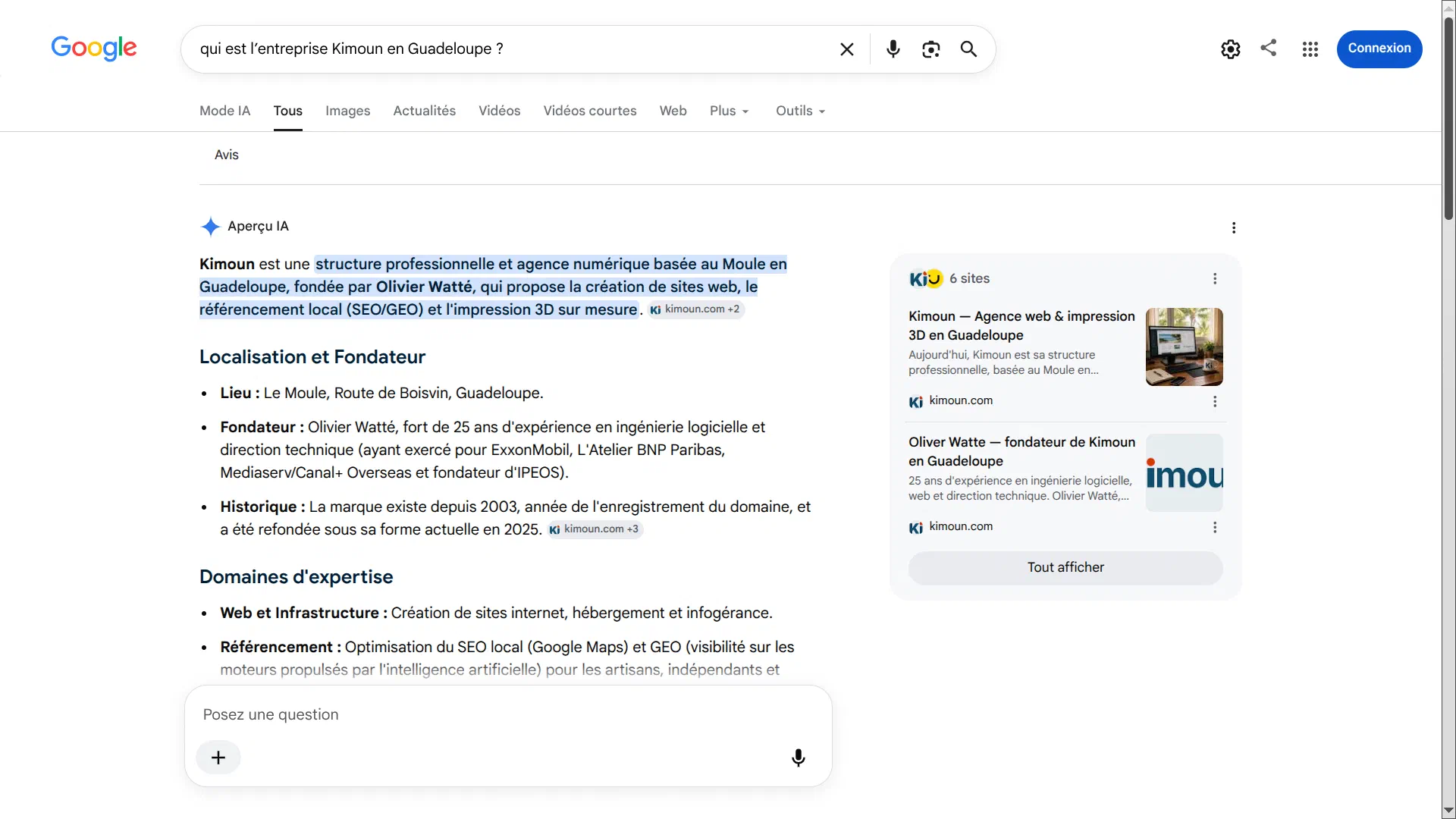
The query qui est l'entreprise kimoun en Guadeloupe? on google.fr, from Guadeloupe, on 23 July 2026: Google writes the answer and cites kimoun.com among its sources. A site readable for Google is readable for its AI too.
The figures measured where the tool already runs
Important
When an AI Overview appears, the first result’s click-through rate falls by 58% on average. But fewer than 1% of users click the sources cited in the box: being cited does not replace the lost click.
Two years of hindsight in the United States, the United Kingdom or Germany let us move past impressions. What’s documented:
| What the studies measure | Figure |
|---|---|
| Drop in click-through rate on position 1 when an AI overview appears | −58% on average (range −34 to −64%) |
| Traffic drop for exposed news publishers | −20 to −40% |
| Users who click a source cited in the box | fewer than 1% |
| Cited sources already in the organic top 10 | 80% |
The click-through drop is real and large. The Ahrefs study measures −58% CTR on average for the page in first position when an AI box appears; across studies, the ranges run from −34 to −64%. Among news publishers in exposed markets, the observed traffic drops swing between 20 and 40%.
Citation doesn’t make up for it. Fewer than 1% of users click the links cited in the box. A UX study of 70 filmed sessions shows why: most users read the visible part of the answer, don’t scroll, and click neither the organic results nor the sources.
Not everyone is hit the same way. The boxes trigger mainly on long, question-shaped, informational queries. Short-tail queries trigger few; transactional and brand queries almost none. And a detail that matters: in 80% of cases, the cited sources are already in the organic top 10. Solid classic SEO stays the price of entry — exactly what Google’s official guide published in May already said.
Which Guadeloupe queries trigger AI answers
Tip
The exposed queries are the ones you phrase as a question: how to open a guesthouse in Guadeloupe, what grants to digitise my business. Your brand queries and your quote requests don’t move.
Let’s transpose. The typical profile of a query that triggers an AI box — long, question-shaped, informational — maps very precisely onto what people here type when they’re gathering information: how to set up a SASU in Guadeloupe, what steps to rent seasonally in Saint-François, which legal status for a food truck. If your site lives on that research traffic — a general blog, guide pages, a directory — you’re on the front line: Google’s AI overview replaces the clicks that used to reach you.
Conversely, three families of queries stay sheltered:
- Brand searches — people are looking for you.
- Transactional searches — website quote, price, contact.
- Local searches with immediate intent — where the Google Business Profile and the local pack keep doing the work.

On one side, the question you ask Google ends up in the AI overview and the click no longer reaches you. On the other, whoever searches for your name or a quote still finds you.
The practical consequence, as I already wrote about Google’s guide: traffic becomes more selective. What thins out is the visitor who came looking for a definition. What remains is the one looking for a provider, a product, a named business. Less volume, more intent.
Who’s exposed, who’s protected — the local read
Something else the two years of hindsight show: the 20-to-40% drops hit generic content first — the pages that reword what ten other sites already say. An AI synthesises what exists; it can’t summarise what exists nowhere but on your site.
And that’s where the game plays out differently for a Guadeloupe business. The content structurally protected from AI synthesis is the content that exists only with you:
- first-hand field experience;
- the case study with real data;
- the local figure;
- the named testimonial;
- the on-the-ground constraint that national content ignores.
On how to run a guesthouse in Saint-François in high season, the generic Paris guide has nothing to say — the precise, honest source from here does. I already saw it with a client in the tourism sector: the AI cites the one source that truly answers. That logic, which held for ChatGPT and Perplexity, now applies to the engine everyone uses.
In other words: the arrival of AI Overviews penalises filler and rewards rootedness. For once, proximity beats size — provided you have something true to say.

The AI dissolves the generic content that ten sites already repeat. But the true local detail, the one only you have, it can only cite.
What we’re measuring right now: the Kimoun Observatory
Every figure cited above comes from the United States, the United Kingdom or Germany. Nobody measures the real impact on the digital economies of Guadeloupe, Martinique, French Guiana and Réunion. That’s precisely the purpose of the Kimoun Observatory: our study on the digital maturity of the region’s websites — including their readiness for AI engines — gives us a before/after we’re tracking closely.
The first readings are in, in fact: two days after the launch, we measured the AI overview on 189 overseas web-agency sites. Striking result — even web professionals are their own number-one source in only one case out of two. Here’s what those first figures show.
The next chapter is being written in local search. In July 2026, OpenAI signed a deal with Yelp to feed ChatGPT with business reviews, an agreement that ignores the Caribbean but signals the direction of travel: what it changes, and what it does not change yet here.
Three moves this week
No panic, no rebuild. Three concrete moves.
- Segment your Search Console. Look at how your clicks evolve by query type: informational on one side, brand and transactional on the other. Freeze your July figures — that’s your “before” baseline. In September you’ll know exactly where the AI box bit, instead of guessing.
- Find what you’re the only one to say. Take your two or three most important pages: what do they say that no one else says? If the answer is “nothing”, that’s where you add your data, your case, your local figure.
- Check the basics. Indexing, mobile speed, readable structure and clean data: the foundation that serves Google also serves the AIs. There’s still no “special AI” recipe — there’s good SEO, done seriously.
This article actually applies what it describes: real questions in a structured FAQ, clear answers at the top of each section, local data. It’s the same method we deploy for our clients.
I don’t run a forum on this blog, and the question I’m leaving you deserves better than silence: have you already seen an AI Overview show up on one of your searches from Guadeloupe?
So let’s carry on elsewhere. Come discuss it on LinkedIn: I reply to comments, and the best exchanges often end up becoming the next article. And if you want what comes next without having to think about it — including the Observatory’s first figures after the summer — subscribe to the Kimoun newsletter: once or twice a month, a curated watch that goes straight to the point. One-click unsubscribe.
Sources
- Abondance — Google officially launches AI Overviews in France (22/07/2026)
- Blog du Modérateur — Google rolls out AI Overviews and AI Mode in France
- Blog du Modérateur — AI Overviews: what the studies reveal
- Ahrefs — AI Overviews in France: the essentials
- Ahrefs — AI Overviews Reduce Clicks by 58%
- Search Engine Journal — 846,000 Google searches: how AI overviews keep users on the page longer (ClickStream Solutions / Surfer SEO study)
- Autorité de la concurrence — €250M sanction (neighbouring rights, March 2024)
- Ad’s up Consulting — AI Overviews & AI Mode: what our study reveals
- Kimoun page — SEO & GEO in Guadeloupe
- Kimoun Observatory — digital maturity GP/MQ/GF/RE