



MCP Server: What It Is and What It Really Costs in 2026
🇫🇷 Lire en français : Serveur MCP : c'est quoi, combien ça coûte en France en 2026 ?
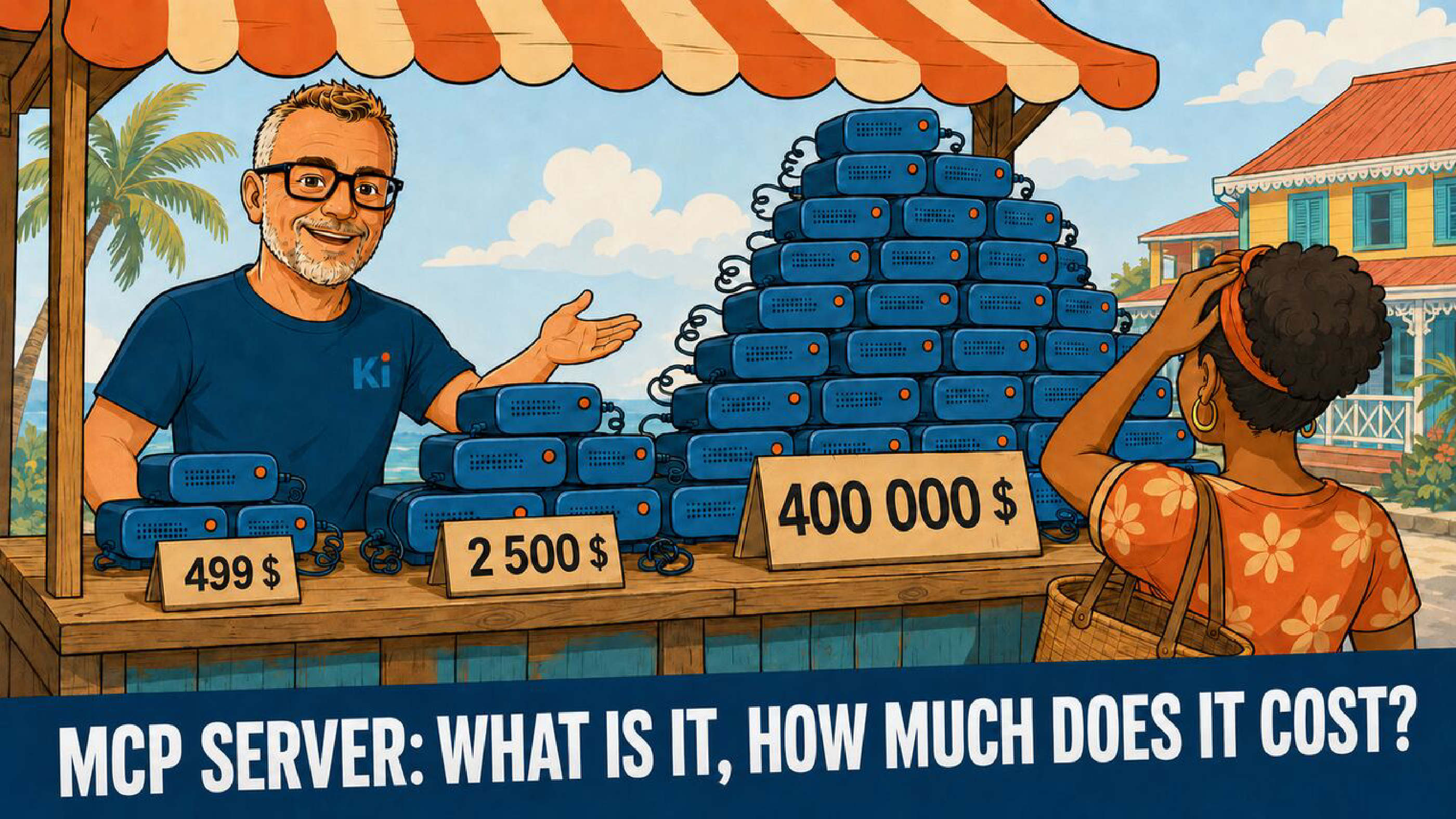
More than 10,000 public MCP servers are running worldwide according to the Linux Foundation, and quotes to build one range from $499 to over $400,000 — a 1-to-800 spread for the same three letters. In France, where Kimoun operates, almost no provider publishes its prices, and serious explanations of the subject are hard to find. This guide sets the record straight: what an MCP server actually is, what it changes inside a business, how it gets built, what the market charges in 2026 — and the cost line most quotes leave out.
MCP: the standard that plugs AI into your tools
Tip
An MCP server is a standardised connector between an AI assistant and a business tool: it exposes to the AI the functions you decide — read your email, publish on your website, query your invoicing — and nothing else.
MCP stands for Model Context Protocol. It is an open standard created in late 2024 by Anthropic, the maker of Claude, to solve a simple problem: an AI assistant, however capable, only knows the public web and whatever you paste into it. Your email, your accounting, your CMS, your client base — everything that actually runs your business — is invisible to it.
The most telling analogy is USB-C. Every device used to have its own charger; today, one plug fits all. Before MCP, connecting a tool to an assistant meant a specific integration, rebuilt for each assistant. With MCP, you build one connector — the MCP server — and it works with every compatible assistant: Claude, ChatGPT, Gemini, Copilot and most development tools.
The protocol no longer belongs to a single vendor either: in December 2025, Anthropic donated it to the Agentic AI Foundation, a foundation hosted by the Linux Foundation and co-founded with OpenAI and Block, backed by Google, Microsoft and Amazon Web Services. Even the French State has joined in: we covered how data.gouv.fr exposes its public data through an official MCP server.
Technically, an MCP server is a small piece of software that speaks the protocol on one side and your tool on the other. It declares “tools” — functions the assistant may call: search an email, publish an article, read an invoice. The decisive point for a business: the server only exposes what you decide, with the permissions you decide.
What it changes in a business: four servers we run in production
The best way to understand what an MCP server is for is not the spectacular demo: it is the ordinary, everyday use. At Kimoun, four MCP servers run in production — we use what we sell:
- The mailbox. Finding a six-month-old thread, listing the quotes that never got a reply, drafting a follow-up: the assistant does in plain language what used to take ten minutes of digging through the inbox.
- The knowledge base. Our internal notes — procedures, decisions, projects — live in an Obsidian vault the AI reads, extends and reorganises. The company’s memory can be queried the way you would ask a colleague.
- SEO data. Search Console, Google Trends, autocomplete: queried straight from the assistant for our audits, without juggling three dashboards.
- A SPIP CMS. The fourth runs at a client’s, a website publisher — see below.
These connectors don’t only run in-house. The mail server, for instance, is used every day by four solo business owners — three men and one woman, each running the show alone: the switchboard, the sales rep and the archivist of their own business rolled into one. Their setup: several professional addresses — the contact inbox, the quotes inbox, the old trading name that still receives messages — handled by one dedicated server, through a single point of entry. The assistant sorts, retrieves and drafts follow-ups across all the addresses at once, instead of a tour of three webmail tabs every morning.
Note
Case running in production. A SPIP website publisher asked us to connect his CMS to his AI assistant: writing, translating, publishing, organising the media library — in plain language, within limits he defined himself. The MCP server built for that need runs in production today: the AI acts directly in the back office, and the publisher keeps control over what goes live. The gain is not spectacular, it is daily: the end of copy-pasting between the assistant and the CMS.
That case has a sequel. The SPIP MCP server built for this publisher is now available as an integration for other organisations running SPIP — agencies, local authorities, nonprofits. This French open-source CMS is widespread in the public sector and the nonprofit world across French-speaking countries, and, as far as we know, MCP connectors proven in production there are rare. If your site runs on SPIP and writing, translation or the media library eat up your hours, get the integration quoted: the server already exists, and the work is deploying it, securing it and adapting it to your site — the first of the two paths described in the next section.
These connectors follow you onto your phone, too: since Claude Desktop arrived on Linux, the workstation can be driven from mobile, MCP connectors included. The test for your own business fits in one sentence: if a piece of information lives in one of your tools and you retype it for the AI, an MCP server probably has a place.
Integration or custom build: the two ways to get one
There are only two roads to an MCP server, and they do not cost anywhere near the same.
First road: integrate an existing connector. If your tool is mainstream — WordPress, Notion, n8n, GitLab, most of the big SaaS platforms — an open-source MCP server probably already exists among the thousands published. The work is selecting the right one, deploying it, securing it (authentication, filtering of the functions actually exposed) and adapting it to your workflows. That is a matter of days, not weeks.
Second road: build custom. If your tool is specific — line-of-business software, an internal database, a particular CMS — the connector gets built from scratch: audit of the tool and its APIs, definition of the functions to expose, development, testing with the teams. That is a matter of weeks, sometimes months.
What drives the hours up is documented in detail by Triple Minds’ pricing guide, the sector’s reference: each exposed function adds 8 to 20 engineering hours; a read-only server comes in roughly 30 to 40% cheaper than one that writes into your tools; authentication ranges from zero hours (none) to 10-15 hours (API key), 40-80 hours (OAuth) and 80-150 hours (enterprise SSO); and an old or poorly documented internal API can add 50 to 200 hours on its own. That set of dials — number of functions, read or write, authentication, state of the APIs — explains most of the price spread.
What it costs: the 2026 market price list
Tip
At Western agency rates (~$30/h), an MCP server runs from $1,200 for a simple connector to $12,000 for multi-system orchestration — and the market floor is $499 for a tightly scoped connector, delivered in five days.
The English-speaking market, more mature than the French one, publishes its numbers. Here is the grid by project type, based on the hour volumes in the Triple Minds guide, priced at Western agency rates (~$30/h):
| Type of MCP server | Hours | Indicative price | Timeline |
|---|---|---|---|
| Simple connector (1-2 functions, no auth) | 40-80 h | $1,200 – $2,400 | 1-2 wks |
| Database server (scoped queries) | 60-120 h | $1,800 – $3,600 | 2-3 wks |
| Document server (semantic search) | 80-160 h | $2,400 – $4,800 | 2-4 wks |
| SaaS connector (CRM, invoicing…) | 100-200 h | $3,000 – $6,000 | 3-5 wks |
| Action server (write access, human approval) | 100-200 h | $3,000 – $6,000 | 3-5 wks |
| Standard custom server (5-10 functions, auth, monitoring) | 120-200 h | $3,600 – $6,000 | 3-5 wks |
| Multi-system orchestration | 200-400 h | $6,000 – $12,000 | 6-10 wks |
Beyond that, you change category: regulated compliance (healthcare, audit) or a full AI agent, $7,500 to $15,000; a multi-tenant platform, $24,000 to $45,000 and several months of work.
Two anchors complete the grid. At the bottom, mcpdone charges $499 for a tightly scoped custom MCP server, delivered in five days — the market’s assumed floor. At the top, Bacancy prices an MVP from $25,000 and an enterprise project at $400,000 and up, with most production deployments landing between $40,000 and $120,000. Both are right at the same time: they are simply not selling the same thing. An MCP server quote never compares to another quote — it compares to a scope.
Two reading precautions. First, very low hourly rates exist ($9/h offshore at Triple Minds, against ~$30/h at a Western agency): the sticker price says nothing about review, security, or who answers when it breaks. Second, these grids price the build — not the running costs, covered below.
And in France? The market there is young, and providers who publish their prices can be counted on one hand. We publish ours, as a comparison point in euros: integration of an existing connector from €490, custom development from €2,500 to €9,000 depending on whether the AI reads or writes, managed hosting from €49/month — the full grid is on our MCP server page. Worth noting: it sits at the lower end of the English-speaking market’s agency band, for a comparable scope.
Maintenance: the line item quotes leave out
An MCP server is not a piece of furniture you deliver: it is software plugged into a protocol that is still moving. On 28 July 2026, the MCP specification published a major revision — the protocol core goes stateless, protocol-level sessions disappear, and the official SDKs follow. Excellent news for the standard’s robustness, and a concrete obligation for every server in service: update to stay compatible with up-to-date assistants.
The market has put numbers on that reality. The Triple Minds guide counts 5 to 10 engineering hours per month to maintain an MCP server, sold as retainers of $200 to $800/month, and estimates the full running cost of a business server — hosting, model usage, maintenance — at $200 to $1,200/month. In other words: over two or three years, running the server can cost more than building it. That line — far more than the initial build — is what really separates the offers.
Warning
An MCP server delivered and then left unmaintained stops working — not from wear, but because the protocol and the assistants evolve without it. Before signing, insist that the quote states who maintains the server, at what pace, and for what monthly price.
Where to start
The right first step is always the same: one tool, a few functions, a clear scope. Start where retyping costs you the most — usually the mailbox or the CMS. Check whether an open-source connector exists for your tool: if so, the project is an integration, not a build. And insist on two numbers in any quote: the build price and the monthly running price, maintenance included.
If you want to know what can be connected in your business, the assessment is free: one conversation is enough to map your tools — CMS, accounting, documents, email — and tell you where to start. We operate remotely from Guadeloupe (France), for clients across France and beyond.
Sources
- Model Context Protocol — original announcement, Anthropic (November 2024)
- The 2026-07-28 MCP Specification — official Model Context Protocol blog
- MCP joins the Agentic AI Foundation — official Model Context Protocol blog (December 2025)
- Linux Foundation — formation of the Agentic AI Foundation (MCP, goose, AGENTS.md)
- MCP Development Cost 2026 — Triple Minds (pricing guide, hours and recurring costs)
- How much does an MCP server actually cost to build? — mcpdone
- MCP Server Development Cost: 2026 Pricing & Timeline Guide — Bacancy Technology
- Kimoun page — MCP server: development, integration and managed hosting