



Tourist Tax in Guadeloupe: Who Keeps Airbnb in Check?
🇫🇷 Lire en français : Taxe de séjour en Guadeloupe : qui contrôle Airbnb ?
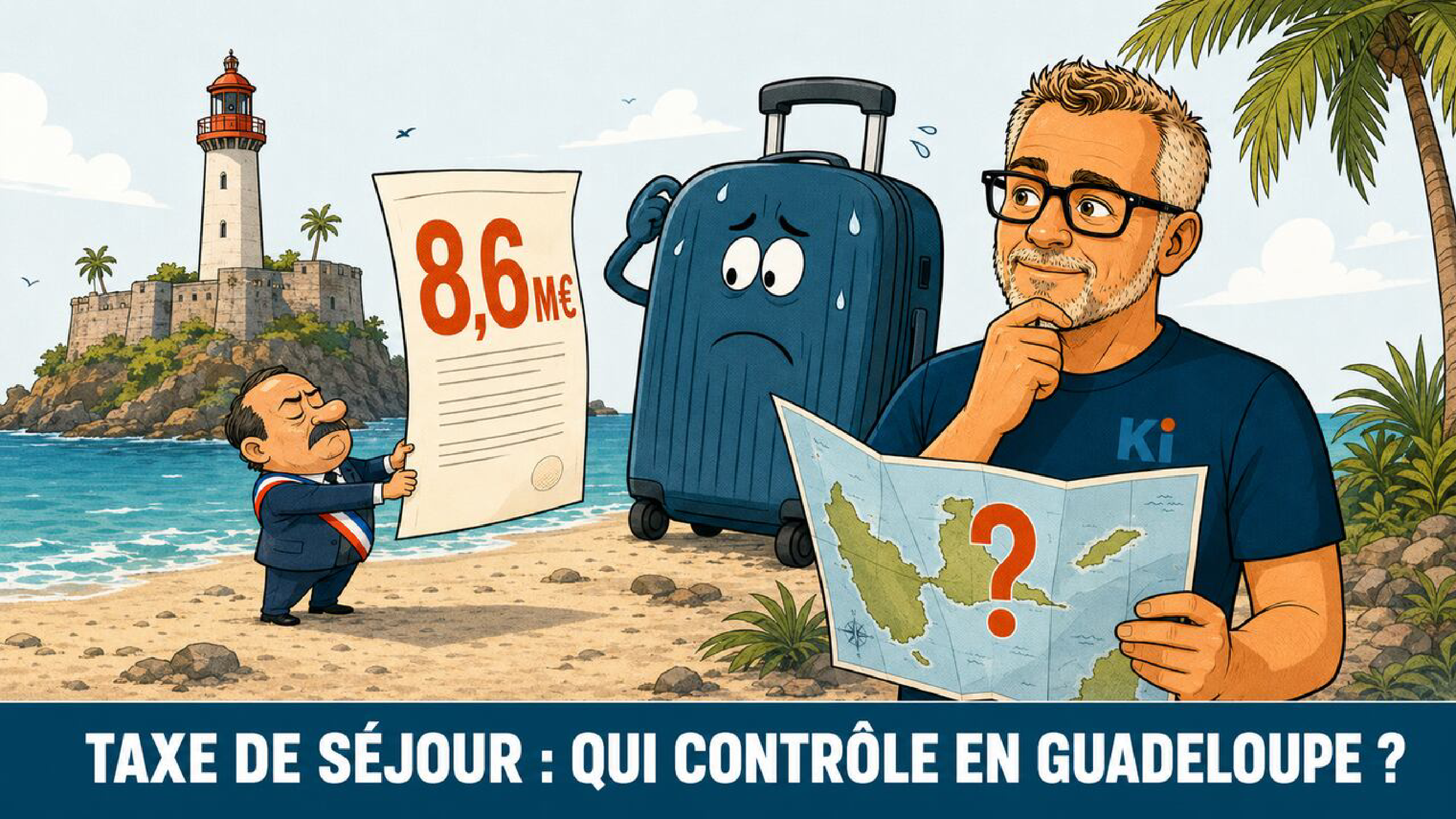
On 31 July 2026, France’s Constitutional Council upheld the penalty regime that has cost Airbnb €8.6 million in its standoff with the Île d’Oléron — a small island community of 22,000 people off France’s Atlantic coast — over tourist taxes not remitted in 2021 and 2022. A tiny local authority made the platform bend. In Guadeloupe, where thousands of holiday rentals are now booked through Airbnb and Booking, I wanted to check one simple thing: does the tourist tax exist here, and who makes sure it gets paid? I went looking for the answer in DELTA, the French tax administration’s open database — the very file platforms use to configure their collection.
Oléron: €8.6 million upheld by France’s Constitutional Council

Here is the case in short. The Île d’Oléron’s intermunicipal authority found that Airbnb had not remitted the tourist tax due on its territory in 2021 and 2022. It went to court under the French local government code, which provides for a fine per breach. In April 2025, the Poitiers court of appeal ordered Airbnb to pay €8.6 million for 7,410 nights — local officials had claimed 30. The platform, which had blamed a “technical error linked to a data management problem” and eventually paid the taxes claimed, did not dispute the obligation to collect; it disputed the proportionality of the fine — more than 25 times the uncollected taxes, by its own calculation. A priority constitutional review followed. Verdict on 31 July (decision no. 2026-1214/1215 QPC): the penalty regime is compliant with the Constitution.
The case is not entirely over — it now returns to the Cour de cassation, France’s highest court, which must still check whether the amount is proportionate in this specific case — but the message to local authorities is crystal clear: the penalty mechanism holds, and a local authority that counts its nights can make a tech giant pay. Nor was this Oléron’s first round: as early as 2023, the La Rochelle court had fined Airbnb €30,000 for collection failures on the same island.
What struck me in this case was less the amount than the method. Oléron won because it checked. It cross-referenced online listings, declarations and remittances. The obvious next question: who does that work in our archipelago?
In Guadeloupe, the tourist tax now exists everywhere — but only recently
Tip
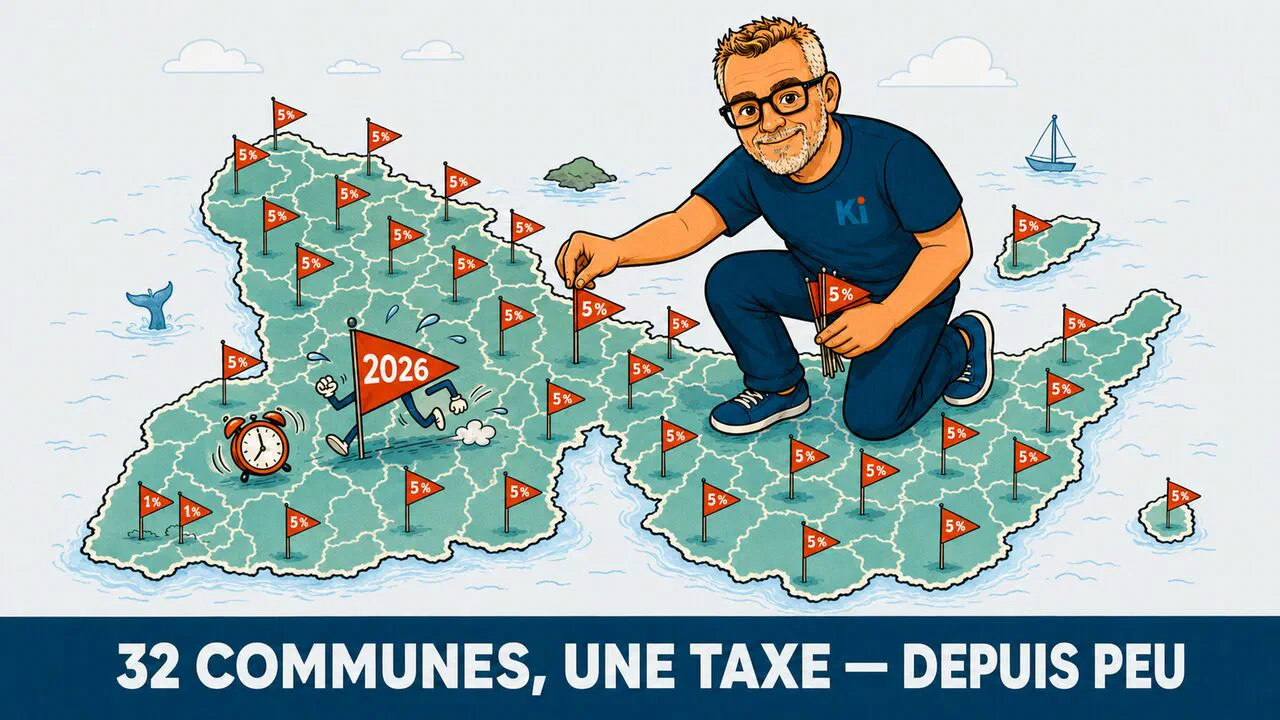
All 32 municipalities of Guadeloupe are covered by a tourist tax based on the actual price paid: platforms are therefore legally required to collect it, everywhere.
First reflex: check whether our local authorities have even instituted the tax. Without a decision recorded with the tax administration, a platform has nothing to collect — and nobody can hold anything against it.
Note
Method: I queried DELTA, the open database of the French tax administration (DGFiP, data.economie.gouv.fr), which records the tourist-tax decisions of every French local authority. It is the reference file that platforms subject to the collection obligation have used since 2019. A municipality absent from the file = no tax applicable. For Guadeloupe (département 971): 850 tariff lines covering all 32 municipalities, from the decisions of 6 intermunicipal authorities and 7 towns levying the tax directly.
The result, to my knowledge, had never been published:
| Authority | Municipalities covered | Tax in force since | Rate, unclassified rentals |
|---|---|---|---|
| Cap Excellence | Abymes, Pointe-à-Pitre, Baie-Mahault | 1 January 2026 | 5% |
| Riviera du Levant | Gosier, Sainte-Anne, Saint-François, La Désirade | 2022 | 5% |
| Nord Grande-Terre (CANGT) | Le Moule, Morne-à-l’Eau, Petit-Canal, Port-Louis, Anse-Bertrand | 2022 | 5% |
| Grand Sud Caraïbe | Basse-Terre, Capesterre-Belle-Eau, Trois-Rivières, Vieux-Fort, Vieux-Habitants, Terre-de-Bas | 2022 | 5% |
| Nord Basse-Terre (CANBT) | Petit-Bourg, Lamentin, Sainte-Rose, Goyave, Pointe-Noire | 2023 | 5% |
| CC Marie-Galante | Grand-Bourg, Capesterre-de-Marie-Galante, Saint-Louis | 2020 | 5% |
| Towns levying directly | Deshaies (2022), Bouillante (2023), Terre-de-Haut (2024), Gourbeyre (2019), Saint-Claude (2020), Baillif (2017) | — | 5% (1% in Baillif and Saint-Claude) |
Three takeaways.
The rate is at the ceiling almost everywhere. 5% of the price per person per night for unclassified accommodation — the category most Airbnb-type rentals fall into. On a villa at €200 a night for four, that is several euros per night that should flow back to the local authority.
The system is recent. Outside Marie-Galante and a few pioneering towns, most of the archipelago only voted the tax in 2022-2023. Above all: Cap Excellence — the economic heart of the island, Jarry, the airport, the cruise port — only joined the intermunicipal scheme on 1 January 2026. Only Baie-Mahault had levied a municipal tax since 2020, at 3%. For every Airbnb night in Abymes or Pointe-à-Pitre before that date, subject to any history predating the DELTA database, there was in all likelihood nothing to collect — and therefore nothing collected.
Cap Excellence also voted a flat-rate tax on one category — marinas. A technical detail that matters: platforms only collect the tax based on the actual price paid. The flat-rate version remains the host’s direct responsibility.
Instituting a tax is not the same as collecting it

Having a decision recorded in DELTA is the starting condition. Collecting the money is another story — a chain of three links, and each one can fail.
First link: does the platform collect correctly? The obligation has existed since 1 January 2019 for operators that handle the payment. But the Oléron case proves the obligation alone is not enough, and a written question in the French National Assembly documented how opaque the system is: local authorities struggle to obtain from platforms the detail of nights collected on their territory. Airbnb publishes a national figure — more than €210 million remitted to French municipalities in 2025 — but no public breakdown for overseas territories.
Second link: is the local authority equipped to receive and verify? In northern Basse-Terre, more than two years passed between the intermunicipal decision and the opening of the hosts’ declaration portal, in April 2025. Without a declaration tool, no reliable register; without a register, no way to cross-check what the platforms remit.
Third link: is anyone counting? That is where Oléron makes the difference. The ministerial answer to the written question mentioned above reminds local authorities that they can assess the tax unilaterally when no declaration is filed, with the court-imposed fine as back-up. Those levers exist. I found no public trace of their use in the archipelago. Hotels alone sell close to 1.3 million nights a year in Guadeloupe according to INSEE, the French statistics office; add several thousand active platform rentals, and the question deserves to be put to our intermunicipal authorities — not as an accusation, but as elementary financial housekeeping.
This mechanism is part of a wider movement I described in my analysis of economic sovereignty in the overseas territories: tourism value is shifting to platforms that pay neither local payroll charges nor any significant local tax here. The tourist tax is precisely one of the few mechanisms designed to keep part of that value on the territory. It still has to be made to work.
What this changes for hosts
Warning
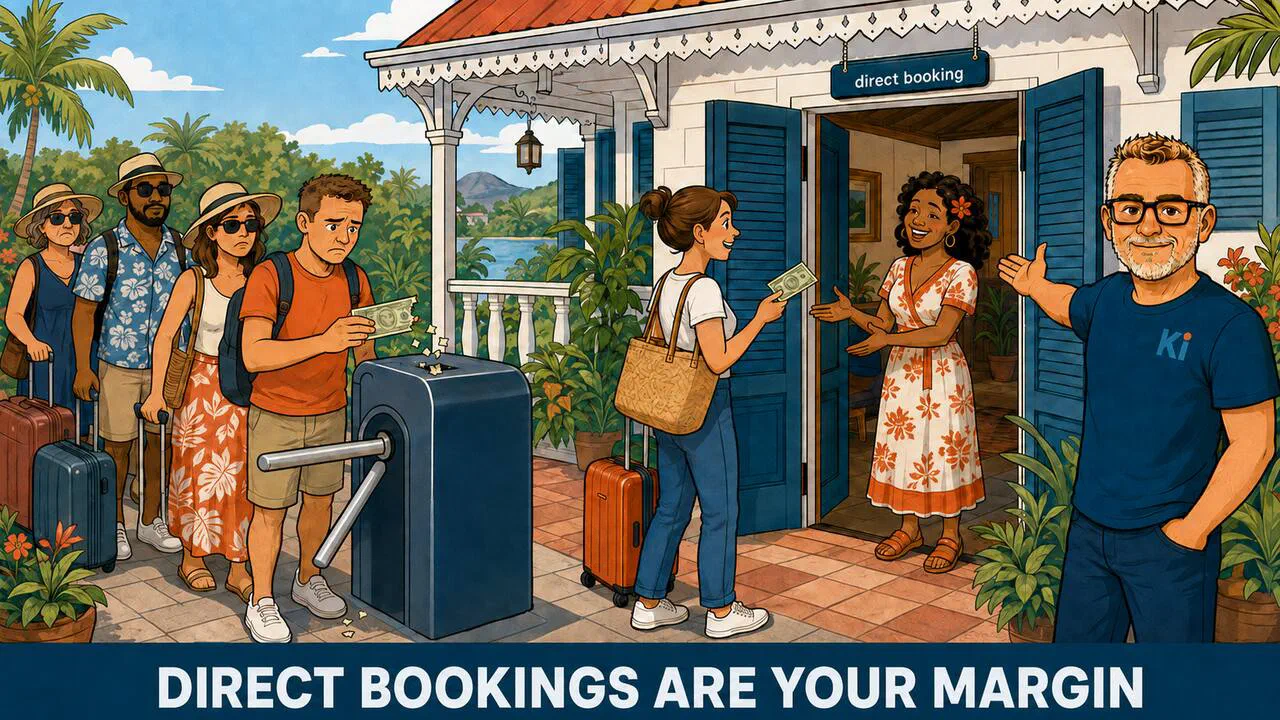
A platform only collects on its own bookings. For your direct bookings — phone, WhatsApp, your own website —, it is up to you to collect the tax, keep a register and pay it over. Failing to do so exposes you to the same penalties as Airbnb, at your own scale.
If you rent out a guesthouse, a villa or rooms in the archipelago, remember three things. One: on your platform bookings, the tax is normally charged to the guest and remitted without any action on your part — but check your statements; the technical error Airbnb invoked at Oléron should be enough to convince you not to sign off blindly. Two: on your direct bookings, collection is your job, and most intermunicipal authorities now have a declaration portal. Three: the tax is paid by the guest, not by you — it does not eat into your margin, unlike the 15 to 20% commission platforms take on every booking, according to the fee schedules published by Airbnb and Booking.
Nobody had gathered the declaration portals either — here they are, checked one by one:
- Cap Excellence (Les Abymes, Pointe-à-Pitre, Baie-Mahault): capcoeurguadeloupe.taxesejour.fr
- Riviera du Levant (Le Gosier, Sainte-Anne, Saint-François, La Désirade): rivieradulevant.taxesejour.fr
- Nord Grande-Terre: ngt.taxesejour.fr
- Grand Sud Caraïbe: grandsudcaraibe.taxesejour.fr
- Nord Basse-Terre: nordbasseterre.taxesejour.fr
- Marie-Galante (managed by the tourist office): taxe.3douest.com/mariegalante.php
- Deshaies, levying directly: taxe.3douest.com/deshaies.php. For the other towns levying the tax directly (Bouillante, Terre-de-Haut, Gourbeyre, Saint-Claude, Baillif), contact the town hall.
And that is the real underlying issue for a Guadeloupean host: the tourist tax costs the guest the same whatever the channel, but the commission only hits platform bookings. Every booking you win back directly — through a website of your own, a well-kept Google profile, solid local search visibility — puts that margin back in your pocket, along with the customer relationship. Platforms will remain an acquisition channel; they have no reason to remain the only one.
Sources
- Constitutional Council — decision no. 2026-1214/1215 QPC of 31 July 2026, tourist-tax fines (Airbnb / Île d’Oléron case) — in French
- DELTA database — tourist-tax tariffs voted by French local authorities (DGFiP, data.economie.gouv.fr) — in French
- Written question no. 10924 and ministerial answer, French National Assembly — collection and remittance of the tourist tax by platforms — in French
- INSEE — 2024 economic report: hotel occupancy remains high in Guadeloupe — in French
- France 3 Nouvelle-Aquitaine (with AFP) — the Constitutional Council upholds the penalties in the Airbnb / Oléron case — in French
- Airbnb — tourist tax remitted to French municipalities in 2025 — in French
- Tourist-tax online declaration portal — Nord Basse-Terre intermunicipal authority — in French