



Submarine Cable: Where Your Internet Really Comes From
🇫🇷 Lire en français : Câble sous-marin : d'où vient l'internet en Guadeloupe
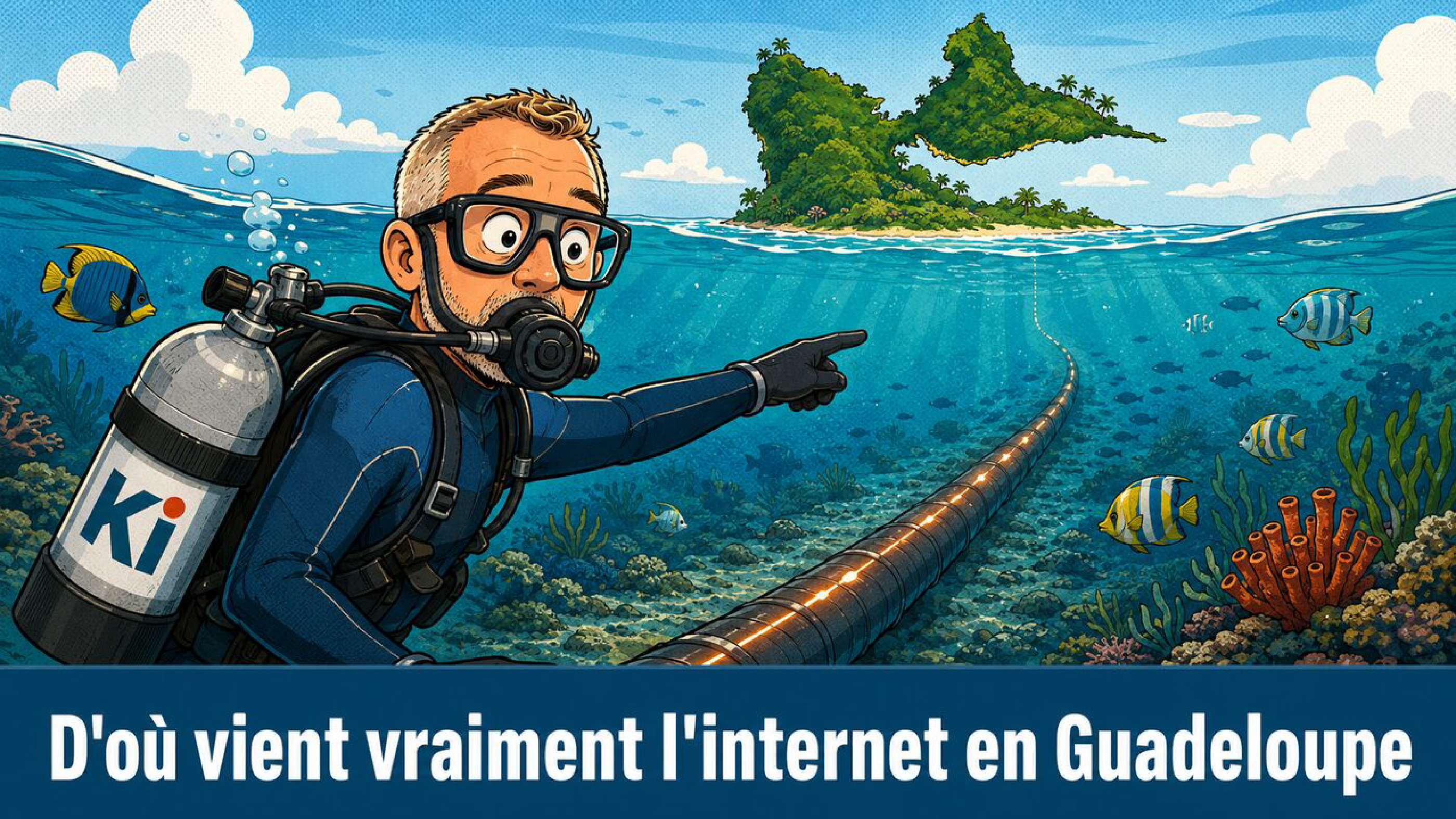
When the internet slows down or drops in the islands, it’s almost never “the web acting up”: more often than not, it’s a cable — thousands of metres down on the ocean floor. The Caribbean is connected to the world by a handful of submarine cables, and for a long time by a single one. I ran the infrastructure of a regional operator back when that one link governed everything across the territory. Here’s how the internet actually reaches us, what the new Caribbean Connect cable changes, and why your website’s availability depends on it far more than you’d think.
How the internet actually reaches the islands
Tip
Your connection rests on two worlds: the fibre running under your feet, and a few submarine cables that tie us to the rest of the planet.
We tend to picture the internet as a cloud. It’s the opposite: it’s cable, a lot of cable, with seawater on top. Two layers coexist. On land, fibre and the operators’ networks carry the connection to your office or shop, from a network core concentrated in industrial hubs. And between the islands and the rest of the world sit the submarine cables, which come ashore at a handful of precise landing points.
It’s the railway image operators like to use: your fibre is the local service; the submarine cable is the main line out of the island. Cut the main line, and however shiny the local service is, nothing comes in or goes out.
Where the bandwidth shortage came from
To understand our relationship with connectivity, you have to go back a little. Much of the local telephone network was rebuilt in a hurry after Hurricane Hugo in 1989, to restore lines destroyed by the storm — a makeshift copper network, laid before broadband became widespread. Quality suffered from it for years, levelled down.
On top of that sat a structural problem: as long as a territory was served by a single cable, there was almost no competition between operators on international capacity. Less competition means dependency in practice — and bandwidth that was both scarce and billed at a fortune per month. The real battle for internet providers back then wasn’t the abstract “global internet”: it was the quality of the link all the way to the end user.
45 Mbit/s in Paris, 2 Mbit/s in Guadeloupe
I lived that gap from the inside. Before settling here, I worked at L’Atelier (BNP Paribas’ innovation lab): we had 45 Mbit/s symmetrical for a team of about twenty, plus servers and monitoring agents, and we even ran two live video broadcasts a day. When I arrived as technical director at Mediaserv in Guadeloupe — for all the clients’ connections, the head office’s dozen or so staff, a handful of locally hosted sites, subscribers’ personal home pages and the streaming of two radio stations, including Énergie Antilles — I had… 2 Mbit/s.
Twenty times less, to run an operator’s infrastructure. It wasn’t a technical fate: it was the direct consequence of a single landing cable. That experience marked me for good — so much so that I drew a way of reading things from it, which I lay out in the pillar article on digital sovereignty: a territory’s bandwidth, and above all what it’s used for, says a great deal about its economic vitality.
From Americas-2 to Kanawa: loosening the single-cable grip
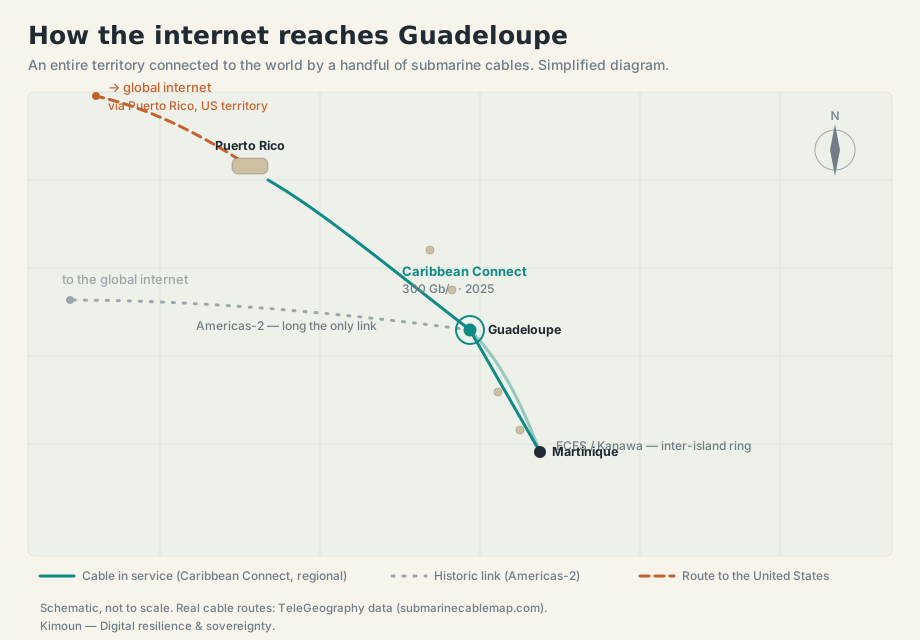
For years, the Americas-2 cable was the only link connecting Guadeloupe to the global internet. A single thread for an entire territory: no redundancy, and the slightest maintenance window slowed the whole region. When you operate that, you measure every day what “single point of failure” really means.
This is partly what public initiatives set out to address. The first real change came in 2006: the Guadeloupe regional authority had a new submarine cable laid from Jarry, through a public-service delegation awarded to Global Caribbean Network (GCN) — around €22 million to break the single-link dependency and aim for “broadband for all”. Together with other regional links (ECFS, which connects around fifteen Caribbean islands, and Kanawa in 2018), the mesh gradually thickened, adding capacity and redundancy. But the underlying logic stayed the same: we depend on distant infrastructure, run by players we have no control over.
Note
That connection gap had one delicious side effect. For a long time, online gamers here suffered a far higher “ping” than their opponents in mainland France or Canada: their screens updated a beat late. The result was cohorts of local players who became formidable precisely from compensating for that handicap — and were known, once they left to study elsewhere, for wiping the floor with everyone. Technical adversity sometimes forges excellence.
Caribbean Connect: real progress that doesn’t make us independent
Warning
More capacity doesn’t mean more autonomy: our new link to the world will run through a US territory.
In October 2025, CANAL+ unveiled a new submarine cable, Caribbean Connect, designed to link Guadeloupe and Martinique to Puerto Rico with far more capacity than earlier links. It is being commissioned gradually, with associated services (datacentres, local hosting) announced for 2026. On paper, it’s real progress: more throughput, more redundancy, better latency, less digital isolation.
But look at the map. This cable reaches the world by way of Puerto Rico — US territory. In other words, our “link to the world” remains a link toward, and through, the United States. Redundancy isn’t sovereignty: we have more pipes, and we still depend on infrastructure and players we don’t control. That’s exactly the nuance I dig into in the pillar on digital sovereignty.
What it means for your business
None of this is just an operators’ affair. The day a cable has an incident — and it happens, sometimes for several days while a repair is carried out at sea — your site hosted “elsewhere” becomes slow or unreachable. Your email, your cloud, your online point-of-sale, your booking tools: everything that lives off the islands passes through that thread. I’ve described elsewhere, through the scenario of a 72-hour outage, just how quickly a “digital” outage becomes an economic one.
The good news is that while you don’t control the cable, you do control your choices: a light website optimised for mobile (the majority of local usage, on tighter bandwidth than in Europe), hosting chosen with eyes open, and an organisation built to hold up even when the link weakens. That’s where it’s all decided — not in the pipe, but in the way you plug into it.
The fragility doesn’t lie only in the cable: your digital subscriptions themselves drain value out of the territory — a subject I cover in AI and economic sovereignty overseas.
“We don’t control the cable on the ocean floor. We control how our business is connected to it — and that’s a choice, not a fate.”
— Olivier Watte, known as Oliver · founder of Kimoun
The first step, as so often, is to know what you truly depend on.
Sources
- Environmental authorisation dossier — Southern Islands optical cable (French State services, Guadeloupe)
- TeleGeography — Submarine Cable Map
- Région Guadeloupe — the submarine cable (GCN, 2006)
- Caribbean Connect — CANAL+ Télécom announcement, October 2025 (local press).