



Digital Sovereignty in the Caribbean: From Cable to Click
🇫🇷 Lire en français : Souveraineté numérique en Guadeloupe : du câble jusqu'à l'usage
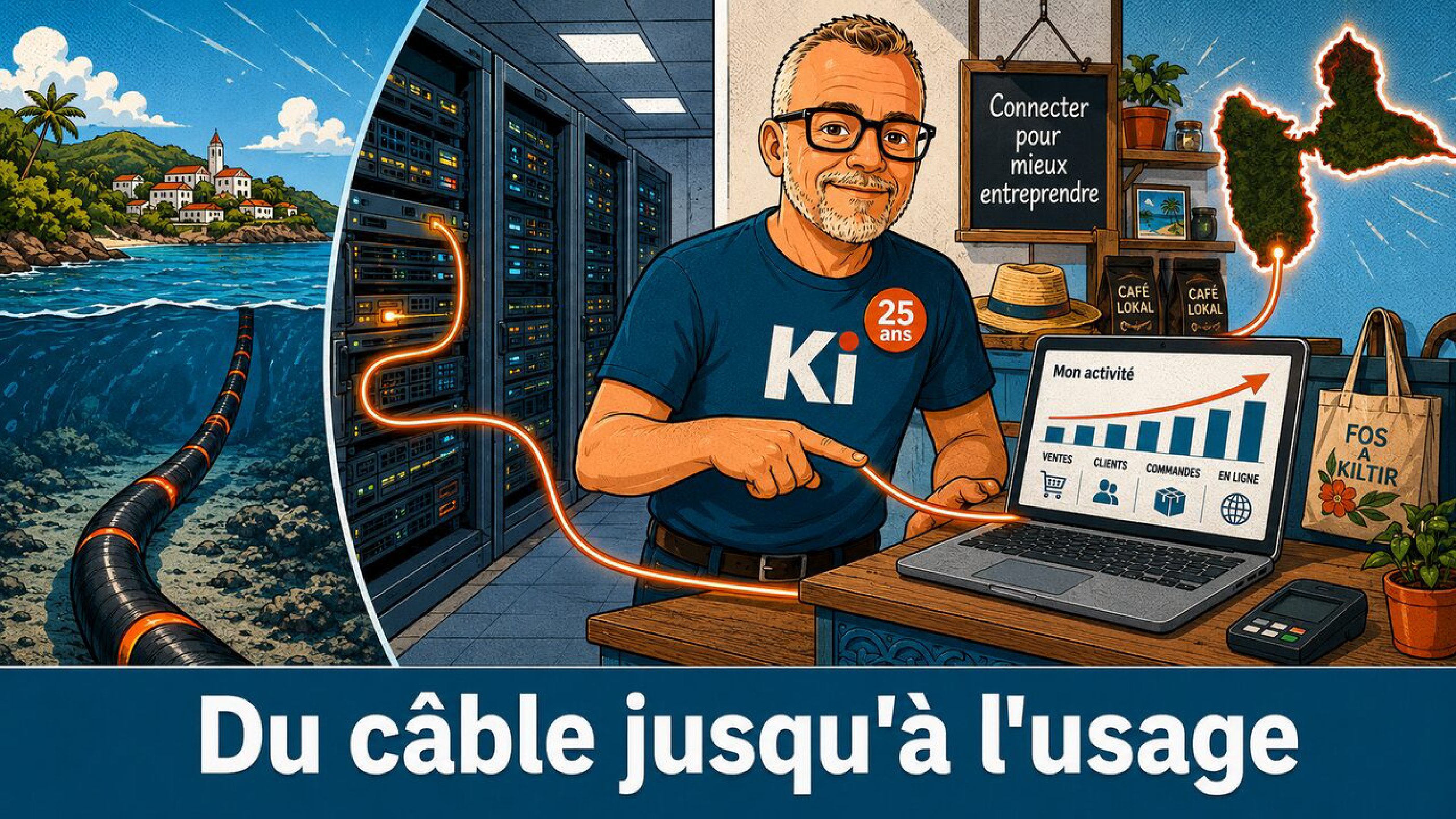
Everyone is talking about digital sovereignty. Governments are even putting a number on it: Europe’s digital dependency alone is estimated at €265 billion a year, most of it flowing to providers outside the continent. But here in the Caribbean, that word has a very concrete meaning I’ve lived with for a long time. In the early 2000s, I ran the technical side of a regional operator — back then, an entire territory hung on a single undersea cable. But I’ve spent most of my twenty-five years on the other side: building the websites, applications and online presences that businesses here run on. That double view — from the cable to the click — changes how you understand what “sovereign” does, and doesn’t, mean for a business in the islands.
What digital sovereignty really means (and what it doesn’t)
Tip
Being sovereign isn’t hosting everything yourself — it’s understanding your dependencies, keeping control, and being able to change your mind without breaking everything.
The word either frightens people or sells to them, depending on who’s using it. Let’s set it straight. Digital sovereignty isn’t self-sufficiency, and it isn’t “my data stays on the island, so I’m fine” either. It’s the ability to know what you depend on, to recover your data and your access whenever you want, and to avoid becoming the prisoner of a single provider.
That’s exactly how the idea is framed at the policy level: sovereignty isn’t declared, it’s built — through the mastery of your dependencies. Data hosted with a large provider remains subject to the laws of that provider’s country; that’s the whole point of legislation with extraterritorial reach. The issue isn’t to name a villain. It’s to look clearly at where the value goes, and at who could, one day, turn off the tap.
For a Caribbean business, then, the right question isn’t “how do I control everything?” — that’s out of reach — but “how do I keep enough room to manoeuvre that I’m never tied hand and foot?”.
What I learned when a whole island hung on a single cable
I was technical director at Mediaserv, in Martinique and then in Guadeloupe. Back then, the Americas-2 cable was the only link connecting us to the global internet. A single thread on the ocean floor for an entire territory: no redundancy, and the slightest maintenance window slowed down the whole region. Once you’ve lived that from the inside, you never again see a connection as a given.
The contrast hit me hard. Just before, at L’Atelier (BNP Paribas’ innovation lab), I had 45 Mbit/s symmetrical for a team of about twenty, plus servers and monitoring agents — we even ran two live video broadcasts a day, at a time when streaming was reserved for big organisations and we were RealMedia and Pinnacle partners. When I arrived to run the technical side at Mediaserv in Guadeloupe — to host a few local sites and carry local radio — I had… 2 Mbit/s. That starved, wildly overpriced bandwidth wasn’t a technical fate: it was the direct consequence of a single landing cable, which limited competition and entrenched dependency.
I spent the following years making the case to local players — chambers of commerce, entrepreneurs, the community sector — for one simple idea: as long as we depended on a single link, we’d stay fragile. The newer regional links genuinely improve things. And the latest, Caribbean Connect — unveiled in October 2025 and now being rolled out — will reach the world by way of Puerto Rico, a US territory. More capacity, yes; a dependency that merely changes shape, too — to the point that a US decision can now cut off access to a tool overnight, based on your nationality rather than your use.
Bandwidth as a mirror of economic vitality
Tip
A territory’s bandwidth — and above all what it’s used for — says more about its economic health than many official indicators.
From that experience I drew a way of reading things that I still use. The bandwidth available to the end user, upload as well as download, is a fair thermometer for comparing territories. But the raw figure isn’t enough: what matters is what you do with it.
A connection used only to consume — streaming content, running services hosted elsewhere — sends value out of the territory. A connection used to create — building sites, services, economic, artistic or cultural output of our own — keeps that value here. Two territories can post the same speed and have nothing like the same vitality, depending on whether they sit at the end of the chain or are busy building their own.
That’s where sovereignty stops being an engineers’ debate and becomes a question of the local economy.
The real battle is economic
Warning
Every subscription paid to a distant provider is value leaving the territory — money that funds neither local jobs nor local training.
Take a concrete example. A small organisation that replaces a task with one or two Claude subscriptions is looking at exactly €200 to €400 leaving each month for the United States. Over a year, that’s the equivalent of one to two minimum-wage salaries flowing out of the territory, funding no local activity and training no one here. It isn’t AI that “destroys” jobs: it’s a displacement of value that, for want of anticipation, amplifies weaknesses already in place.
And this isn’t a hypothesis. We already see it in retail. In Guadeloupe, where I work, the regional monetary authority has documented local retail revenue falling while it rises nationally — because extra-regional online platforms capture a growing share of local demand without reinvesting anything on the ground. Every Caribbean market will recognise the pattern. The risk, with poorly integrated digital tools and AI, is to replay at work what e-commerce already did to local retail: a trading-post economy, in dematerialised form.
The good news is that dematerialisation can also set us free. The skills are here — universities across the region, from the Université des Antilles to the University of the West Indies, teach AI and open-source and run real research, including high-performance computing. The grey matter and the means exist. The question is whether we put them to work producing locally, or settle for consuming what’s designed elsewhere.
I’ve since gone deeper into this mechanic in a dedicated article, which extends this section with the tourism precedent and concrete action paths: AI: economic sovereignty plays out overseas too.
An island knows how to run in degraded mode: “digital civil safety”
There’s one thing island territories do better than most: keep going in degraded mode. We live with hurricanes, earthquakes and the threat of coastal flooding. That culture of risk is one we haven’t really carried over to the digital world yet — even though it has become infrastructure as vital as water or power.
I call this idea “digital civil safety”: applying the reflexes of civil protection to the digital world — anticipate, train, drill, plan fallbacks. In 2015, during the first CaribeWave exercise in Guadeloupe — the Caribbean-wide UNESCO tsunami drill — while I chaired the local free-software association, we and a handful of volunteers set up a WiFi bridge between two islands: a citizen-run emergency network able to restore services in degraded mode. People from here, trained, with accessible equipment. Around the same time, we launched a community internet provider, in the spirit of France’s FDN federation of independent ISPs: open-source software and independent networks.
Note
A small organisation we worked with had all its data with a provider it could no longer reach. First job: take back control of the access and set up a backup that could actually be restored — both locally and in the cloud. No technical heroics — just anticipation.
What these experiences taught me fits in one sentence: resilience isn’t a product you buy, it’s a capability you build — before the crisis.
“Digital sovereignty, on an island, isn’t declared. It’s built through choices — about your tools, your data, your providers — made before a crisis forces them on you.”
— Olivier Watte, known as Oliver · founder of Kimoun
What this means for your business
Keeping control doesn’t call for a revolution. It comes down to a few principles I’ve applied for twenty-five years, for my clients and for myself.
Choose software building blocks you control, favouring open-source and open formats where it makes sense, so you can audit and evolve them without asking anyone’s permission. Work with an ethical, regional or European host when you outsource — a data centre that is GDPR-compliant, mindful of its energy footprint, and that guarantees reversibility rather than lock-in. And design your organisation so it keeps running even when the link weakens: a blend of local and cloud, backups on both sides, simple written procedures. I’ve seen that architecture prove its worth in real conditions — including switching an entire team to remote work overnight during the pandemic.
It all starts with an honest inventory. I’ve described elsewhere, through the scenario of a 72-hour outage, what happens when you’ve never done it. The first step isn’t to buy a solution: it’s to know what your business truly depends on. That’s precisely the job of a digital resilience audit — mapping your dependencies, spotting your breaking points, and deciding with your eyes open. You can even get a first outside snapshot: I put a digital-sovereignty observatory to the test on kimoun.com, from the Caribbean. The rest — a site that holds up, hosting you control — follows naturally.