



AI: Economic Sovereignty Is at Stake in Overseas Territories Too
🇫🇷 Lire en français : IA : la souveraineté économique se joue aussi outre-mer
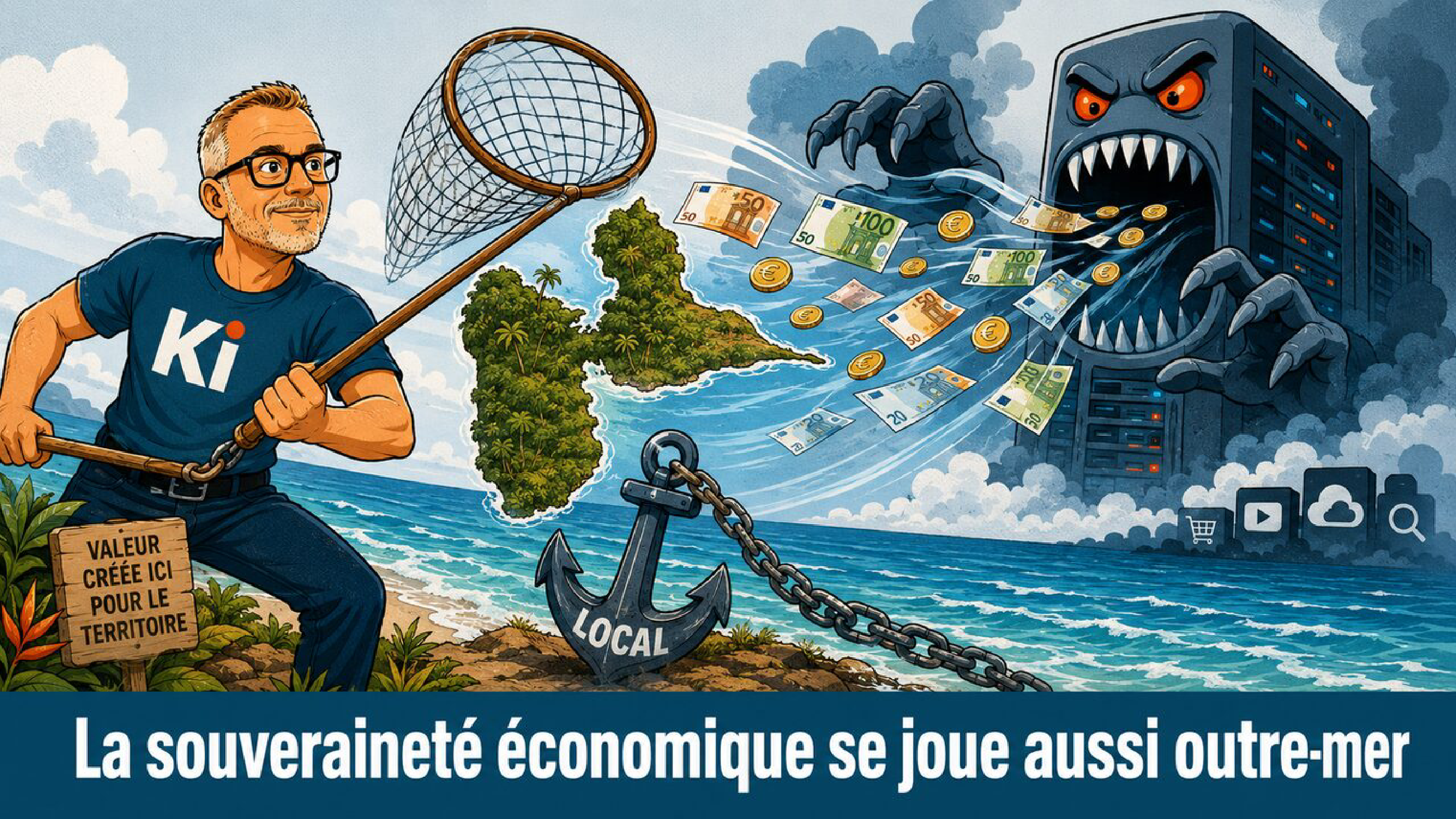
The Paris debate on AI sovereignty is intense — Mistral, the Mensch hearing, the National Assembly’s inquiry committee. But it never reaches us. Yet the mechanism it describes — economic value leaving the territory toward US providers — is already at work, measurable. In 2025, hotel nights in Guadeloupe fell by 9.4%, even as air traffic continued to grow: visitors still come, but they sleep with Airbnb. With AI, we’re still upstream. We can still choose.
The national AI sovereignty debate, explained simply
On 12 May 2026, Arthur Mensch, co-founder of Mistral AI, was heard by the National Assembly’s inquiry committee “on structural dependencies and systemic vulnerabilities in the digital sector”, chaired by MP Philippe Latombe. His argument: if Europe imports its AI massively, roughly one trillion euros per year will be added to Europe’s trade deficit within 3 or 4 years. How does he arrive at that figure? He notes that at Mistral, AI consumption already represents 10% of the company’s payroll, then extrapolates to the European scale.
The extrapolation is contested — this is a Mistral-scale estimate, not a European measurement. But the underlying point is documented. A study by the Asterès consultancy for CIGREF put a figure on it as early as 2025: roughly €265 billion per year is what European companies already pay to US cloud and software providers. 80% of European spending on this item is captured by US players, funding close to 2 million jobs over there. A second Asterès-CIGREF study, published in May 2026, adds an estimated surcharge of €140 billion per year by 2030, driven by US provider price inflation — which Asterès calls an “invisible American tax”.
The debate focuses on two tracks: building a European champion (Mistral) and tightening regulation (AI Act, DORA, NIS2). All of these conversations happen in Paris or Brussels. None of them examines what this mechanism produces, concretely, 7,000 kilometres away.
The precedent: what Caribbean tourism already shows us
Tip
The IEDOM 2025 report already documented the local mechanic: more passengers, fewer hotel nights, and value flowing out to US platforms.
The mechanism Mensch describes is not theoretical. It is already at work, measurable, in a sector every person in Guadeloupe can see operating right outside their door: tourism.
The IEDOM figures for 2025 are clear. Hotel nights in Guadeloupe fell by 9.4% over the year, even as air traffic grew by 1.8% (2.1 million passengers, 89% of 2019 levels), and cruise visitors also increased (+2%). More visitors, in other words, but shorter stays — and above all: they are no longer sleeping in hotels.
They’re sleeping with Airbnb. They’re booking on Booking. US platforms capture the dominant share of short-stay accommodation — and with it, commissions of 15 to 20% per booking, which immediately flow off the territory toward technical infrastructure installed in the United States.
The net balance is simple to state. The value that leaves — platform commissions, banking fees on international payments, US technical infrastructure — exceeds what comes in through on-the-ground spending, already compressed by shorter stays. Local hoteliers, who pay payroll taxes here, hire here, and irrigate the territory’s real economy, are losing revenue. US platforms, which pay no significant local taxes or charges, are cashing in. That leaves the tourist tax — one of the few mechanisms that keeps a share of tourism value on the territory, provided its remittance is actually checked.
I covered these figures and what they mean for tourism businesses in our analysis of the IEDOM Guadeloupe 2025 report. What matters here is this: tourism is already showing us — 9.4% fewer hotel nights, more passengers, and the dominant share of short-stay accommodation flowing to Airbnb and Booking. The same mechanism is taking hold with AI, except that we’re still upstream. We can still choose.
With AI, the same mechanism scales up
Tip
Each AI tool at ~€200 per month that replaces a task means €200–400 leaving every month toward the US, and €0 for the local economy or the training of a local workforce.
Multiply by the number of AI subscriptions a typical micro/small business (SMB) takes out in 2026 — a writing assistant, a visual design tool, a code co-pilot, an automated sales agent — and you quickly get several hundred euros per month flowing out of the territory, with no local trickle-down. At the scale of one SMB, it’s invisible. At the scale of a territory, it’s massive. And it’s exactly the mechanic of Airbnb or Booking commissions, but upstream, installing itself right now.
For a territory like Guadeloupe, this dependency comes with a triple simultaneous weakening:
- Technical — a growing reliance on services whose access hangs by a submarine cable (I covered this point in our article on submarine cables and internet in Guadeloupe).
- Economic — the same value drain already described for tourism, transposed to a line item that is becoming structural for digital productivity.
- Social — local jobs and skills bypassed. Every euro of imported AI is a euro that does not train, does not hire, does not grow a local tech community.
The national debate does not frame this diagnosis at the overseas scale. And the centralised response it proposes — a national champion like Mistral — does not reach the territory. Overseas territories need to think through their own response, because no policy from Paris will formulate it for them.
The paradox: dematerialisation can also set us free
Stopping at the observation would be defeatist — and wrong. Because the very property that makes AI so convenient for US providers gives us, for the first time, real room to manoeuvre.
AI is dematerialised. It does not need a deep-water port, a railway line, or an industrial zone to produce value. For the first time in the economic history of the Caribbean, on a significant segment of the digital economy, distance and insularity are no longer a decisive handicap.
We have the assets. A skilled workforce — developers, systems and network administrators — trained at the University of the Antilles, whose LAMIA lab has been working on AI for years, fed by local tech communities structured over time. Connectivity strengthened by new submarine cables. And an experience that mainland territories don’t have: knowing how to produce under constraints, anticipate disruptions, operate in degraded mode. Our resilience experience becomes an exportable asset.
The realistic path is not to wait for an overseas champion, nor to bet everything on Mistral. It is to play plural and open sovereignty: open models (Llama, Qwen, Mistral in open weights), self-hostable AI, free building blocks. Not a new imported monopoly, even a French one.
Producing locally, concretely
This is what I have been doing with Kimoun for over 20 years, long before generative AI: building local solutions, open source, fully controlled by clients themselves, with human support rooted in Guadeloupe. The value produced stays in the territory, the client remains the owner of their code and data, and the technical dependency remains reversible.
Concretely, that means making tool choices. Software building blocks independent of US services where possible. An ethical European host like OVH France, which respects the GDPR, publishes its eco-index, and guarantees reversibility — I explain the detail in our article on open-source office suites and sovereign email in Guadeloupe. Open or self-hosted AI models for use cases where that’s relevant. Each time, the same objective: to keep the value produced, as much as possible, at the France or Europe level, with as much of that chain as possible operated locally.
This article is part of the same approach. Everything I learn building these solutions, I make public on this blog, for free, so that other SMBs and organisations in the territory can use it without having to reinvent it. It’s the most modest version of producing locally — but perhaps the most reproducible one.
What you can do right now
You don’t need to wait for a public policy to take back control. A few simple steps, within reach of an SMB owner or an association manager:
- Map your monthly AI subscriptions. Service name, amount, provider, billing country. Many people discover their real exposure simply by doing this inventory.
- Measure your dependency with the Digital Resilience Index (IRN). It’s a free tool, published under a Creative Commons licence, launched on 26 January 2026 at the French Ministry of Finance by the Digital Resilience Initiative association (David Djaïz, Yann Lechelle, Arno Pons), with the support of Caisse des Dépôts, RTE, and Docaposte. It evaluates 8 pillars — software, data, infrastructure, technological assets, internal skills, governance, shock resilience — and is aligned with the European regulatory framework (AI Act, DORA, NIS2). Any organisation can use it directly. As a complement, for an instant outside snapshot of your site’s sovereignty, I put a dedicated observatory to the test.
- Test an open model on a non-critical use case: a summary, a classification, a simple text generation. Before paying a subscription every month for years, check what you can do with what you already own.
- For larger organisations or a new venture launch: a local audit provides the field-level reading the IRN alone does not — a full dependency map, a prioritised action plan, and implementation support. That is what our digital resilience audit in Guadeloupe offers.
Who writes these lines
My name is Oliver — Olivier Watte on official documents. I have 25 years of experience in software engineering and digital transition (ExxonMobil, L’Atelier BNP Paribas, Mediaserv now Canal+ Overseas, then IPEOS in Guadeloupe), including over 20 years building web and software solutions across the archipelago with Kimoun. It is that experience — Caribbean field work and an understanding of the full digital chain, from submarine cable to application — that leads me to frame economic sovereignty from an angle the national debate does not take.
Sources
- IEDOM, The Guadeloupe Economy in 2025 — Annual Summary, April 2026. iedom.fr
- Asterès for CIGREF, Technological dependency on US software & cloud services: an estimate of the economic consequences in Europe, presented 24 April 2025. cigref.fr
- Hearing of Arthur Mensch (Mistral AI) before the National Assembly inquiry committee “on structural dependencies and systemic vulnerabilities in the digital sector”, 12 May 2026. Coverage by LCP.
- Digital Resilience Index (IRN), launched 26 January 2026 by the Digital Resilience Initiative association. Caisse des Dépôts presentation.
- Kimoun article — Analysis of the IEDOM Guadeloupe 2025 report (tourism mechanic).
- Kimoun article — Digital sovereignty for businesses in Guadeloupe — the thematic cluster this article belongs to.