



The US Bans Claude Fable for Caribbeans
🇫🇷 Lire en français : Les USA interdisent Claude Fable aux Guadeloupéens
I rushed. Fable 5, Anthropic’s most powerful model, was included in my subscription until 22 June — I wanted to get the most out of it before the deadline. Stunned: on 12 June, well before that date, the model had already vanished from my account. Dismayed when I understood why — the US government had just cut access for all foreign nationals, me included, on national-security grounds. Not a banned use: a nationality. For a business here that builds its operations on US tools, this isn’t a geopolitical anecdote: it’s a very concrete warning.

12 June. I open my account. The model is gone — ten days before the deadline.

Fable is included in my Claude plan until the 22nd. First test: six months of work reorganised in 5 minutes.

12 June. I open my account. The model is gone — ten days before the deadline.

Dismayed when I understood: banned for foreigners. Not for what I do. For my nationality.
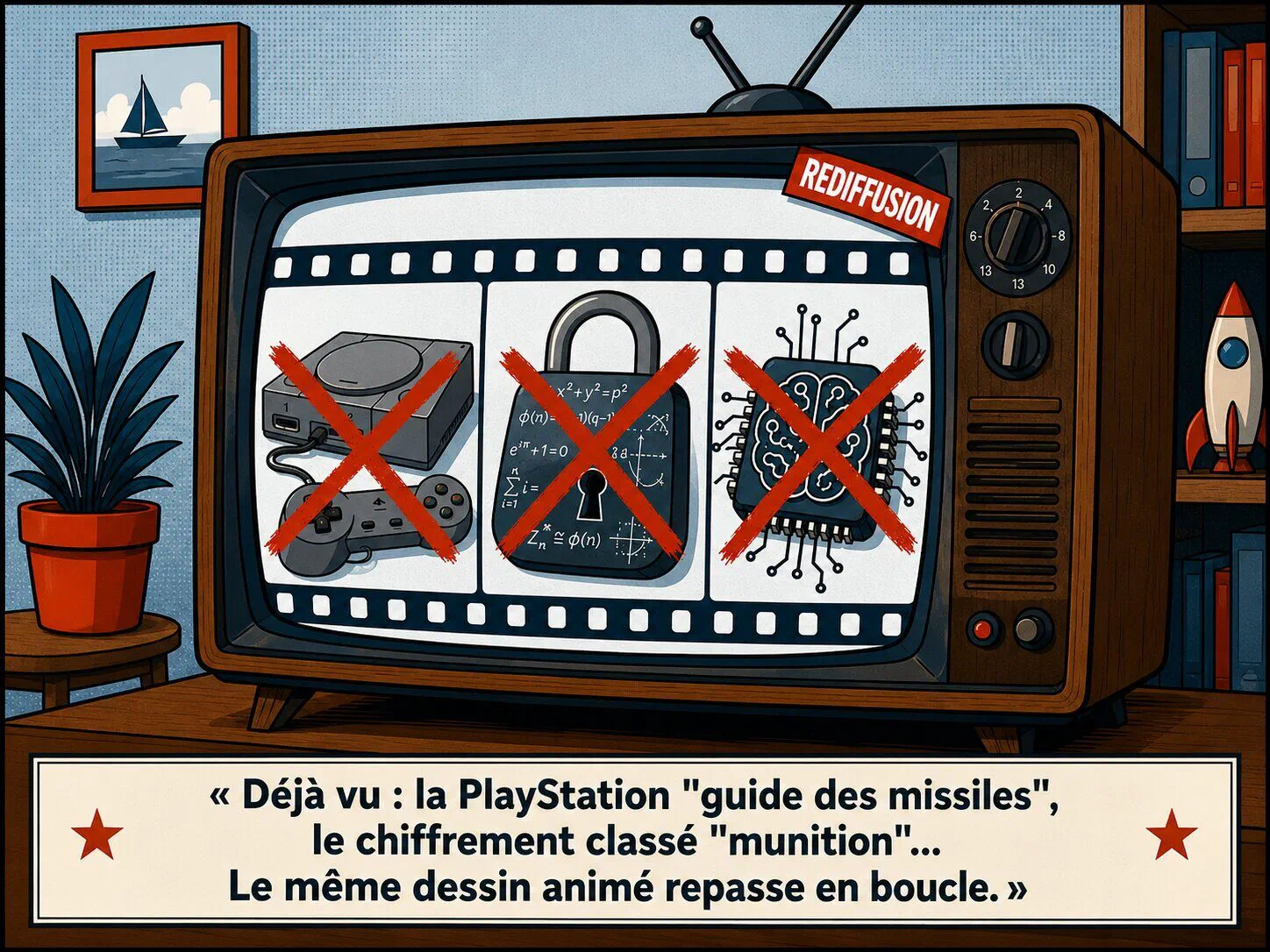
Seen it before: the PlayStation 'missile guide', encryption classed as 'munitions'… The same cartoon, on a loop.
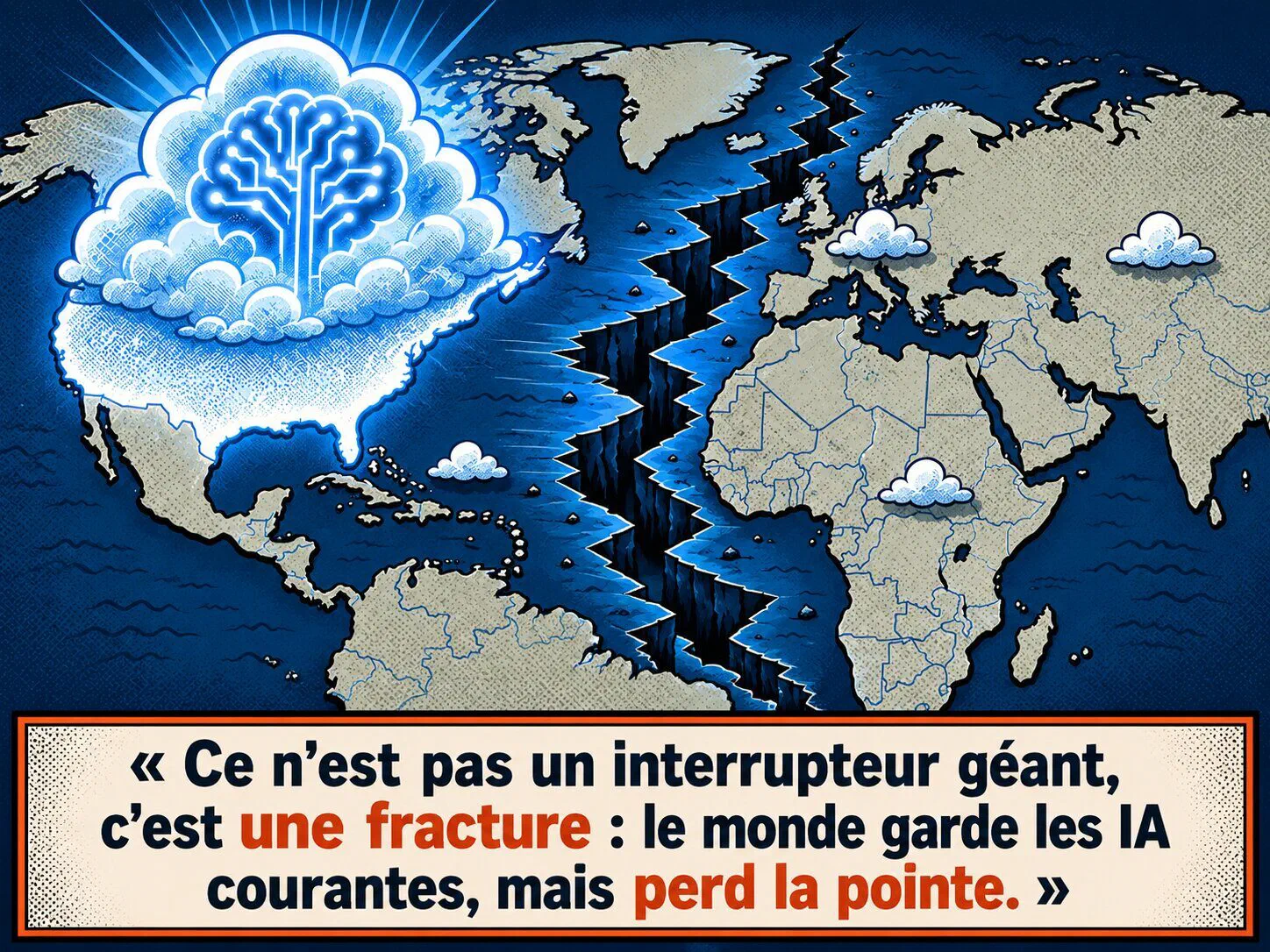
It's not one giant switch, it's a fracture: the world keeps the everyday AIs but loses the frontier.
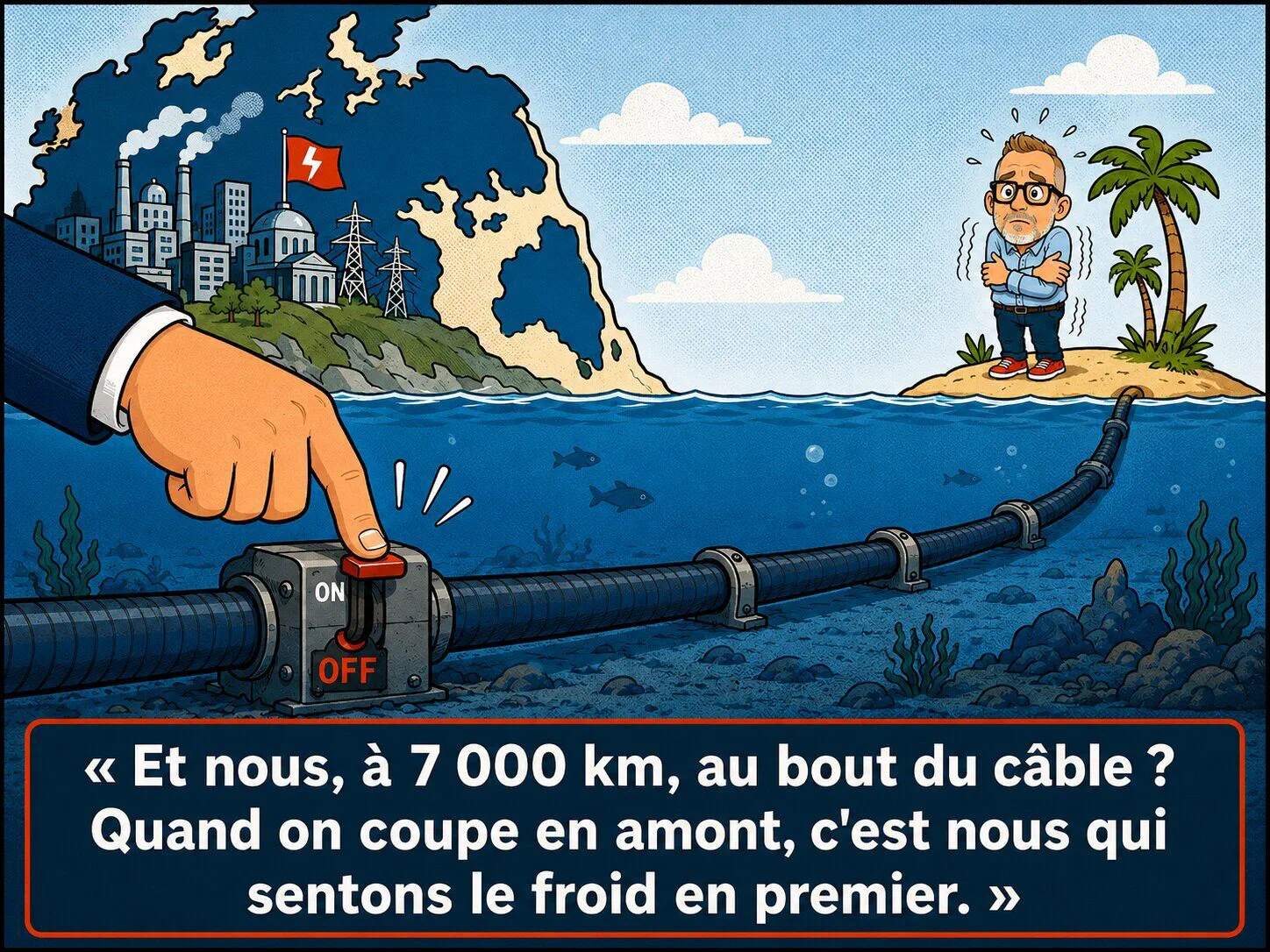
And us, 7,000 km away at the end of the cable? Cut it upstream and we feel the cold first.
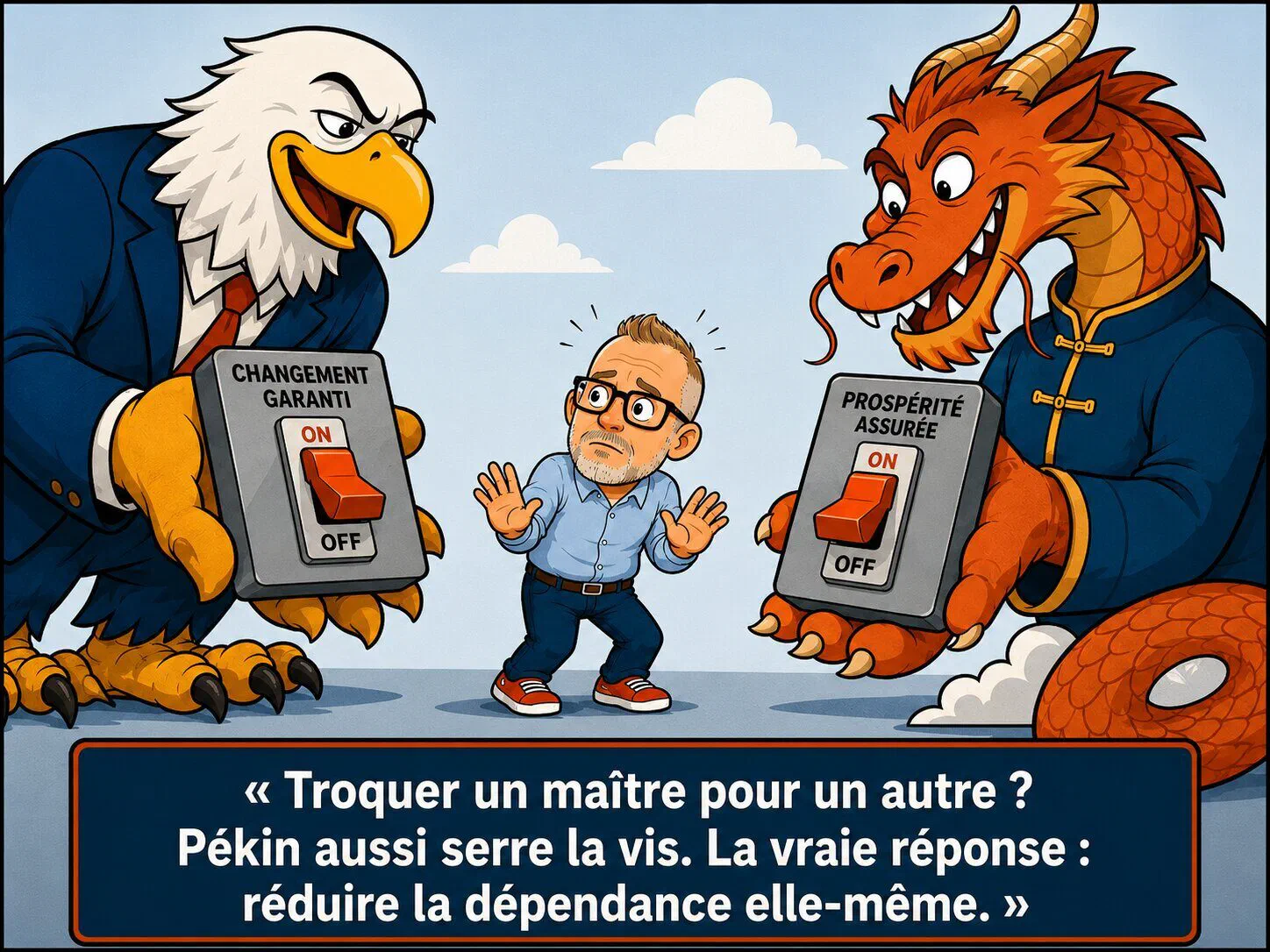
Washington or Beijing: swapping masters isn't getting free.

A teacher here already did it. It's not just savings: it's your competitiveness. Resilience audit · kimoun.com
On 12 June, an AI — a computing capability — became a weapon
Important
An export-control directive doesn’t target what you do, but who you are: here, the blocking criterion is nationality, not use.
Let’s take the facts, because they’re precise. The US didn’t ban “AI”. It targeted 2 Claude models — Fable 5 and Mythos 5, the most powerful in the catalogue — under export controls. The other models remain available: the target is narrow.
What isn’t narrow is the criterion. The block doesn’t rest on some dangerous use, but on who you are: any foreign national loses access, wherever they are, including Anthropic’s own non-American employees. You could be a faultless developer in Pointe-à-Pitre: if your passport isn’t American, the door closes.
Anthropic is complying but contesting it publicly: it speaks of a misunderstanding tied to a narrow flaw it says is present in other models too, and says it is working to restore access. A reason eventually surfaced: according to Semafor and the Los Angeles Times, the measure was reportedly triggered by fears that a China-linked group had accessed Mythos, the other model targeted. Who’s right on the technical merits matters little. The fact that concerns us is elsewhere: a single foreign decision was enough to cut off, overnight, a tool used by millions of people — most of whom weren’t the target.
It’s nothing new: the cartoon keeps rerunning
The scene is absurd — a consumer software product treated like military hardware. But it isn’t the first time it’s been played: it’s the same cartoon that comes back with every generation of technology, with new characters.
2000 episode: the PlayStation suspected of firing missiles. The PlayStation 2’s computing power — the famous “Emotion Engine” — and its encryption exceeded export-control thresholds. The Japanese government made the console subject to export approval beyond two units, fearing they could be clustered to guide missiles. Iraq reportedly imported thousands, triggering a military investigation. No weapons programme was ever proven: a living-room console reclassified as a weapon for its raw computing power alone.
1990s episode: encryption classed as “munitions”. In the United States, strong encryption was on the munitions list, on a par with missiles. When Phil Zimmermann put his PGP software online, in 1991, he was the subject of a federal investigation for “arms export”. His offence: giving private individuals a way to protect their communications. The first “individual-level” tussle over access to a digital capability.
You can see the pattern. A civilian computing capability becomes powerful enough to frighten a state, which reclassifies it as a weapon and decides who may use it. Console, encryption, AI: same plot, new episode. Each time the restriction looked ridiculous in hindsight and was eventually lifted — but in the meantime, those who depended on it paid the price.
Why it concerns us, here in the Caribbean
Warning
Dependency isn’t a problem as long as everything’s fine. It’s a switch someone else holds in your place — and can flip without asking you.
Ask yourself: what stops, in your business, if a US provider cuts you off tomorrow? Automated customer support? Content generation? Part of your code? If the answer is “a lot of things”, you’re holding the fragility I’m talking about — the same question as an Internet down for 72 hours, at the scale of your tools. A first step to pin it down: measure. I put a digital-sovereignty observatory to the test on kimoun.com — a sovereignty score already gives you a first picture of your visible dependencies.
This isn’t paranoia, it’s risk management. Building your whole business on a foundation someone else can pull away — political decision, price hike, change of terms — makes you a tenant, not an owner.
And for us, here, the fragility is structural. I’ve already written that value is already draining off the territory through US platforms, and that AI will amplify it. Technical dependency is its other face: 7,000 kilometres from Paris, and further still from Silicon Valley, we sit at the end of the chain. When they cut upstream, we’re the ones who feel the cold first.
And make no mistake: swapping masters isn’t a solution. Chinese models — Qwen, DeepSeek — now dominate open weights, but their tooling isn’t yet turnkey for a business, and Beijing is already tightening its grip: restricting the overseas travel of its top experts, pressuring its labs to monetise — even to close — once-open models. The real answer isn’t to trade one dependency for another — it’s to reduce the dependency itself.
Because this dependency isn’t only material. As Tariq Krim argues, cutting off Fable isn’t a mere switch: it’s a “geographic cognitive fracture”. The world keeps the everyday models but is stripped of the frontier intelligence — the very thing that multiplies the productivity of a firm, a practice, a software publisher. A foreign decision can, overnight, relegate you to second-tier AI while your competitors keep the best. It’s no longer about cost: it’s your productivity — and so your competitiveness — that a third party can throttle from afar, and with it your autonomy of thought.
Taking back control: it’s IT, not magic
Warning
Don’t go it alone hosting a model: it’s a craft. Running a frontier model on the desk next door doesn’t exist. What changes everything is the right use and the right provider.
Beware the misreading: the answer isn’t “I’ll install an AI on my own in the back office”. A small business won’t run a frontier model on an office machine, and the ones that fit on light hardware are far more limited. Promising otherwise would be lying.
But between “hand everything to a US giant” and “do everything yourself”, there’s a wide space. Hosting an AI for precise, well-scoped tasks is within reach of many businesses, provided you’re well supported. It’s IT: the job of an IT department in larger structures, of your local provider in a micro or small business.
There are many tools, and the right choice depends on the use. For sovereignty, a European open-weight model like Mistral is a better bet than a US model whose licence stays under its publisher’s control. You can host it on European infrastructure — or locally: Guadeloupe already has its own TIER III data centre, opened by CANAL+ Télécom at Jarry in 2022 and designed for data territorialisation; other local hosting projects are reportedly under study.
I was part of Mediaserv’s technical management: I know this chain, from the cable to the server rack. Combined with the Caribbean Connect cable, this kind of facility opens the way to AI tools managed locally, by local players.
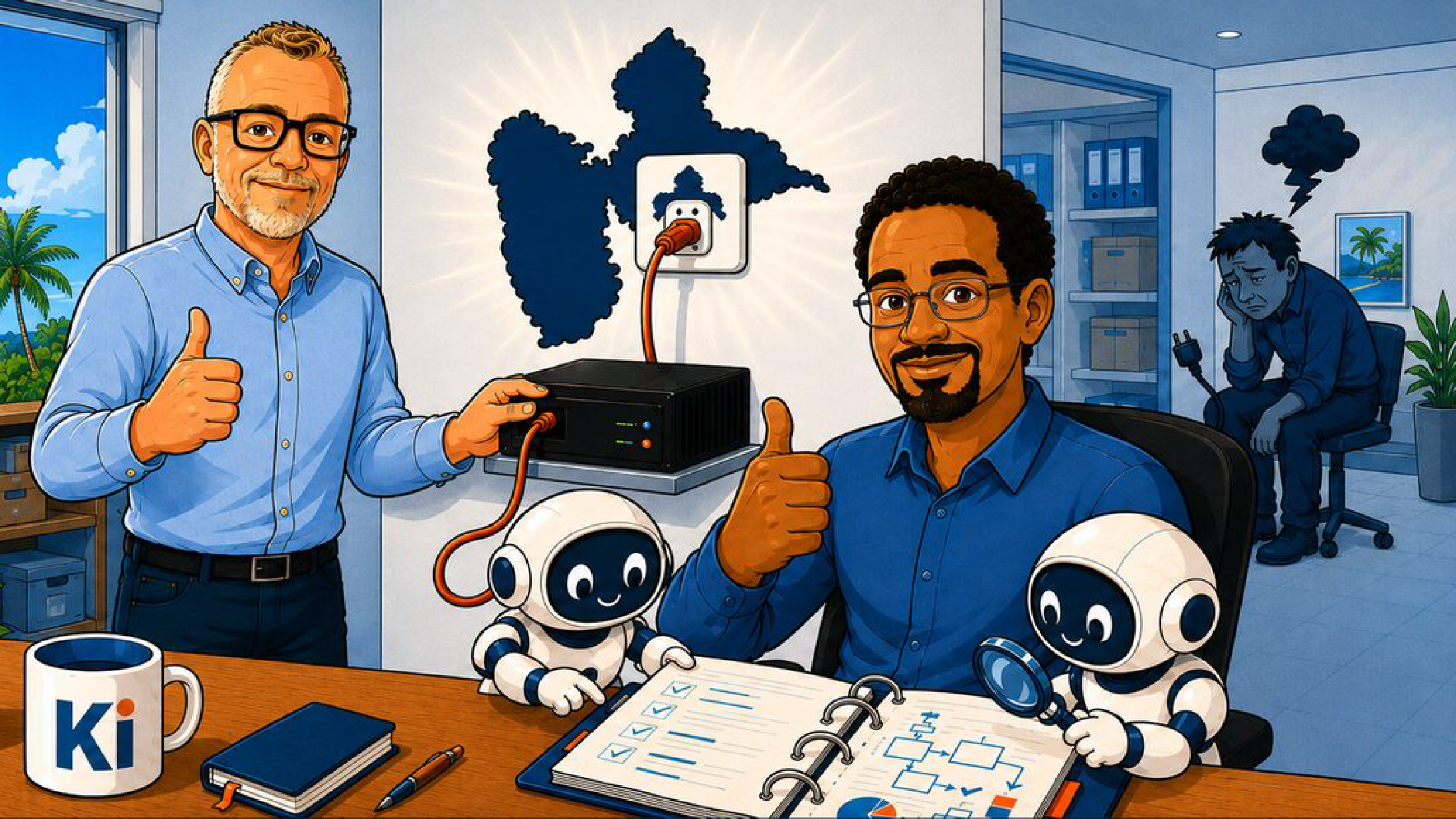
And there’s nothing theoretical about it. Recently, I set up for a Guadeloupean teacher a bespoke solution: his AI agents — Claude, ChatGPT — talk directly to all his lessons and documents. They live in Obsidian, versioned with git, on a server Kimoun manages for him in OVH’s data centre at Gravelines. He calls it his “second brain”. The AIs help him prepare lessons and track curriculum progress; but he owns his files, he decides who can access them, and he saves tokens by submitting to the models only what’s useful. A real European data centre, GDPR-compliant, but with a local contact — expert and available — rather than an anonymous desk in Silicon Valley. I’ve detailed this architecture — separating the treasure (your data) from the agents (the intelligence) — in protecting your data in the AI era.
Here’s the real point. Taking back control isn’t only about saving money: it’s a matter of competitiveness — and of not being unplugged by a decision you didn’t make. The PlayStation 2 and PGP eventually slipped free of those who wanted to lock them down; the question, for your business, is not to be the one that waits, unplugged, for the misunderstanding to be sorted out in Washington.
Sources
- Anthropic — Statement on the US government directive to suspend access to Fable 5 and Mythos 5 (12 June 2026)
- New America — Doomed to Repeat History? Lessons from the Crypto Wars of the 1990s
- Make Tech Easier — Retrospective on the PlayStation 2 export restrictions (2000)
- CANAL+ Télécom — “sovereignty and data territorialisation” positioning (relayed by EWAG, 2021)
- RCI Guadeloupe — Inauguration of CANAL+ Télécom’s TIER III data centre at Jarry (28 April 2022)
- Los Angeles Times — Anthropic shuts down Mythos access after sweeping U.S. order (13 June 2026)
- GoodTech (based on Reuters) — Why China may soon “close” its models (in French)
- Tariq Krim, Cybernetica — “Embargo sur l’intelligence” (15 June 2026, in French)